Western Ghats Birds face Habitat Shrinkage under Climate Change
Source:The Hindu ↗
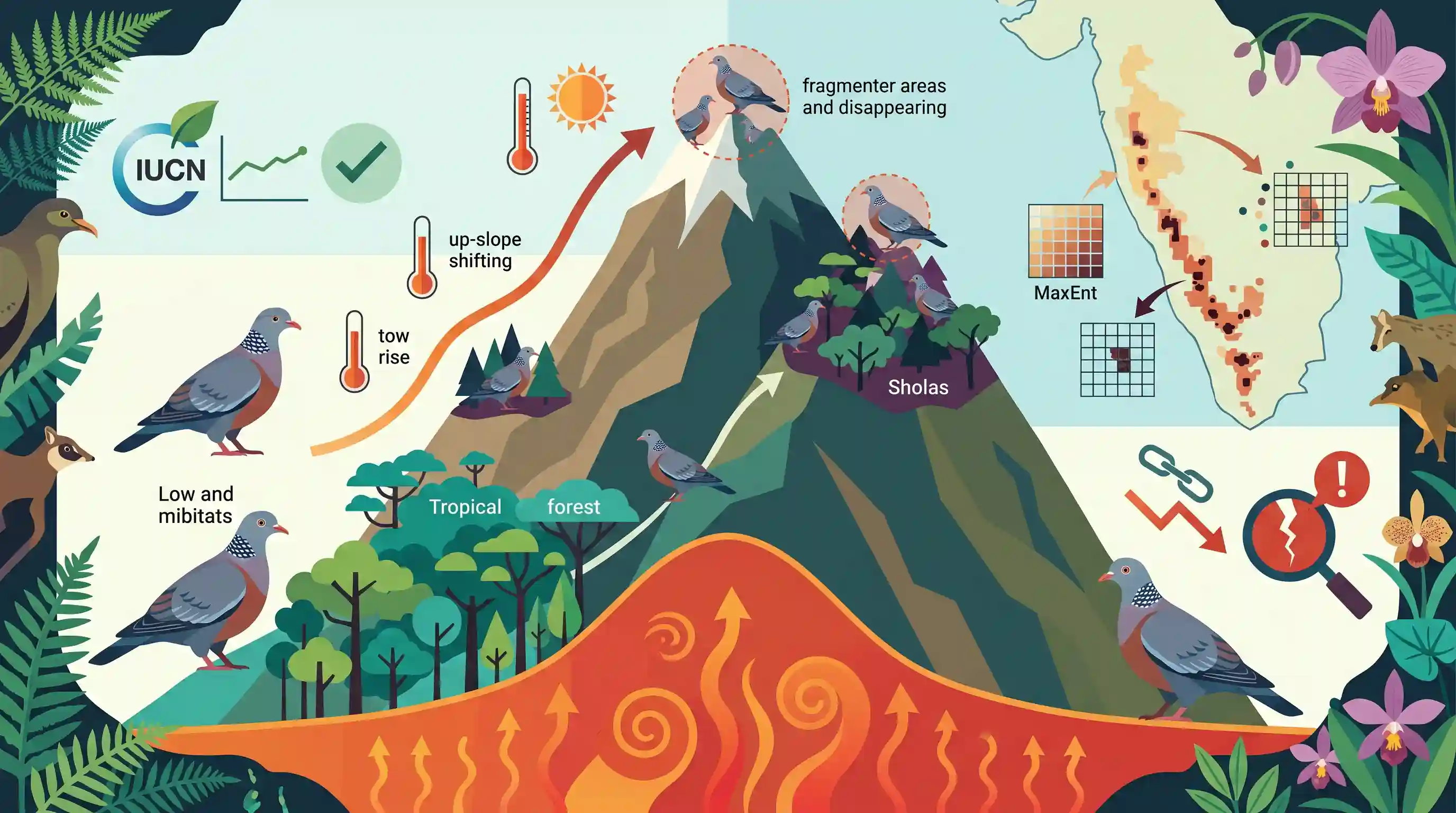
Why It Matters
Introduces vital ecological concepts like 'sky islands' and 'up-slope shifting' while highlighting the vulnerability of montane endemic species to climate change, which are highly relevant for Prelims biodiversity questions and Mains GS3 environment essays.
Summary
A recent study utilizing MaxEnt modeling warns that climate change could severely restrict the habitat of the Nilgiri Wood Pigeon, an endemic bird of the Western Ghats. As global temperatures rise, montane species in these 'sky islands' are expected to experience 'up-slope shifting', moving to higher elevations until they run out of habitat space. This challenges the IUCN's recent decision to downlist the species to 'Least Concern'.
Key Points
- The Nilgiri Wood Pigeon (Columba elphinstonii) is an endemic bird species inhabiting the high-elevation wet evergreen and moist deciduous forests, or 'sky islands', of the Western Ghats.
- Climate change is triggering 'up-slope shifting', where montane species migrate to higher elevations to escape warming temperatures, eventually leading to severe habitat contraction.
- Researchers utilized MaxEnt modeling and citizen science data from eBird to project the long-term habitat suitability for the bird.
- Despite the bird's recent downlisting to 'Least Concern' by the IUCN, scientists argue this may be premature given future climate risks and the lack of systematic ground surveys.
Important Terms
Nilgiri Wood Pigeon

A large, frugivorous bird endemic to the Western Ghats' high-altitude forests. Recently downlisted by IUCN to 'Least Concern,' though climate studies warn of severe habitat loss.
UPSC context
GS Paper III: Biodiversity. Tests knowledge of endemic species, their conservation status, and threats from climate change.
Shola Forests
High-altitude (above 1500m) montane evergreen forests unique to the Western Ghats, occurring in patches within grasslands. They harbor high endemism and are vital for water retention.
UPSC context
GS Paper I & III: Geography and Environment. Critical for understanding unique Indian ecosystems and regional climate adaptation.
Sky Islands
Isolated mountain peaks rising from dramatically different lowland environments. These 'islands' in the Western Ghats act as evolutionary laboratories for species like the Nilgiri Wood Pigeon.
UPSC context
GS Paper III: Ecology. Tests concepts of geographic isolation, endemism, and climate-induced 'escalator to extinction.'
MaxEnt Modeling
A machine-learning algorithm that predicts species geographic distribution using 'presence-only' data and environmental variables. It is a standard tool for modeling habitat suitability under climate change.
UPSC context
GS Paper III: Science & Technology/Environment. Relevant for modern conservation technology and evidence-based environmental policy.
Up-slope Shifting
The movement of species to higher elevations to escape rising temperatures. Also called the 'escalator to extinction,' as species eventually run out of habitat space at summits.
UPSC context
GS Paper III: Climate Change. Tests understanding of biological responses to global warming and altitudinal migration patterns.
IUCN Red List
A global inventory assessing the extinction risk of biological species. It uses categories like 'Vulnerable' and 'Least Concern' to guide international conservation priorities.
UPSC context
GS Paper III: Conservation. A core topic for Prelims and Mains regarding international environmental governance and species status.
Prelims Trap
"The Nilgiri Wood Pigeon is classified as 'Endangered' by the IUCN due to severe climate-induced habitat contraction."
Aspirants intuitively link 'endemic + severe climate threat' to Endangered status, but the IUCN recently downlisted this bird to 'Least Concern'—a key paradox highlighted by researchers.
Static Concepts Connected
What characterizes the 'Sky Islands' and Shola forest ecosystems of the Western Ghats?
- Geographic Isolation: Isolated high-elevation mountain tops separated by deep valleys, functioning ecologically like oceanic islands.
- Vegetation Profile: A mosaic of stunted evergreen trees (Shola) occupying the valleys, interspersed with expansive rolling grasslands on the hill slopes.
- High Endemism: Extreme geographic and climatic isolation fosters a very high degree of endemism, hosting species found nowhere else on Earth.
What is 'up-slope shifting' in the context of montane ecology and climate change?
- Thermal Migration: Species move to higher elevations seeking optimal cooler temperatures as lower altitudes become abnormally warm due to climate change.
- Peak Extinction Risk: Also known as the 'escalator to extinction', high-altitude species eventually run out of land area at mountain peaks, leading to localized extinctions.
- Habitat Contraction: As species move up a conical mountain shape, the available habitable surface area geometrically shrinks, drastically reducing carrying capacity.
Cross-Topic Patterns
Citizen Science + Ecological Modeling
The use of eBird data combined with MaxEnt modeling highlights the growing reliance on citizen-sourced big data (e.g., butterfly tracking, bird counts) for formal conservation policy and ecological assessments.
Western Ghats Endemics + Climate Vulnerability
The concept of 'up-slope shifting' applies broadly to Western Ghats endemics, linking this pigeon's plight to similar climatic threats faced by the Nilgiri Tahr, Lion-tailed Macaque, and endemic amphibians.

Expect a 2026 Prelims question linking 'up-slope shifting' in Western Ghats sky islands to the paradox of an IUCN 'Least Concern' status.
Linked PYQs · 4
Linked PYQs · 4
- 2011PrelimsGS1
Three of the following criteria have contributed to the recognition of Western Ghats-Sri Lanka and Indo-Burma regions as hotspots of biodiversity: 1. Species richness 2. Vegetation density 3. Endemism 4. Ethno-botanical importance 5. Threat perception 6. Adaptation of flora and fauna to warm and humid conditions Which three of the above are correct criteria in this context?
- 2020PrelimsGS1
With reference to India's biodiversity, Ceylon frogmouth, Coppersmith barbet, Gray-chinned minivet and White-throated redstart are
- 2017MainsGS3
'Climate change' is a global problem. How India will be affected by climate change? How Himalayan and coastal states of India will be affected by climate change?
- 2012PrelimsGS1
Which one of the following groups of animals belongs to the category of endangered species?
