Climate Change Threatens Nilgiri Wood Pigeon Sky Island Habitats
Source:The Hindu ↗
Why It Matters
It illustrates the concept of 'up-slope shifting' and 'sky islands' in montane ecosystems, which are highly relevant for UPSC Environment and Geography questions. It also highlights the vulnerabilities of endemic species to climate change, offering a specific case study for Mains answers.
Summary
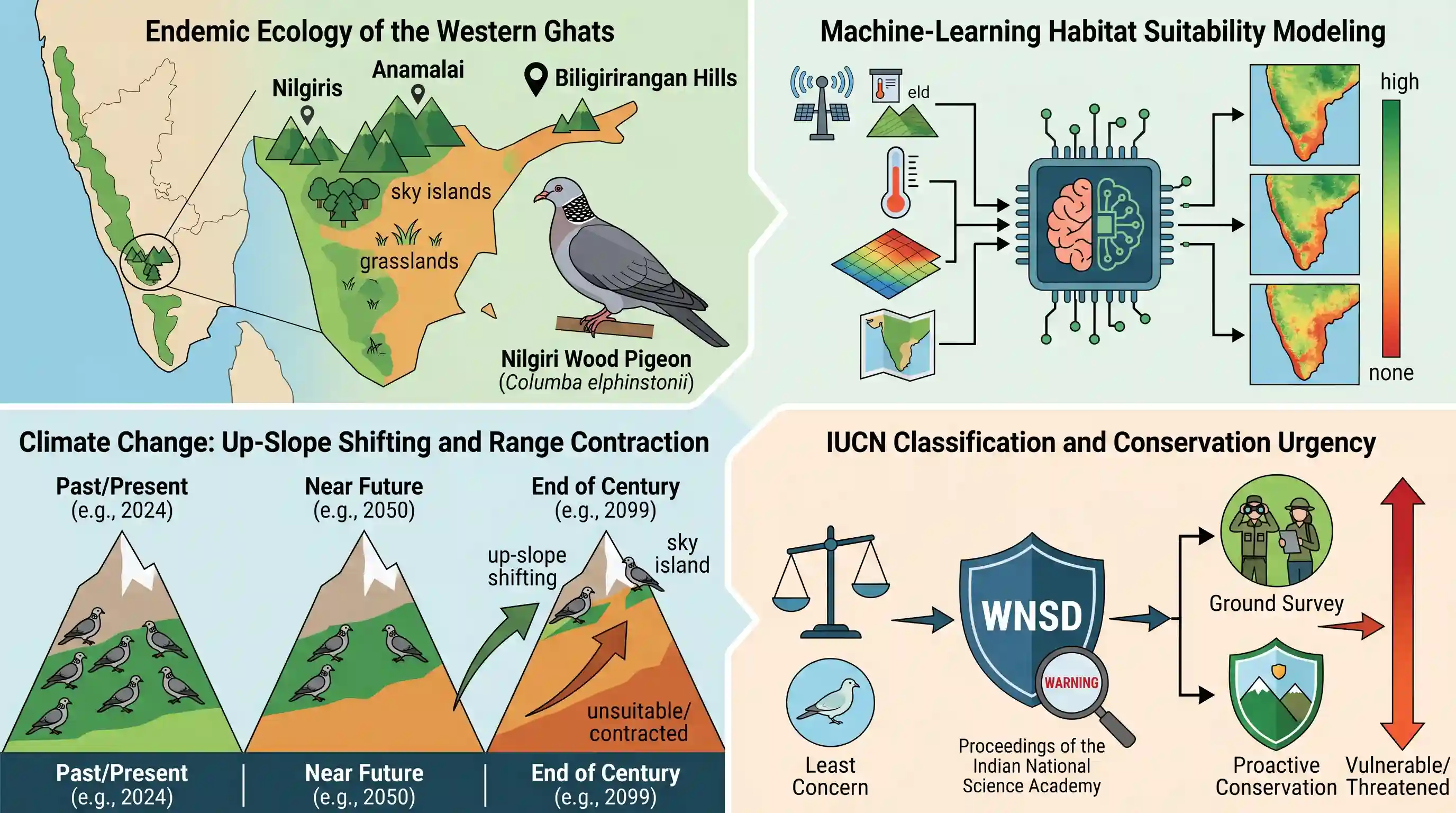
A recent study published in the Proceedings of the Indian National Science Academy warns that climate change will severely restrict the habitat of the Nilgiri Wood Pigeon, an endemic species of the Western Ghats. Utilizing machine-learning models to map habitat suitability, researchers found that while short-term habitat availability might expand slightly, the end of the century will bring sharp declines and range contractions due to 'up-slope shifting'. The pigeon relies on highly specialized high-elevation ecosystems termed 'sky islands', located in the Nilgiris, Anamalai, and Biligirirangan Hills. The findings prompt a reassessment of the IUCN's recent decision to classify the bird as 'Least Concern', highlighting a need for systematic ground surveys and proactive conservation in vulnerable montane regions.
Key Points
- The Nilgiri Wood Pigeon, an endemic bird of the Western Ghats, faces significant habitat constriction due to climate change, according to a recent modeling study.
- The species relies on high-elevation wet evergreen and adjoining moist deciduous forests, known as 'sky islands', which harbor specialized, vulnerable biodiversity.
- While models suggest an initial expansion of suitable habitat by 2040 due to lower montane areas becoming viable, a severe range contraction and 'up-slope shifting' is predicted by the end of the century (2081-2100).
- Researchers question the IUCN's recent decision to down-list the Nilgiri Wood Pigeon to 'Least Concern', arguing that the status change is not backed by systematic ground surveys and ignores long-term climate vulnerabilities.
Important Terms
Western Ghats

A 1,600km mountain range along India’s west coast and a UNESCO World Heritage site. It is one of the world's eight "hottest hot-spots" of biological diversity and endemism.
UPSC context
GS Paper 1 (Geography) and GS Paper 3 (Environment). Critical for biodiversity, monsoon regulation, and UNESCO status.
Nilgiri Wood Pigeon
A large pigeon endemic to the Western Ghats, recognizable by its grey color and checkerboard neck-patch. It is protected under Schedule I of the Wildlife (Protection) Act, 1972.
UPSC context
GS Paper 3 (Environment/Biodiversity). Often features in Prelims as an indicator or endemic species of the montane ecosystem.
Sky Islands
Isolated high-altitude habitats separated by "seas" of lower-elevation valleys. In India, these occur on Western Ghats peaks, hosting unique evolutionary lineages and specialized ecosystems like Shola forests.
UPSC context
GS Paper 1 and 3 (Geography/Environment). Represents a niche ecological concept related to mountain biodiversity and climate vulnerability.
IUCN Red List
The world's most comprehensive inventory of the global conservation status of biological species, maintained by the IUCN. It categorizes species by extinction risk to guide international policy.
UPSC context
GS Paper 3 (Environment). Frequently tested in Prelims regarding the status (e.g., Vulnerable, Endangered) of specific Indian flora and fauna.
Shola Forests
Stunted tropical montane evergreen forests found in high-altitude valleys of the Southern Western Ghats. Interspersed with grasslands, they act as "overhead water tanks" critical for perennial rivers.
UPSC context
GS Paper 1 and 3 (Geography/Environment). Essential for understanding Western Ghats ecology and high-altitude water-harvesting systems.
Up-slope Shifting
A climate-driven phenomenon where species migrate to higher elevations to escape rising temperatures. This can lead to "mountaintop extinction" for species that run out of upward habitat.
UPSC context
GS Paper 3 (Climate Change). Tests understanding of the biological impacts of global warming on specialized mountain ecosystems.
Least Concern (LC)
An IUCN Red List category for species evaluated to have a low risk of extinction. Species in this category do not qualify as threatened or near-threatened.
UPSC context
GS Paper 3 (Environment). Tests knowledge of conservation categories and the ability to distinguish between varying levels of species threat.
Indian National Science Academy (INSA)
The premier scientific academy in India (established 1935) dedicated to promoting science and its application. It publishes research, including the journal 'Proceedings of the Indian National Science Academy'.
UPSC context
GS Paper 3 (Science and Technology). Important for understanding the institutional framework of scientific research and publication in India.
Prelims Trap
"The Nilgiri Wood Pigeon is classified as Endangered by the IUCN due to severe habitat loss in the Western Ghats."
Despite facing severe climate-induced range contractions, the IUCN controversially down-listed it to 'Least Concern', making it a prime counter-intuitive trap.
Static Concepts Connected
What are 'Shola' forests and 'Sky Islands' in the Western Ghats?
- Shola Forests: Stunted tropical montane evergreen forests found in undulating high-altitude valleys, uniquely surrounded by rolling grasslands.
- Sky Islands: Isolated high-elevation mountain peaks with drastically different climates than the lowlands, fostering high species endemism.
- Altitude & Location: Typically found above 1,500 meters in regions like the Nilgiris, Anamalais, and Palani hills.
Why are the Biligirirangan (BR) Hills ecologically critical?
- Biogeographic Link: They act as a vital ecological land bridge directly connecting the Eastern Ghats and the Western Ghats.
- Wildlife Corridor: They form a crucial contiguous corridor for the movement of megafauna (elephants, tigers) and inter-range gene flow.
Cross-Topic Patterns
Up-slope shifting & montane ecology
Climate change forcing species to higher altitudes links global warming with geographic range compression. Similar terminal threats face Himalayan species like the Pika or the Nilgiri Tahr in the Ghats.
Discrepancies in IUCN Red List updates
UPSC frequently tests species with debated or counter-intuitive statuses. The Nilgiri Wood Pigeon’s 'Least Concern' status mirrors past prelims traps on the Snow Leopard's downgrade to 'Vulnerable'.

A matching question pairing 'Sky Islands' or 'Up-slope shifting' with endemic fauna (Nilgiri Wood Pigeon) is highly likely in 2026.
Linked PYQs · 5
Linked PYQs · 5
- 2017PrelimsGS1
From the ecological point of view, which one of the following assumes importance in being a good link between the Eastern Ghats and the Western Ghats?
- 2023PrelimsGS1
Consider the following statements: 1. Amarkantak Hills are at the confluence of Vindhya and Sahyadri Ranges. 2. Biligirirangan Hills constitute the easternmost part of Satpura Range. 3. Seshachalam Hills constitute the southernmost part of Western Ghats. How many of the statements given above are correct?
- 2017MainsGS3
'Climate change' is a global problem. How India will be affected by climate change? How Himalayan and coastal states of India will be affected by climate change?
- 2020PrelimsGS1
With reference to India's biodiversity, Ceylon frogmouth, Coppersmith barbet, Gray-chinned minivet and White-throated redstart are
- 2011PrelimsGS1
Three of the following criteria have contributed to the recognition of Western Ghats-Sri Lanka and Indo-Burma regions as hotspots of biodiversity: 1. Species richness 2. Vegetation density 3. Endemism 4. Ethno-botanical importance 5. Threat perception 6. Adaptation of flora and fauna to warm and humid conditions Which three of the above are correct criteria in this context?
