Climate Mitigation Impacts on Air Pollution Mortality Rates
Source:The Hindu ↗
Why It Matters
The article exposes the policy trade-offs between international climate justice (Common But Differentiated Responsibilities) and localized public health outcomes (air pollution). It presents a nuanced understanding necessary for GS3 Environmental Conservation and GS2 Global Agreements, showing that shifting the carbon mitigation burden away from developing nations must be paired with dedicated air pollution control investments to avert millions of premature deaths.
Summary
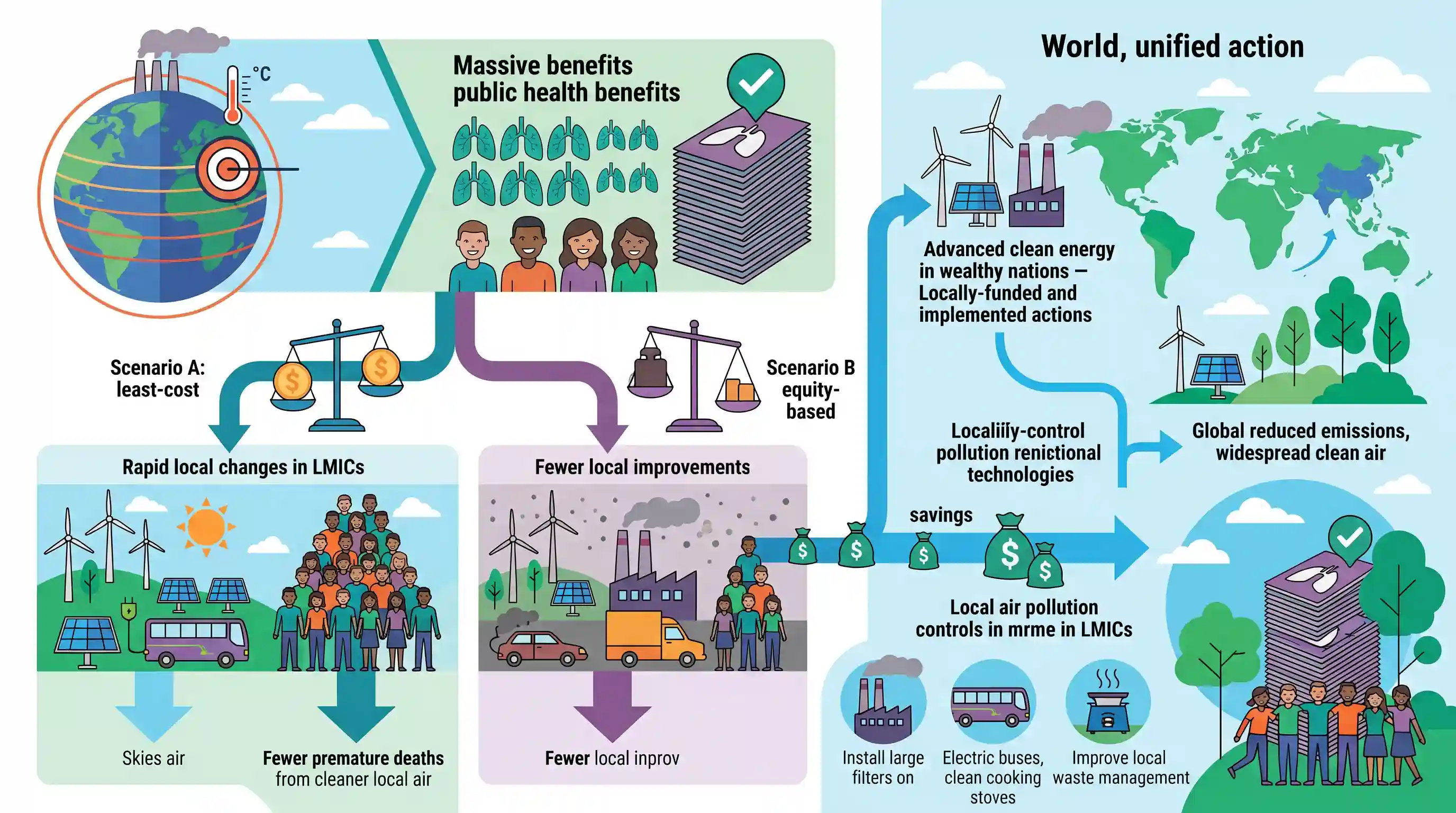
A recent study published in *The Lancet Global Health* highlights that global climate action limiting warming to 2°C can prevent over 13.5 million premature deaths from air pollution by 2050, mostly in low and middle-income countries (LMICs). The research uncovers a critical tension between international climate justice and localized public health benefits. While a 'least-cost' mitigation strategy maximizes lives saved in LMICs, an 'equity-based' approach, which places the emission reduction burden on wealthy nations, inadvertently reduces health benefits in LMICs by curbing local air quality improvements. To resolve this, researchers recommend an equitable regime where LMICs utilize savings from lower mitigation obligations to independently fund conventional air pollution controls.
Key Points
- Limiting global warming to 2°C could prevent over 13.5 million premature deaths from air pollution by 2050, primarily in low and middle-income countries (LMICs).
- A 'least-cost approach' places a higher mitigation burden on LMICs but provides them with the greatest air quality health benefits.
- An 'equity-based approach' shifts climate mitigation to wealthier nations but results in millions of fewer averted deaths in LMICs since fossil fuel emissions persist where air pollution is worst.
- The most effective scenario combines climate equity with LMICs investing mitigation savings into conventional air pollution controls (like reducing soot and sulphur dioxide) to maximize both fairness and life-saving potential.
Important Terms
Paris Agreement

A 2015 legally binding international treaty aiming to limit global warming to well below 2°C, preferably 1.5°C, through voluntary Nationally Determined Contributions (NDCs).
UPSC context
GS Paper III (Environment); vital for understanding global governance, climate finance, and India’s 'Panchamrit' climate targets.
Climate Justice
A framework treating climate change as an ethical and political issue, emphasizing fair burden-sharing based on historical emissions and protecting vulnerable populations.
UPSC context
GS Paper II & III; key to India’s stance on 'Common But Differentiated Responsibilities' (CBDR) in international negotiations.
Least-cost Mitigation Strategy
A climate policy approach where carbon emissions are reduced where it is most economically efficient, often shifting early mitigation efforts to developing nations.
UPSC context
GS Paper III; tests understanding of the trade-offs between economic efficiency and international equity in environmental policy.
Equity-based Mitigation Strategy
An approach assigning emission reduction targets based on a nation's wealth and historical contribution to global warming rather than economic efficiency.
UPSC context
GS Paper III; relevant for discussing 'climate debt' and the North-South divide in UNFCCC summits.
Air Pollution Co-benefits
Localized health improvements, such as reduced respiratory diseases, that occur as a secondary result of policies primarily intended to reduce greenhouse gas emissions.
UPSC context
GS Paper III (Environment/Health); tests the ability to link environmental mitigation with socio-economic and public health outcomes.
LMICs (Low and Middle-Income Countries)
A World Bank classification for economies with a Gross National Income per capita within specific thresholds; major stakeholders in global climate negotiations.
UPSC context
GS Paper II (Social Justice) & III; central to discussions on universal health coverage and sustainable development goals (SDGs).
Prelims Trap
"An equity-based climate mitigation approach automatically maximizes local air quality benefits for developing countries."
Shifting mitigation to wealthy nations means LMICs burn fossil fuels longer, delaying local air quality improvements unless separate pollution controls are simultaneously funded.
Static Concepts Connected
What is the principle of CBDR-RC under the UNFCCC?
- Historical responsibility: Acknowledges developed countries' dominant historical contribution to cumulative global greenhouse gas emissions since the industrial revolution.
- Varying capacities: Mandates that climate mitigation burdens correspond to differing national wealth, technological capacity, and developmental priorities.
- Carbon space: Allows developing nations extended timeframes to peak emissions, preserving carbon space for poverty eradication and growth.
How do climate 'co-benefits' differentiate between GHGs and local air pollutants?
- Global vs. Local: CO2 causes global long-term warming, while short-lived pollutants like SO2, NOx, and soot trigger immediate, localized respiratory diseases.
- Dual impact: Moving away from fossil fuels inherently reduces both simultaneously, explicitly tying global climate targets to massive localized public health savings.
Cross-Topic Patterns
Climate Equity vs. Public Health
The trade-off between securing 'carbon space' for economic growth and battling severe local air pollution bridges international environmental diplomacy with domestic health governance.
Thermal Plants, FGDs, and Climate Finance
Highlights why delayed mitigation in LMICs requires funding for end-of-pipe technologies, like Flue Gas Desulfurization (FGD) in coal plants, linking climate justice to energy infrastructure.

Prelims 2026 may test the paradoxical relationship between CBDR equity principles and localized public health co-benefits of mitigation.
Linked PYQs · 3
Linked PYQs · 3
- 2022MainsGS3
Discuss global warming and mention its effects on the global climate. Explain the control measures to bring down the level of greenhouse gases which cause global warming, in the light of the Kyoto Protocol, 1997.
- 2025MainsGS3
Write a review on India's climate commitments under the Paris Agreement (2015) and mention how these have been further strengthened in COP26 (2021). In this direction, how has the first Nationally Determined Contribution intended by India been updated in 2022?
- 2020MainsGS3
Explain intra-generational and inter-generational issues of equity from the perspective of inclusive growth and sustainable development.
