Yamuna River Rejuvenation and Najafgarh Drain Trash Skimmer Deployment
Source:Indian Express ↗
Why It Matters
Provides a practical example of utilizing technology and source-level interventions for river cleaning (Yamuna rejuvenation) and enhancing urban flood resilience, relevant for GS3 environment and disaster management.
Summary
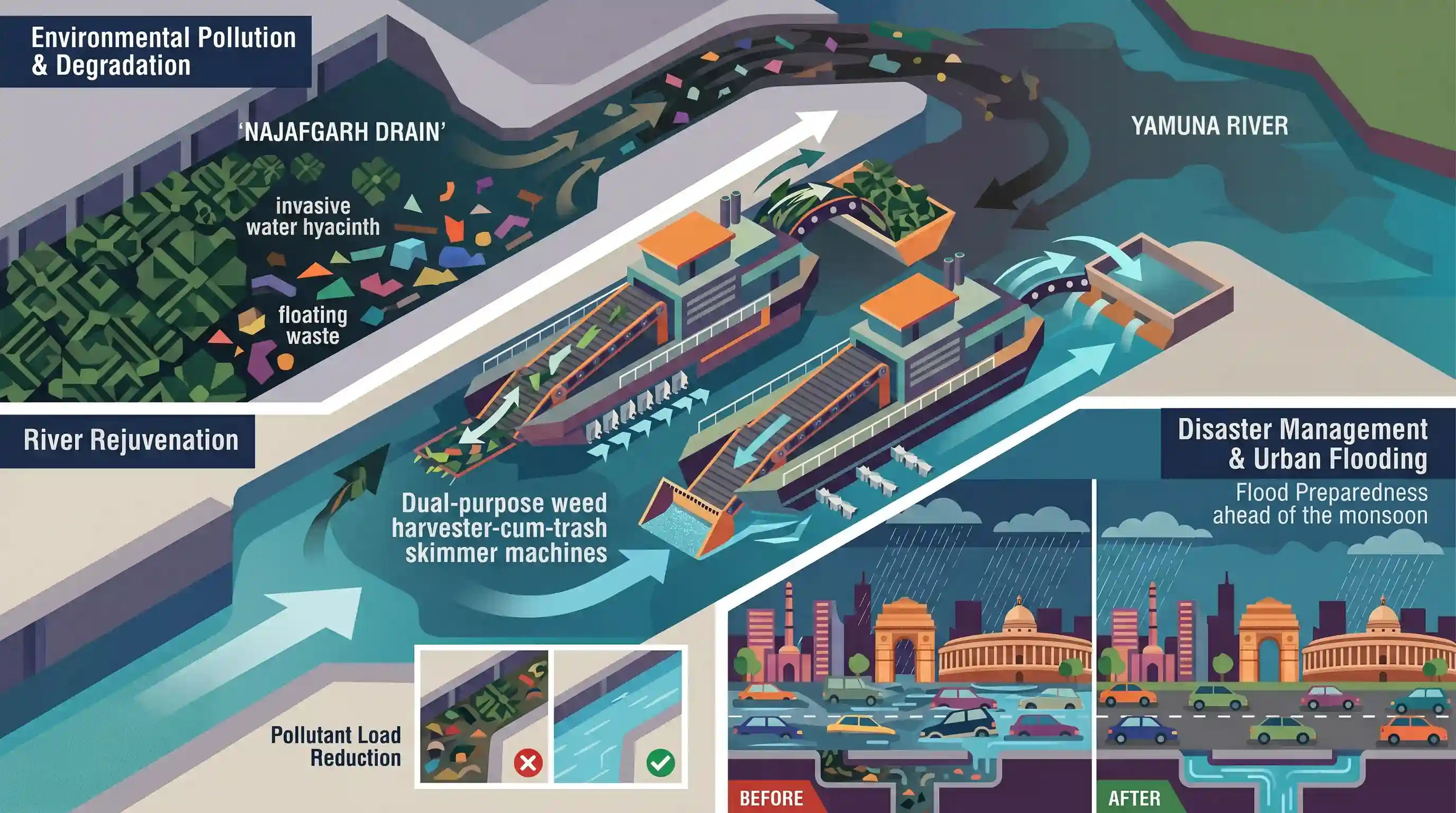
The Delhi Irrigation and Flood Control (I&FC) department has deployed two advanced dual-purpose weed harvester-cum-trash skimmer machines at the Najafgarh drain to clean the Yamuna River. This Rs 2.9 crore initiative targets the major source of pollutants entering the river by efficiently removing floating waste and invasive aquatic vegetation like water hyacinth. Aligned with the Swachh Bharat vision, the deployment not only aids in river rejuvenation by reducing the pollutant load but also improves drainage efficiency, mitigates waterlogging, and strengthens flood preparedness ahead of the monsoon.
Key Points
- The Delhi Irrigation and Flood Control (I&FC) department deployed two advanced weed harvester-cum-trash skimmer machines at the Najafgarh drain.
- The machines are designed to target and remove floating waste, invasive aquatic weeds (like water hyacinth), and untreated pollutants at the source before they enter the Yamuna river.
- Aligned with the Swachh Bharat vision, the initiative aims to reduce the pollutant load entering the river and ensure continuous cleaning and better water flow.
- Beyond river rejuvenation, cleaning the drain will also help mitigate waterlogging and strengthen the city's flood preparedness ahead of the monsoon season.
Important Terms
Swachh Bharat Mission (SBM)

A nationwide campaign launched in 2014 to achieve universal sanitation, eliminate open defecation, and improve municipal solid waste management through behavioral change and infrastructure development.
UPSC context
GS II (Government Policies) and GS III (Environment). Key for understanding waste management and sanitation-led health outcomes.
River Rejuvenation
The process of restoring a river's natural flow, water quality, and ecological health by removing pollutants, treating wastewater, and managing floodplains.
UPSC context
GS III (Conservation/Environmental Degradation). Vital for water security and ecosystem restoration strategies like the Namami Gange program.
Najafgarh Drain
The largest drain in Delhi, contributing roughly 60-70% of the Yamuna's total pollution load. It carries a mix of treated/untreated sewage and industrial effluents.
UPSC context
GS III (Environment/Pollution). Significant as a case study for urban river pollution and National Green Tribunal (NGT) interventions.
Water Hyacinth
An invasive, free-floating aquatic plant (Eichhornia crassipes) that depletes dissolved oxygen, blocks sunlight for aquatic life, and obstructs water flow in drains.
UPSC context
GS III (Environment/Biodiversity). Relevant for studying invasive alien species and their impact on aquatic ecosystem services.
Urban Flooding
The inundation of property in built-up areas caused by rainfall overwhelming the capacity of drainage systems, often exacerbated by unplanned development and encroachment.
UPSC context
GS III (Disaster Management). A critical topic for analyzing urban infrastructure resilience and NDMA guidelines.
Prelims Trap
Water hyacinth improves river health by increasing Dissolved Oxygen (DO) through photosynthesis.
Although a plant, its dense mats block sunlight for submerged flora, and its subsequent decomposition drastically lowers Dissolved Oxygen and spikes Biochemical Oxygen Demand (BOD).
Static Concepts Connected
How do invasive weeds like water hyacinth affect BOD and DO?
- DO Depletion: Dense surface mats block sunlight, preventing photosynthesis by submerged plants and severely lowering Dissolved Oxygen.
- BOD Spike: The decomposition of dead weeds by aerobic bacteria consumes large amounts of oxygen, drastically increasing Biochemical Oxygen Demand.
- Dead Zones: This oxygen depletion suffocates native aquatic biodiversity and accelerates eutrophication, creating ecological dead zones.
What are the primary anthropogenic causes of urban flooding in India?
- Drainage Congestion: Solid waste dumping and invasive weed growth choke storm-water drains, critically reducing their carrying capacity.
- Concretization: High ratios of paved surfaces reduce natural groundwater infiltration, leading to rapid and excessive surface runoff.
- Encroachment: Illegal construction over natural drainage channels, wetlands, and river floodplains restricts the natural flow of water.
Cross-Topic Patterns
Invasive species + Eutrophication
The water hyacinth menace links directly to untreated sewage and nutrient runoff, showing how urban water pollution acts as a catalyst for invasive alien species proliferation.
Solid waste + Urban flooding
Delhi's Najafgarh drain issue mirrors Chennai and Mumbai floods, where poor municipal solid waste management directly causes drainage failure and severe monsoon waterlogging.

Expect a multi-statement question linking invasive aquatic species (water hyacinth), Eutrophication/BOD changes, and urban flood mechanics.
Linked PYQs · 3
Linked PYQs · 3
- 2024MainsGS3
Industrial pollution of river water is a significant environmental issue in India. Discuss the various mitigation measures to deal with this problem and also the government's initiatives in this regard.
- 2015MainsGS3
Discuss the Namami Gange and National Mission for Clean Ganga (NMCG) programmes and causes of mixed results from the previous schemes. What quantum leaps can help preserve the river Ganga better than incremental inputs?
- 2024MainsGS3
Flooding in urban areas is an emerging climate-induced disaster. Discuss the causes of this disaster. Mention the features of two such major floods in the last two decades in India. Describe the policies and frameworks in India that aim at tackling such floods.
