Artificial Intelligence Data Centers and Power Grid Sustainability
Source:The Hindu ↗
Why It Matters
As India aggressively builds its digital infrastructure and AI capabilities under the IndiaAI Mission, policymakers must account for the associated environmental and energy costs. Balancing energy-intensive computing demands with the 2070 net-zero commitment is a critical governance and ecological challenge for future development.
Summary
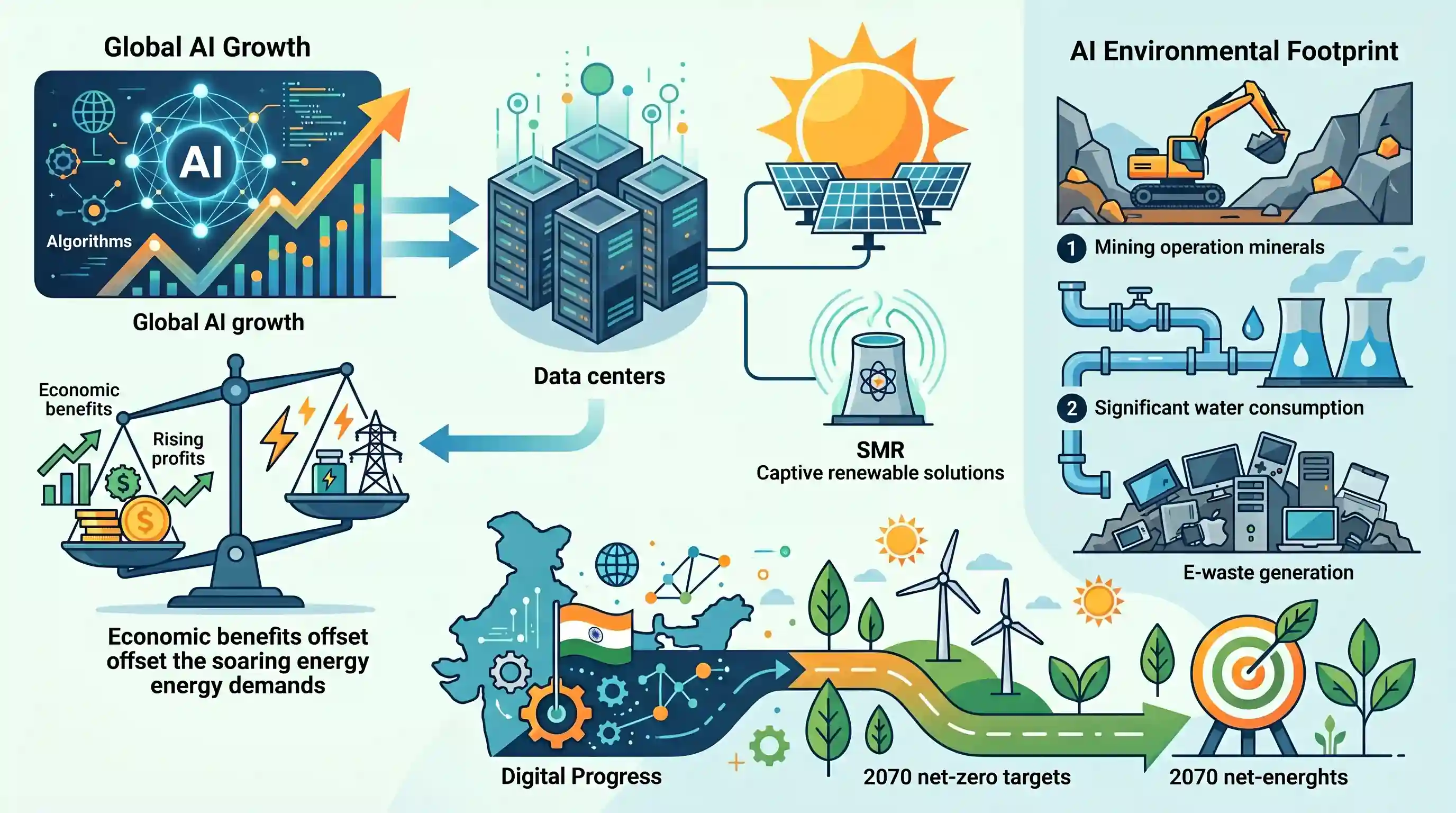
The article analyzes the intersection of artificial intelligence growth and environmental sustainability. A recent IMF report indicates that the economic benefits of AI will likely offset its soaring energy demands. While AI data centers are projected to consume significant electricity globally, they are well-suited for captive renewable energy solutions, such as solar power or Small Modular Reactors. Beyond electricity, the AI ecosystem has a substantial environmental footprint through mineral mining, water consumption, and e-waste generation. For India, maintaining the momentum of initiatives like the IndiaAI Mission while achieving its 2070 net-zero targets will require a concerted shift towards green energy to power digital infrastructure.
Key Points
- An IMF report suggests that the economic productivity gains from AI applications will likely outweigh the environmental costs of increased energy demand from AI data centers.
- While AI data centers will consume significant electricity globally (potentially increasing US electricity prices by up to 9%), their operations are uniquely suited for captive renewable energy setups like solar power or Small Modular Reactors (SMRs).
- India's AI infrastructure, supported by the IndiaAI Mission, currently has a minor impact on its macro energy mix, but future capacity must integrate green energy to align with global climate discussions, such as those at the AI Action Summit in Paris.
- The environmental footprint of AI extends beyond electricity; it involves extensive mineral mining, massive water use for cooling, and hazardous effluents from the electronics manufacturing supply chain.
- Fulfilling India's 2070 net-zero target requires balancing the scale-up of emerging, energy-intensive sectors like AI with accelerated decarbonization of conventional power sources.
Important Terms
IndiaAI Mission

A comprehensive national initiative with a ₹10,372 crore outlay aimed at building indigenous AI compute capacity (10,000+ GPUs), promoting startups, and ensuring ethical AI deployment across priority sectors.
UPSC context
GS Paper III: Science & Technology and Economy; tests knowledge of digital infrastructure and India's strategy for technological sovereignty.
Net-zero by 2070
India's long-term climate commitment, announced at COP26, to neutralize its greenhouse gas emissions by 2070 through a transition to renewable energy and carbon sequestration.
UPSC context
GS Paper III: Environment and Climate Change; critical for questions on the 'Panchamrit' targets and global climate negotiations.
International Monetary Fund (IMF)
An international financial institution that recently projected AI will boost global GDP by 0.5% annually, suggesting economic gains will likely offset the environmental costs of increased energy demand.
UPSC context
GS Paper II & III: International Institutions and Economy; relevant for analyzing global perspectives on technology-driven economic growth.
Small Modular Reactors (SMRs)
Advanced nuclear reactors with a power capacity of up to 300 MW(e) per unit, designed for modular construction and suitable for providing dedicated, reliable power to data centers.
UPSC context
GS Paper III: Science & Technology and Energy; tests awareness of emerging clean energy technologies for decentralised power.
Captive Renewable Energy
A dedicated energy generation facility used primarily by an industrial or commercial consumer (like a data center) for their own consumption, facilitating the use of green energy.
UPSC context
GS Paper III: Infrastructure and Energy; relevant for understanding private-sector contributions to India's renewable energy goals.
Prelims Trap
"The environmental impact of AI data centres is exclusively limited to greenhouse gas emissions from electricity consumption."
AI's environmental footprint is multifaceted, including massive freshwater consumption for evaporative cooling, extensive mineral mining, and significant e-waste generation, not just carbon emissions.
Static Concepts Connected
What are Small Modular Reactors (SMRs) and their advantages?
- Capacity limits: Advanced nuclear reactors with a capacity of up to 300 MW(e) per unit, roughly one-third of traditional reactors.
- Modularity and cost: They are factory-assembled and transportable, significantly reducing construction time, capital costs, and site-specific engineering needs.
- Captive power utility: Highly suitable for remote locations and as dedicated, low-carbon baseload power for industrial hubs or data centers.
What are the core pillars of India's Panchamrit climate pledge?
- 2030 Energy mix: Reach 500 GW of non-fossil energy capacity and meet 50% of energy requirements from renewable energy by 2030.
- Emission reductions: Reduce total projected carbon emissions by one billion tonnes and reduce the carbon intensity of the economy by 45% by 2030.
- Net-zero target: Achieve the ultimate target of net-zero emissions by the year 2070.
Cross-Topic Patterns
SMRs as captive power for AI
The massive energy needs of AI data centers make them prime candidates for Small Modular Reactors (SMRs), linking digital infrastructure growth directly to India's evolving nuclear energy policy.
Water footprint of digital infrastructure
Beyond carbon, massive freshwater consumption for server evaporative cooling exacerbates regional water stress, bridging digital tech initiatives (IndiaAI Mission) with physical geography and water resource management.
AI's critical mineral dependency
The physical hardware driving AI relies heavily on critical minerals (like rare earths and cobalt), linking advanced AI capabilities to geoeconomics, mining footprints, and supply-chain vulnerabilities.

A 2026 prelims question will likely test AI's hidden "water footprint" and SMRs as captive power solutions for data centers.
Linked PYQs · 4
Linked PYQs · 4
- 2023MainsGS3
Introduce the concept of Artificial Intelligence (AI). How does Al help clinical diagnosis? Do you perceive any threat to privacy of the individual in the use of Al in healthcare?
- 2022MainsGS3
Do you think India will meet 50 percent of its energy needs from renewable energy by 2030 ? Justify your answer. How will the shift of subsidies from fossil fuels to renewables help achieve the above objective ? Explain.
- 2025MainsGS3
Write a review on India's climate commitments under the Paris Agreement (2015) and mention how these have been further strengthened in COP26 (2021). In this direction, how has the first Nationally Determined Contribution intended by India been updated in 2022?
- 2025MainsGS3
Mineral resources are fundamental to the country's economy and these are exploited by mining. Why is mining considered an environmental hazard? Explain the remedial measures required to reduce the environmental hazard due to mining.
