Clay Craft India Launches Initial Public Offering on NSE Emerge
Source:economic-times ↗
Why It Matters
This IPO highlights the growing maturity of regional manufacturing SMEs in Rajasthan opting for public market listings via SME platforms like NSE Emerge to fund advanced technological upgrades and capacity expansion, reflecting trends in resource mobilization and industrial scaling.
Summary
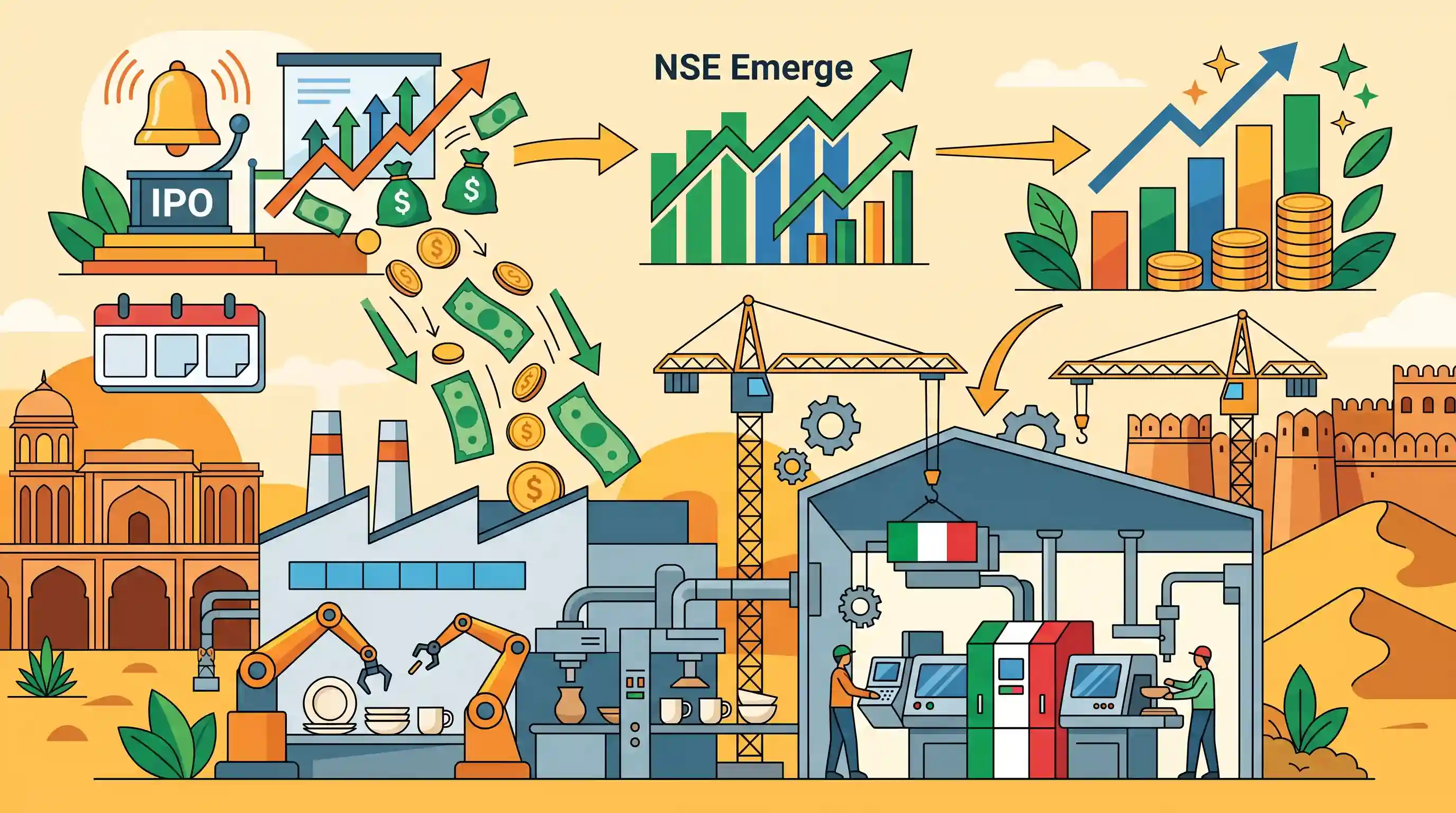
Jaipur-based ceramic tableware manufacturer Clay Craft India Limited is launching a Rs 110.11-crore IPO on the NSE Emerge platform from June 17 to June 19, 2026, with a price band of Rs 193-203. The proceeds will fund a 4,000 MT capacity expansion at its Jaipur facilities using state-of-the-art Italian machinery (SACMI) to supplement its current 6,000 MT capacity. The company reported robust FY26 financials with Rs 179.89 crore in revenue and Rs 27.01 crore in PAT.
Key Points
- Clay Craft India, a premier Jaipur-based ceramic tableware manufacturer, is launching its IPO of Rs 110.11 crore from June 17 to June 19, 2026.
- The price band is fixed at Rs 193 to Rs 203 per equity share, and the company is slated to list on the NSE Emerge platform (the SME segment of NSE).
- The company operates two manufacturing facilities spanning 89,000 sq. mtrs. in Jaipur, with a production capacity of 6,000 MT per annum (82% capacity utilization).
- A major portion of the IPO proceeds will fund an expansion to add 4,000 MT of capacity by installing advanced European machinery from Italy's SACMI to cater to rising demand.
- Financially, the company recorded operational revenue of Rs 179.89 crore, an EBITDA of Rs 41.96 crore (23.33% margin), and a PAT of Rs 27.01 crore in FY26.
- Clay Craft sells its products under the brand names 'Clay Craft' and 'JCPL', offering over 5,770 SKUs distributed via 130+ distributors, e-commerce, retail, and HoReCa segments.
Important Terms
National Stock Exchange (NSE) Emerge

A dedicated platform of the National Stock Exchange of India designed to help startups and small-and-medium enterprises (SMEs) raise equity capital and list with simplified compliance requirements.
UPSC context
GS Paper III (Indian Economy); tests knowledge of capital markets, MSME financing, and financial inclusion initiatives in India.
SME IPO
An Initial Public Offering specifically for small and medium-sized enterprises, allowing them to raise public equity capital and list on specialized platforms under relaxed regulatory and compliance standards.
UPSC context
GS Paper III (Indian Economy); tests understanding of alternative capital mobilization channels for MSMEs and regulatory frameworks governed by SEBI.
Clay Craft India Limited
A Jaipur-based ceramic tableware manufacturer that launched a public listing to fund capacity expansion, serving as a real-world case of SME capital mobilization in India’s manufacturing sector.
UPSC context
GS Paper III (Industrial Growth); serves as a case study of indigenous manufacturing expansion and credit/equity financing under MSME frameworks.
SACMI (Italy)
A world-leading international engineering group based in Italy that designs, builds, and supplies advanced technologies, machinery, and complete plants for the ceramics, packaging, and beverage industries.
UPSC context
GS Paper III (Industrial Technology); illustrates global technology transfer, manufacturing automation, and industrial modernization in India’s ceramic and tableware sectors.
Prelims Trap
SME exchange listing requires a minimum post-issue paid-up capital of Rs 25 crore.
Under SEBI norms, Rs 25 crore is the maximum post-issue capital threshold for listing on SME platforms. Above this, Main Board listing is mandatory.
Static Concepts Connected
What are the regulatory distinctions between SME IPOs and Main Board IPOs under SEBI?
- Capital Ceiling: Post-issue paid-up capital (face value) must not exceed Rs 25 crore for SME platforms; Main Board requires a minimum of Rs 10 crore.
- Compulsory Underwriting: SME IPOs must be 100% underwritten by merchant bankers, who must also provide compulsory market making (liquidity) for at least three years.
- Higher Lot Size: SME IPOs have high minimum application sizes (typically Rs 1 lakh to Rs 1.4 lakh) to restrict retail participation to seasoned investors.
How does Rajasthan leverage its mineral wealth for ceramic and glass industrial growth?
- Resource Base: The state holds vast geological reserves of essential non-metallic minerals including feldspar, quartz, silica, and high-grade ball clay.
- Cluster Strategy: RIICO set up India's first dedicated 750-acre Glass & Ceramic Zone at Ghiloth to aggregate manufacturing and streamline supply chains.
- R&D Infrastructure: The Bikaner CERDC upgrades local industry capability by providing North India's largest high-voltage testing facility close to clay mining basins.
Cross-Topic Patterns
SME Capital Markets + Credit Inclusion
Connecting alternative stock platforms like NSE Emerge to MSME financial health, showing how equity routes can bypass banking sector credit bottlenecks.
Industrial Clusters + Regional Development
Mapping Rajasthan's specialized zones (Ghiloth Ceramic, Bhiwadi Toys) to the national One District One Product (ODOP) initiative for regional development.

SEBI SME IPO listing criteria (maximum capital caps, underwriting, market making) vs Main Board likely to be tested in Prelims 2026.
Linked PYQs · 3
Linked PYQs · 3
- 2021RPSC_PRELIMSGS1
’Mission Become an Exporter’ has been initiated for people aspiring to become exporters
- 2025RPSC_PRELIMSGS1
Match List-I with List-II and select the correct answer using the codes given below: List-I – List-II (New industrial areas developed by RIICO in 2023-24) – (Location) A. Nadol – i. Udaipur B. Dharmpura – ii. Jhalawar C. Umaria – iii. Barmer D. Mal Ki Toos – iv. Pali Code : A B C D
- 2025RPSC_PRELIMSGS1
Which of the following parks/zones has not been developed by RIICO in Rajasthan?
