Class I Officers Assigned Tribal Welfare in NonTribal Districts
Source:timesofindia-indiatimes ↗
Why It Matters
Crucial for understanding administrative reforms and targeted welfare delivery mechanisms for marginalized and vulnerable communities like tribal populations in non-scheduled areas of Gujarat.
Summary
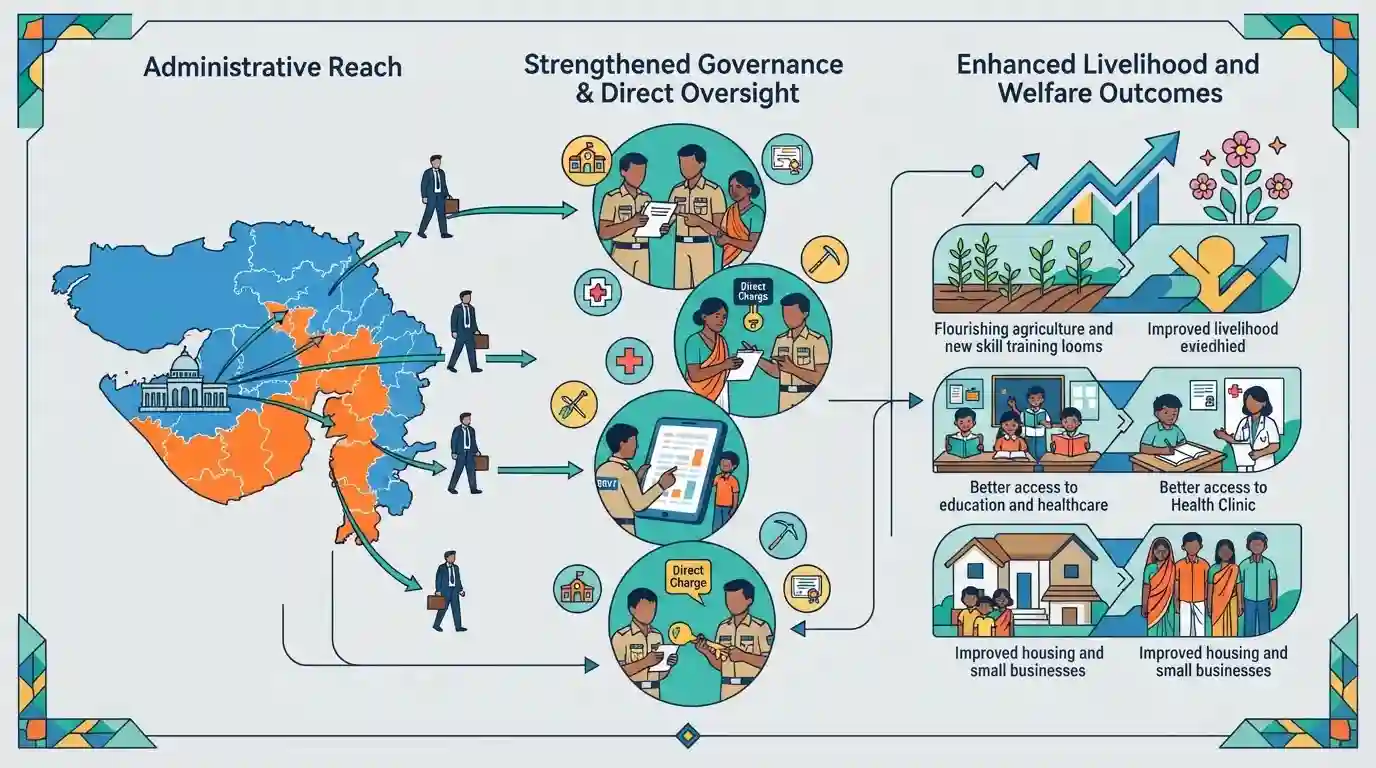
The Gujarat government has deployed Class I officers to take direct charge of tribal welfare initiatives across four non-tribal districts, aiming to strengthen administrative reach, monitor development programs, and enhance the livelihood and welfare of scattered tribal communities.
Key Points
- Class I officers have been given direct charge of tribal welfare in four non-tribal districts of Gujarat to ensure targeted implementation of welfare schemes.
- The initiative aims to bridge governance gaps and improve socio-economic conditions for tribal populations residing outside designated tribal districts.
- The administrative move focuses on effective monitoring, fund utilization, and execution of central and state-level tribal sub-plan schemes.
Important Terms
Mukhyamantri Adimjuth Sarvangi Utkarsh Yojana

A state-level welfare initiative by the Gujarat government focused on the holistic social and economic development of primitive and marginalized tribal communities, such as the Padhar and Siddi groups.
UPSC context
Important for Gujarat-specific welfare schemes, government policies & interventions for vulnerable sections under GS Paper II.
Class I Officers
Senior administrative personnel from the Tribal Development Department appointed as member secretaries of district-level committees to directly oversee welfare projects in non-tribal districts.
UPSC context
Relevant for district administration, bureaucratic structure, and governance mechanisms under GS Paper II.
Primitive Tribal Communities
Marginalized minority groups like the Siddis and Padhars who reside in scattered settlements outside Gujarat's traditional tribal belts, requiring special administrative setups.
UPSC context
Tests understanding of vulnerable and specially targeted tribal groups under GS Paper I and II.
Static Concepts Connected
What are the constitutional provisions and administrative mechanisms for tribal development in Gujarat?
- Fifth Schedule: Fifth Schedule areas provide special governance and protection mechanisms for tribal populations in scheduled districts of Gujarat.
- Financial Outlay: Tribal Sub-Plan (TSP) channels dedicated financial outlays proportional to the state's tribal population percentage.
- Institutional Setup: Project Administrator offices oversee decentralized execution of tribal welfare schemes across notified tribal districts.
Cross-Topic Patterns
Tribal Welfare & District Administrative Reform
Gujarat's administrative restructuring for dispersed tribal groups connects welfare scheme monitoring with decentralised district governance and Panchayati Raj delivery efficiency.
Vulnerable Groups & Micro-targeted Governance
Targeting primitive communities like Siddi and Padhar illustrates the convergence of vulnerable section upliftment with micro-targeted governance delivery models.

Gujarat administrative restructuring for non-tribal district tribal welfare (Siddi/Padhar) is a prime candidate for a multi-statement Q.
Linked PYQs · 2
Linked PYQs · 2
- 2025GPSC_PRELIMSGS1
Which of the following statements is/are correct regarding the G-SAFAL scheme?
- 2026GPSC_PRELIMSGS1
With reference to the Uniform Civil Code Bill recently passed by the Gujarat Legislative Assembly, consider the following statements: 1. The Bill provides for compulsory registration of live-in relationships and excludes Scheduled Tribes from its applicability. 2. The Bill grants legal recognition to same-sex marriages and civil unions on par with heterosexual marriages. Which of the above statement(s) is/are correct?
