India Russia Energy Ties and US Strategic Diplomacy Balance
Source:The Hindu ↗
Why It Matters
Demonstrates the real-world challenges of India's multi-aligned foreign policy and energy security strategies in the face of great power competition and unpredictable diplomatic counterparts. It also raises philosophical questions relevant to GS4 regarding moral clarity versus tactical ambiguity in international relations.
Summary
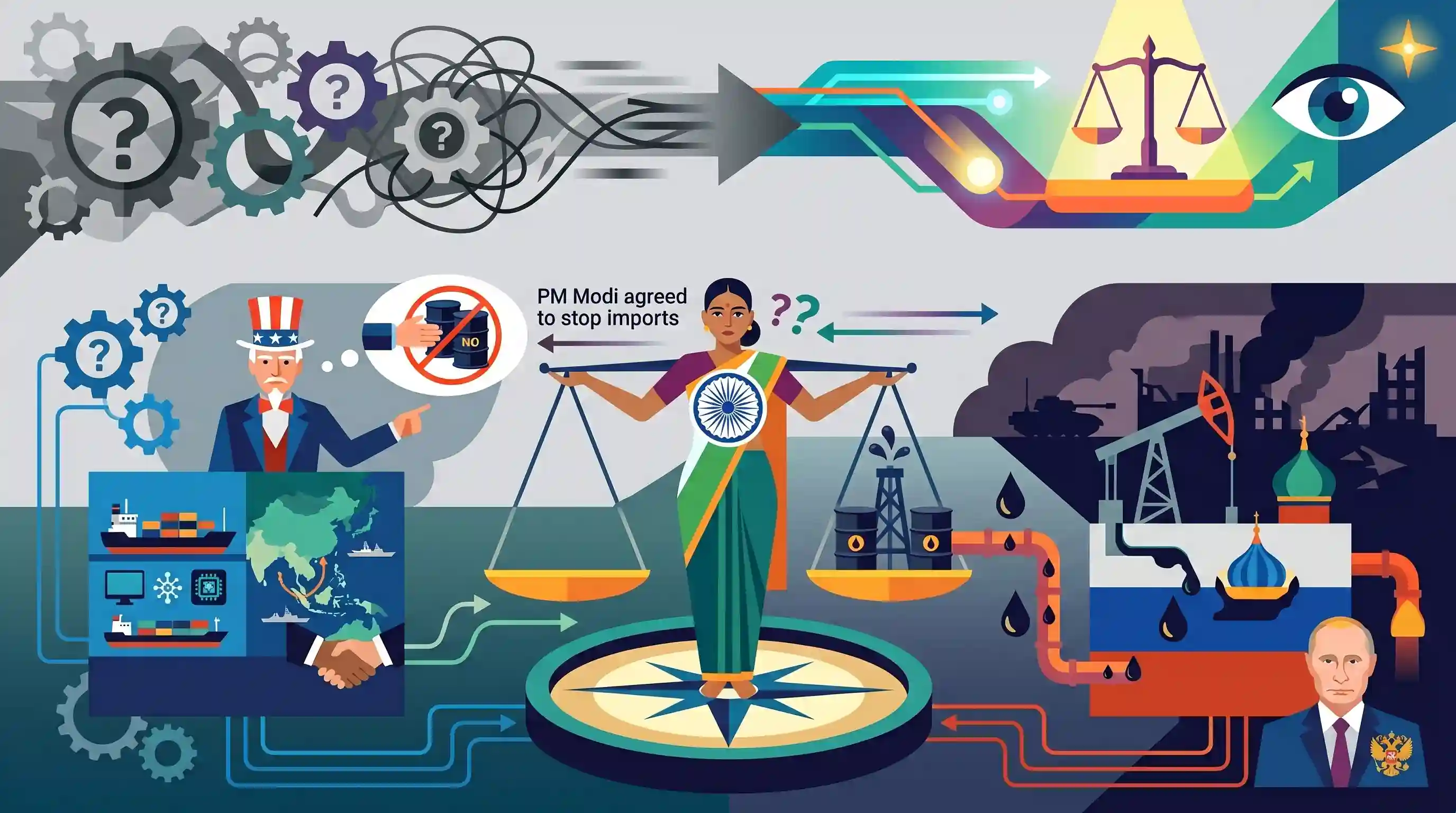
The editorial analyzes India’s diplomatic balancing act in response to recent claims by U.S. President Donald Trump regarding Indian foreign policy. Trump asserted that PM Modi agreed to stop Russian oil imports and that the U.S. mediated an end to 'Operation Sindoor.' India's 'soft denial' highlights the complexities of managing relations with an unpredictable U.S. administration while pursuing strategic autonomy. New Delhi must align its bilateral trade and Indo-Pacific security goals with the U.S. while navigating its energy dependence on Russia amid the Ukraine conflict. The piece concludes that as India rises as a global power, it must replace tactical ambiguity with moral clarity in its international posture.
Key Points
- U.S. President Donald Trump claimed that PM Modi assured him India would halt Russian oil imports and that the U.S. mediated an end to 'Operation Sindoor.'
- India's Ministry of External Affairs responded with a 'soft denial,' reflecting a cautious approach to avoid diplomatic friction while managing the narrative.
- Indian foreign policy faces a quandary in balancing relations with the U.S.—essential for bilateral trade and countering China—against its energy partnership with Russia.
- Trump's unpredictable, transactional diplomacy presents significant challenges for Indian strategists seeking stability and predictability.
- The editorial argues that as an aspiring global power, India must transition from tactical ambiguity to moral clarity, particularly regarding its stance on Russian aggression in Ukraine.
Important Terms
Operation Sindoor

India’s May 2025 precision military strikes on terrorist infrastructure in Pakistan following the Pahalgam attack; a major test of India's bilateral crisis management and rejection of third-party mediation.
UPSC context
GS Paper II: India-Pakistan relations and security; tests understanding of India's 'new normal' response doctrine and strategic communication.
Strategic Autonomy
A core foreign policy principle where India maintains independent decision-making and avoids formal military alliances to pursue its own national interests in a multipolar world.
UPSC context
GS Paper II: Fundamental pillar of India's foreign policy; central to balancing relations with the US and Russia.
Tactical Ambiguity
A diplomatic strategy of maintaining deliberate vagueness on controversial issues to preserve maneuverability and avoid alienating key partners.
UPSC context
GS Paper II/IV: Evaluates the effectiveness of India’s neutral stances in global conflicts like the Ukraine war.
Moral Clarity
A posture advocating for clear, principled ethical positions in international relations, intended to enhance a nation’s credibility and normative leadership as a global power.
UPSC context
GS Paper IV: Ethics in International Relations; tests the balance between idealism and realpolitik.
Energy Security
The uninterrupted availability of energy sources at an affordable price, which often necessitates pragmatic trade choices such as India's continued purchase of discounted Russian oil.
UPSC context
GS Paper III: Economic development and infrastructure; links domestic consumer interests to foreign trade policy.
Ministry of External Affairs
The Indian government arm responsible for the conduct of foreign relations, which issued the 'soft denial' following the US President's claims.
UPSC context
GS Paper II: Executive structure and diplomatic functions; tests the institutional mechanisms of Indian diplomacy.
Prelims Trap
India has officially committed to halting Russian crude oil imports following US mediation.
Statements by foreign leaders are unilateral claims. India's official stance prioritizes energy security, with no formal commitment made to phase out Russian crude oil.
Static Concepts Connected
What is 'Strategic Autonomy' in India's foreign policy?
- Definition: The capacity of a state to make independent, uncoerced foreign policy decisions based purely on national interest, avoiding binding constraints of formal military alliances.
- Evolution: It has transitioned from Cold War-era 'Non-Alignment' (distance from blocs) to modern 'Multi-Alignment' (simultaneous, issue-based partnerships with competing global powers).
- Contemporary Example: Procuring the S-400 missile system and crude oil from Russia while simultaneously deepening Indo-Pacific maritime security cooperation (Quad) with the United States.
Cross-Topic Patterns
Economics of Energy Security
Cheap Russian crude directly limits India's Current Account Deficit and inflation, demonstrating how strategic autonomy in foreign policy is deeply inextricably linked to domestic macroeconomic stability.
Ethics in International Relations
The push for 'moral clarity' over 'tactical ambiguity' bridges GS-2 IR and GS-4 Ethics, questioning whether true global leadership requires normative values or just pragmatic balancing.

Expect a Mains 2026 GS-2 question analyzing India's struggle to balance 'tactical ambiguity' with 'moral clarity' amid US-Russia tensions.
Linked PYQs · 3
Linked PYQs · 3
- 2024MainsGS2
‘The West is fostering India as an alternative to reduce dependence on China's supply chain and as a strategic ally to counter China's political and economic dominance.’ Explain this statement with examples.
- 2025MainsGS2
"Energy security constitutes the dominant kingpin of India's foreign policy, and is linked with India's overarching influence in Middle Eastern countries.” How would you integrate energy security with India's foreign policy trajectories in the coming years?
- 2020MainsGS4
‘The will to power exists, but it can be tamed and be guided by rationality and principles of moral duty.’ Examine this statement in the context of international relations.
