NEET Paper Leak Protests and Examination Governance Reforms
Source:Indian Express ↗
Why It Matters
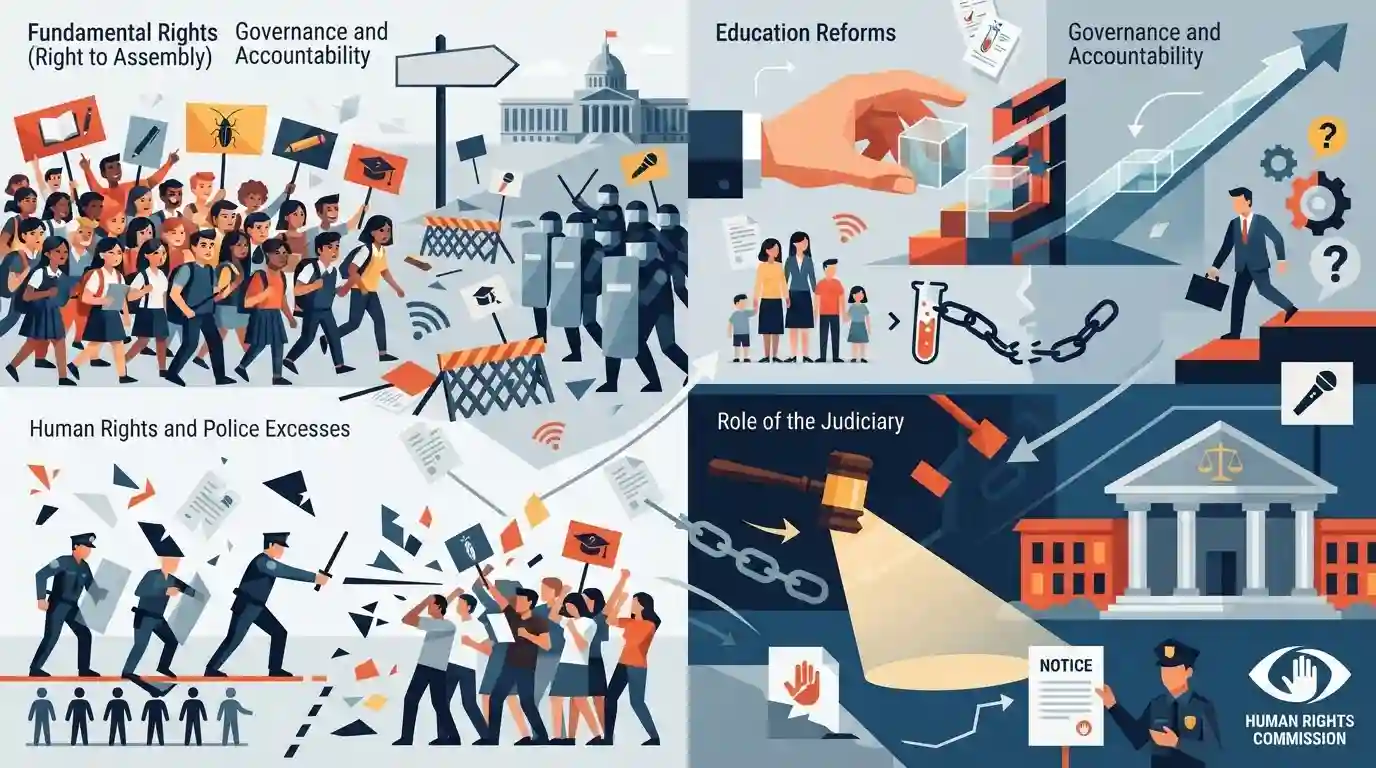
This issue is crucial for UPSC aspirants as it lies at the intersection of governance (accountability in the education sector and high-stakes exams), fundamental rights (the right to protest vs. public order), and the role of institutional checks and balances (High Court and NHRC interventions regarding police excesses).
Summary
The 26-day protest led by the Cockroach Janta Party (CJP) over the NEET paper leak has escalated from a student campaign into a major political movement, spotlighting critical governance failures in India's competitive examination system. Protesters are demanding sweeping education reforms, transparent investigations, compensation for the families of student suicide victims, and the resignation of the Union Education Minister. Tensions peaked during a 'Chalo Sansad' march, resulting in clashes and allegations of police brutality. In response, the Delhi High Court has issued notices to the NHRC and Delhi Police, demanding accountability for the alleged use of excessive force. While the Centre has promised fast-track courts and open dialogue, the persistent protests underscore deeper issues surrounding administrative accountability, the right to peaceful assembly, and the contentious use of internet shutdowns to manage public dissent.
Key Points
- The CJP has led a 26-day protest demanding an impartial probe into the NEET paper leak, sweeping examination reforms, and the resignation of the Union Education Minister.
- A July 20 'Chalo Sansad' march turned violent, leading to allegations of police excesses, lathicharges, and the use of tear gas against protesters.
- The Delhi High Court intervened, issuing notices to the Delhi Police, the Centre, and the NHRC, while directing the preservation of CCTV footage of the police action.
- The government has initiated dialogue with protesters and promised fast-track courts for the guilty, but maintains that the issue should be debated in Parliament.
- The ongoing protests raise significant concerns regarding internet shutdowns, the right to peaceful assembly, and the accountability of bodies conducting high-stakes competitive exams.
Important Terms
National Human Rights Commission (NHRC)

An independent statutory body established under the Protection of Human Rights Act, 1993, responsible for protecting and promoting rights related to life, liberty, equality, and dignity of individuals across India.
UPSC context
GS Paper II (Polity & Governance): Important statutory body, testing institutional human rights protection mechanisms and accountability of public authorities.
National Eligibility cum Entrance Test (NEET)
A uniform, nationwide medical entrance examination conducted by the National Testing Agency (NTA) for undergraduate admissions to MBBS, BDS, and other medical courses in Indian institutions.
UPSC context
GS Paper II (Social Sector & Education): Tests issues related to educational governance, examination integrity, and administrative reforms in India.
Parliament of India
The supreme legislative body of the Republic of India, consisting of the President of India and two houses—the Lok Sabha and the Rajya Sabha.
UPSC context
GS Paper II (Polity): Core legislative institution, testing structural mechanisms, functioning, and the conduct of business of the Union legislature.
Delhi High Court
The premier judicial body for the National Capital Territory of Delhi, established in 1966, possessing original and appellate jurisdiction, as well as writ jurisdiction under Article 226.
UPSC context
GS Paper II (Judiciary): Tests the role, jurisdiction, and powers of High Courts in safeguarding fundamental rights and judicial review.
Cockroach Janta Party (CJP)
A youth-led, satirical political and civic-engagement movement founded in May 2026 to demand educational, judicial, and electoral reforms, acting as a modern pressure group.
UPSC context
GS Paper II (Governance): Tests the role of civil society, pressure groups, and informal youth movements in influencing public policy.
Prelims Trap
The National Testing Agency is a statutory body established under the Public Examinations (Prevention of Unfair Means) Act, 2024.
The NTA is an autonomous society registered under the Societies Registration Act, 1860, not a statutory body. The 2024 Act defines exam offenses but did not create the NTA.
Static Concepts Connected
What is the legal status and structure of the National Testing Agency (NTA)?
- Legal Status: Registered as an autonomous society under the Societies Registration Act, 1860, rather than being created by a specific Act of Parliament.
- Administrative Control: Operates under the Department of Higher Education, Ministry of Education, with a Governing Body that oversees its strategic policies and testing operations.
What are the legal parameters governing internet shutdowns in India?
- Constitutional Right: In Anuradha Bhasin (2020), the SC held that freedom of speech and trade via the internet is protected under Articles 19(1)(a) and 19(1)(g).
- Proportionality Standard: Any shutdown order must satisfy the test of proportionality, be public, and undergo mandatory periodic reviews by a high-level committee.
- Modern Legislation: Regulated under Section 20 of the Telecommunications Act, 2023, replacing older telegraph-era rules, and limits temporary suspension orders to 15 days.
Cross-Topic Patterns
Digital testing vs. Rural digital divide
Transitioning high-stakes exams to computer-based testing at government centers intersects with rural-urban digital infrastructure disparities, a classic GS-2/GS-3 equity challenge.
Public order vs. Digital rights
Administrative use of localized internet shutdowns to prevent paper leaks or manage protests tests the legal boundary between public safety and constitutional digital access.

The statutory basis of NTA and the proportionality test of internet shutdowns during civil unrest are likely 2026 Prelims targets.
Linked PYQs · 2
Linked PYQs · 2
- 2022MainsGS2
“Right of movement and residence throughout the territory of India are freely available to the Indian citizens, but these rights are not absolute.” Comment.
- 2020MainsGS2
National Education Policy 2020 is in conformity with the Sustainable Development Goal-4 (2030). It intends to restructure and reorient education system in India. Critically examine the statement.
