Education Minister Resigns Amidst NEET Paper Leak Protests
Source:Indian Express ↗
কেন এটি গুরুত্বপূর্ণ
The controversy surrounding the NEET-UG exam and subsequent legislative reactions are critical for GS-2. It builds upon the 'Public Examination (Prevention of Unfair Means) Act, 2024' (already a PYQ) by introducing even stricter legal frameworks (statutory fast-track courts, defined timelines). The event also touches on ministerial accountability in a parliamentary democracy and the ongoing constitutional friction between the Right to Protest (Article 19) and the state's power to impose reasonable restrictions for national security.
সারসংক্ষেপ
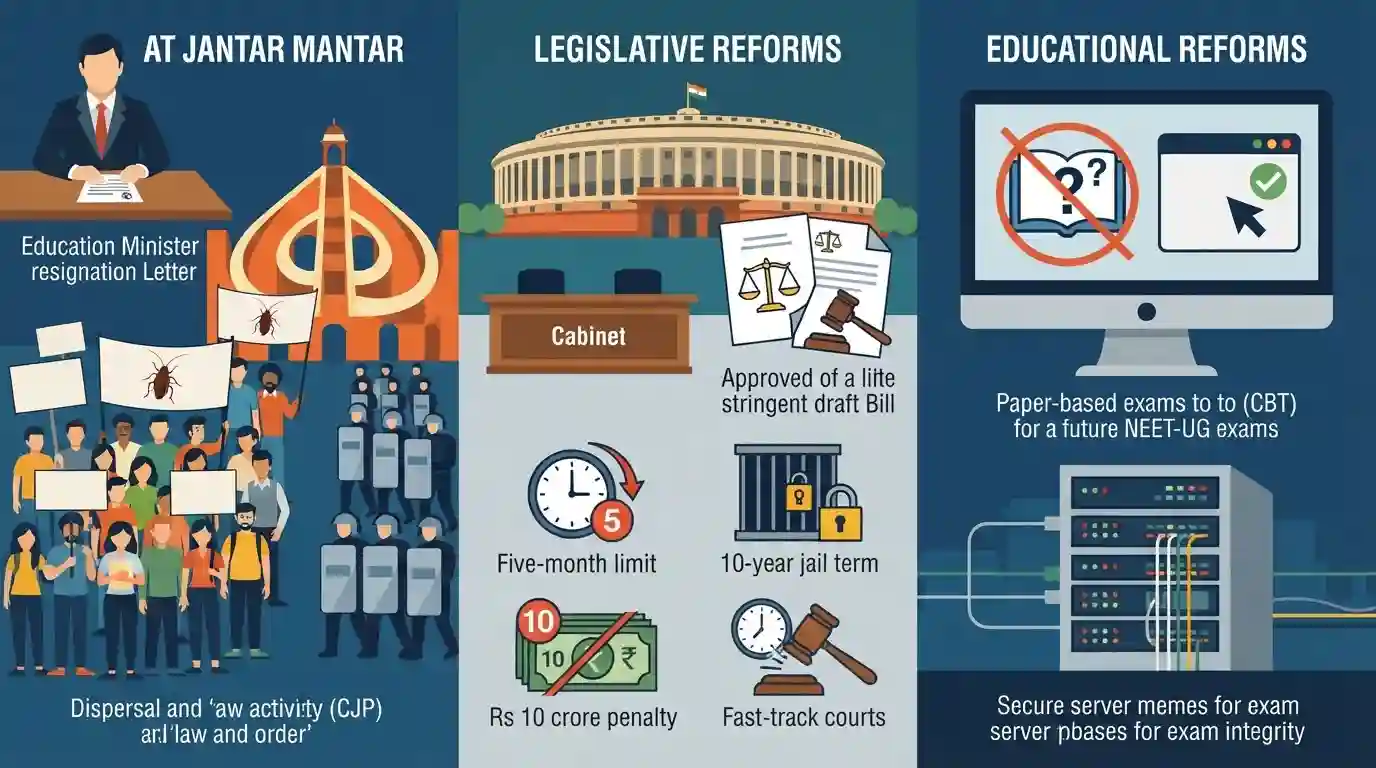
Amidst massive protests led by the Cockroach Janta Party (CJP) at Jantar Mantar over the NEET-UG paper leak, Union Education Minister Dharmendra Pradhan has resigned, fulfilling an Opposition prerequisite for debating a new exam integrity law in Parliament. Concurrently, the Union Cabinet approved a stringent draft Bill that introduces statutory backing for fast-track courts, a maximum jail term of 10 years, a Rs 10 crore penalty, and a five-month limit for concluding investigations and trials. The Centre has also moved to disperse the Jantar Mantar protests citing 'law and order' and national security concerns, whilst announcing a shift to Computer-Based Testing (CBT) for future NEET-UG exams.
মূল বিষয়
- Education Minister Dharmendra Pradhan resigned following massive student protests at Jantar Mantar led by the CJP over the NEET-UG paper leak controversy.
- The minister's resignation was a precondition set by the Opposition to allow a parliamentary debate on a tough new law against paper leaks.
- The Union Cabinet has approved a draft Bill proposing strict measures including a jail term up to 10 years, a penalty of up to Rs 10 crore, and a 5-month timeline for investigation and trial.
- The draft Bill also includes provisions for the statutory backing of fast-track courts to ensure swift justice in examination irregularity cases.
- Citing the presence of 'anti-national forces' and law and order issues, the Centre initiated action to clear the Jantar Mantar protest site.
- Future NEET-UG exams are to be conducted exclusively in Computer-Based Test (CBT) mode to enhance security.
গুরুত্বপূর্ণ শব্দ
National Testing Agency (NTA)

An autonomous, self-sustained testing organization under the Ministry of Education, registered as a society, mandated to conduct secure, transparent, and standardized national-level entrance examinations for higher educational institutions in India.
UPSC context
GS Paper II: Governance. Tests knowledge of administrative reforms, institutional accountability, and standardisation of higher education entrance systems.
Draft Anti-Paper Leak Bill
A proposed legislative amendment to the Public Examinations Act, 2024, introducing harsher punishments (up to 10 years imprisonment and ₹10 crore fines) and statutory fast-track courts to prevent organized cheating in national exams.
UPSC context
GS Paper II: Governance & Education. Tests knowledge of legal mechanisms to preserve exam integrity, protect merit, and deter organised crime.
NEET-UG
The National Eligibility cum Entrance Test (Undergraduate) is a unified national-level competitive entrance examination in India, conducted by the NTA for admissions to undergraduate medical, dental, and alternative medicine courses.
UPSC context
GS Paper II: Education & Governance. Tests understanding of standardized testing, federal educational administration, and institutional challenges in exam management.
Central Bureau of Investigation (CBI)
India's premier investigating agency, operating under the Ministry of Personnel, Public Grievances and Pensions. It derives its investigative powers from the Delhi Special Police Establishment Act, 1946, rather than a direct constitutional or statutory act.
UPSC context
GS Paper II: Statutory/Non-Statutory Bodies. Tests knowledge of central investigating agencies, federal jurisdiction issues, and anti-corruption machinery.
Union Cabinet
The inner, core decision-making body of the Central Government, consisting of the Prime Minister and cabinet-rank ministers, which exercises supreme executive authority under Article 74 of the Indian Constitution.
UPSC context
GS Paper II: Polity & Constitution. Tests understanding of the parliamentary system, cabinet collective responsibility, and executive policymaking processes.
প্রিলিমস ফাঁদ
The Public Examinations (Prevention of Unfair Means) Act uniformly covers all school board matriculation and state university examinations across India.
The Central Public Examinations Act, 2024 (and its amendments) applies strictly to designated central authorities (UPSC, NTA, SSC, etc.). State board and state university exams are governed entirely by separate state-level legislations.
সংযুক্ত স্থির ধারণা
How are Fast-Track Courts (FTCs) established and constitutionally backed in India?
- Constitutional Basis: Derived from the Right to a Speedy Trial under Article 21 (Life and Personal Liberty).
- No Single Statute: They are not created under a single central legislation but via Finance Commission grants, state High Court notifications, or Central Schemes (e.g., Nirbhaya Fund).
- Judicial Control: While funded by the executive, their administrative control and appointment of judges rest entirely with the respective High Courts.
What are the judicial and constitutional boundaries of the Right to Protest in India?
- Constitutional Source: Derived from Article 19(1)(a) (speech) and 19(1)(b) (peaceful assembly), subject to restrictions like public order and sovereignty in 19(2) and 19(3).
- MKSS Ruling (2018): The Supreme Court ruled that while administration can regulate protests, it cannot completely ban or extinguish demonstrations at historic venues.
- Amit Sahni Case (2020): Clarified that public roads and spaces cannot be occupied indefinitely, and protests must occur in designated areas to balance rights with public convenience.
আন্তঃবিষয় প্যাটার্ন
Digital Infrastructure + Exam Integrity
Shifting high-stakes exams to Computer-Based Testing (CBT) via the Radhakrishnan Committee connects digital public infrastructure with administrative accountability in GS2.
Speedy Trial vs Judicial Backlog
Mandating a strict 5-month trial deadline intersects with structural judiciary deficits, illustrating the friction between legislative mandates and actual judicial capacity.

Constitutional parameters of Article 19 protest limits and the non-statutory nature of Fast-Track Courts will likely feature in GS2 2026.
সংযুক্ত PYQ · 3
সংযুক্ত PYQ · 3
- 2024MainsGS2
What are the aims and objects of recently passed and enforced, The Public Examination (Prevention of Unfair Means) Act, 2024? Whether University/State Education Board examinations, too, are covered under the Act ?
- 2015MainsGS2
The quality of higher education in India requires major improvements to make it internationally competitive. Do you think that the entry of foreign educational institutions would help improve the quality of higher and technical education in the country? Discuss.
- 2022MainsGS2
“Right of movement and residence throughout the territory of India are freely available to the Indian citizens, but these rights are not absolute.” Comment.
