Ministerial Resignation and Student Protests over Exam Leaks
Source:Indian Express ↗
ఇది ఎందుకు ముఖ్యం
The event touches upon three core GS2 themes: the individual and collective responsibility of Ministers, the constitutional right to peaceful assembly versus the state's power to enforce reasonable restrictions for public order, and structural reforms in higher education governance to prevent systemic failures like exam leaks.
సారాంశం
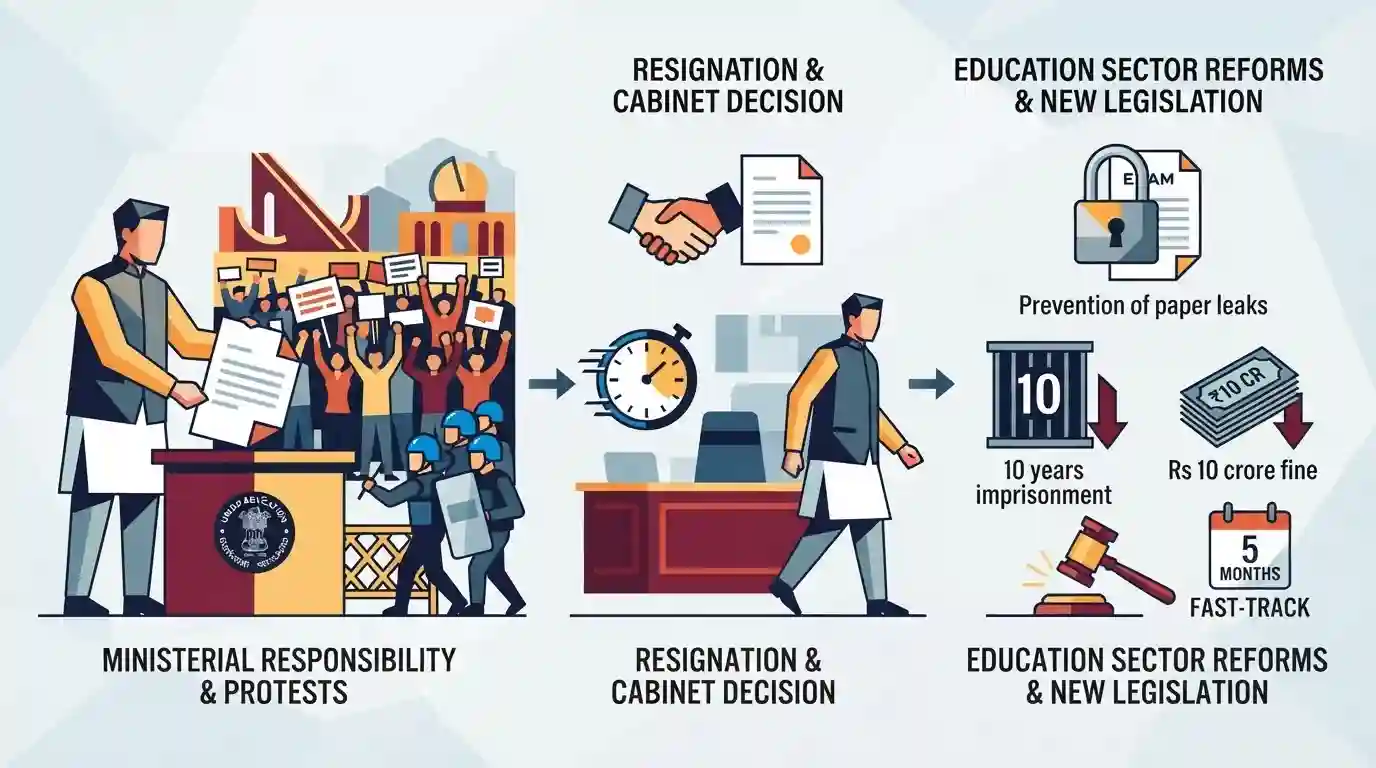
Union Education Minister Dharmendra Pradhan resigned amid intense student protests at Jantar Mantar over the NEET-UG paper leak, citing the need to maintain national unity and prevent exploitation by anti-national forces. Following his resignation, security forces moved to clear the protest site. In a parallel administrative move, the Union Cabinet approved a strict draft Bill proposing up to 10 years imprisonment, a Rs 10 crore fine, and five-month fast-track trials for examination malpractices.
ముఖ్య అంశాలు
- Union Education Minister Dharmendra Pradhan resigned on July 25, 2026, in response to massive student protests over the NEET-UG paper leak.
- The protests were organized by the Cockroach Janta Party (CJP) at Jantar Mantar in New Delhi.
- The Union Cabinet recently approved a draft Bill against exam malpractices, introducing penalties up to 10 years in jail and a Rs 10 crore fine, alongside statutory backing for fast-track courts.
- Security forces were deployed to clear the protest site at Jantar Mantar shortly after the resignation was announced, raising questions around the right to protest and public order.
ముఖ్యమైన పదాలు
Public Examinations (Prevention of Unfair Means) Act, 2024

Central legislation enacted to curb paper leaks and organized cheating in national exams like UPSC and NEET, with 2026 draft amendments proposing up to 10 years imprisonment and 10 crore fine.
UPSC context
GS Paper II: Governance and statutory bills; tests regulatory frameworks to prevent academic malpractices and secure student futures.
NEET-UG
The National Eligibility cum Entrance Test (Undergraduate) is India's unified nationwide entrance examination conducted by the National Testing Agency (NTA) for admission to undergraduate medical and dental courses.
UPSC context
GS Paper II: Social Sector/Services relating to Education and Health; tests issues in standardized public examinations and agency reforms.
National Education Policy (NEP) 2020
A comprehensive national framework designed to overhaul India's education system, introducing a 5+3+3+4 school structure, multi-disciplinary higher education, and an objective to make India a global knowledge superpower.
UPSC context
GS Paper II: Social Sector/Services relating to Education; evaluates national educational policies, reforms, and holistic development goals.
Union Cabinet
The inner core of India’s Council of Ministers, headed by the Prime Minister, serving as the supreme policy formulation and executive decision-making body of the government.
UPSC context
GS Paper II: Executive structure, function, and cabinet committees; tests understanding of the executive organ.
ప్రిలిమ్స్ ఉచ్చు
Offences under the Public Examinations Act, 2024 are bailable if committed by individual students without an organized syndicate.
In reality, all offences under this Act are strictly cognizable, non-bailable, and non-compoundable, regardless of whether they are individual or organized.
అనుసంధానమైన స్థిర భావనలు
What are the facets of ministerial responsibility under Article 75?
- Individual Responsibility: Ministers hold office during the pleasure of the President (acting on the PM's advice), enabling individual accountability and resignations.
- Collective Responsibility: The Council of Ministers is collectively responsible to the Lok Sabha; a defeat on a major policy or no-confidence motion causes the entire cabinet's fall.
- No Legal Responsibility: Unlike the United Kingdom, India has no system of legal responsibility where a minister must countersign public acts.
How does the Supreme Court balance the right to protest with public convenience?
- Amit Sahni Case (2020): Held that peaceful protest is a fundamental right but public ways and spaces cannot be occupied indefinitely, causing public inconvenience.
- MKSS Case (2018): Ruled that while dissent is protected, protests must be conducted at designated sites to protect the rights of other citizens.
అంతర-అంశ నమూనాలు
Exam Integrity & Demographic Dividend
Systemic paper leaks stall youth employment, degrading the trust-index of public recruiters and severely threatening India's demographic dividend.
BNSS Sec 163 vs Article 19(1)(b)
The replacement of CrPC Section 144 with BNSS Section 163 tests the limits of executive discretion when dispersing political assemblies and student protests.

Mains 2026 is highly likely to analyze the limits of peaceful assembly versus public order restrictions under the new BNSS Section 163.
అనుసంధాన PYQలు · 3
అనుసంధాన PYQలు · 3
- 2013PrelimsGS1
Consider the following statements : 1. The Council of Ministers in the Centre shall be collectively responsible to the Parliament. 2. The Union Ministers shall hold the office during the pleasure of the President of India. 3. The Prime Minister shall communicate to the President about the proposals for legislation. Which of the statements given above is/are correct?
- 2022MainsGS2
“Right of movement and residence throughout the territory of India are freely available to the Indian citizens, but these rights are not absolute.” Comment.
- 2020MainsGS2
National Education Policy 2020 is in conformity with the Sustainable Development Goal-4 (2030). It intends to restructure and reorient education system in India. Critically examine the statement.
