India Bhutan Judicial Partnership and Digitalization Support
Source:The Hindu ↗
Why It Matters
It showcases the expansion of India's 'Neighbourhood First' policy into the realms of digital governance, judicial capacity building, and cybersecurity cooperation. It reflects India's soft power and its role as a regional partner in technological and legal development.
Summary
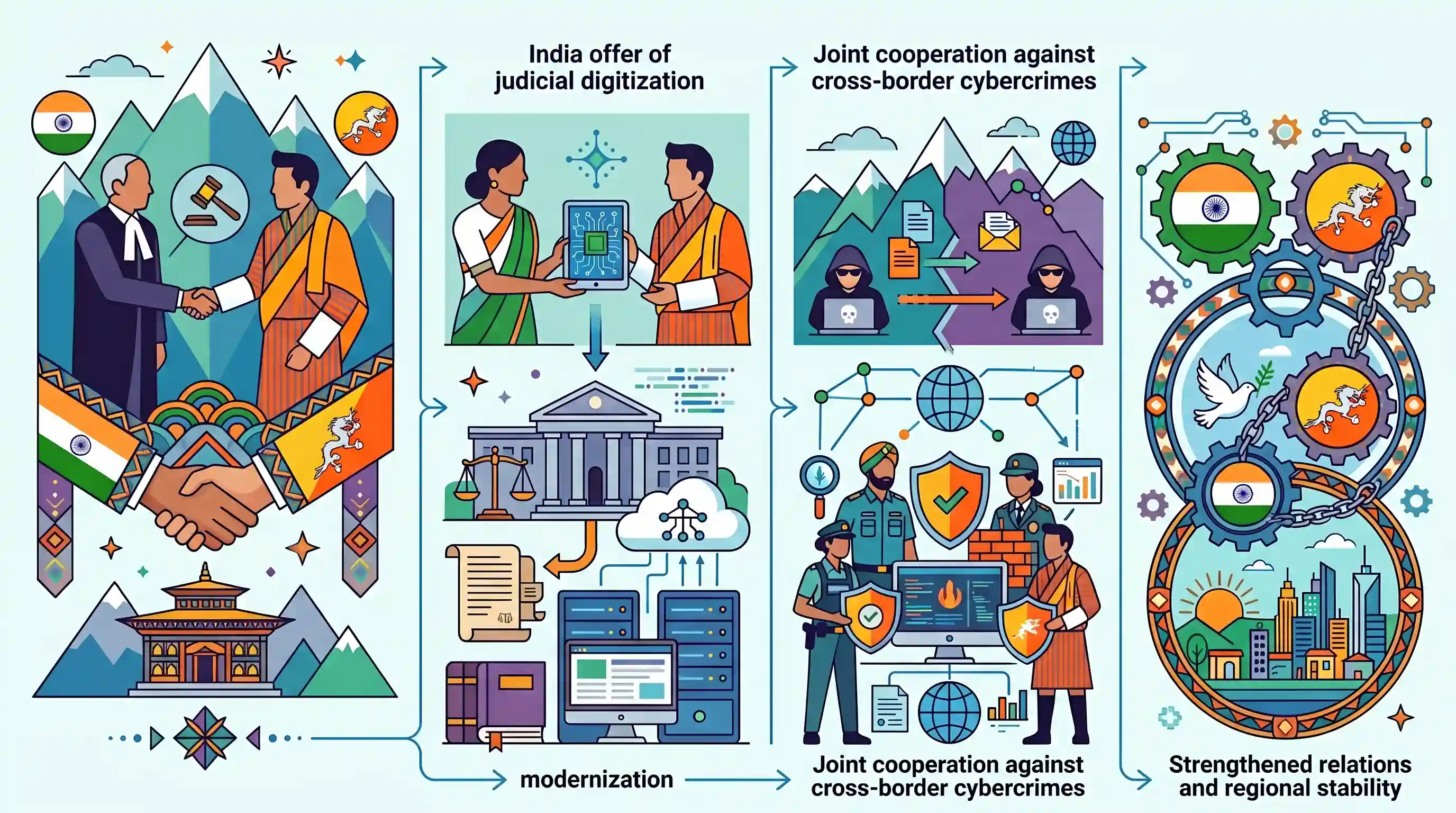
During his visit to Thimphu, Chief Justice of India Surya Kant met with Bhutan's King Jigme Khesar Namgyel Wangchuck to offer India's assistance in digitising Bhutan's judicial processes. The leaders discussed strengthening the deep-rooted bilateral relationship by establishing a formal judicial partnership. Furthermore, they emphasized the necessity of joint cooperation to combat and prosecute the growing menace of cross-border cybercrimes, reflecting India's ongoing commitment to capacity building and security in its neighborhood.
Key Points
- Chief Justice of India Surya Kant offered comprehensive support for the digitisation and digitalisation of Bhutan's judicial processes during his visit to Thimphu.
- The two nations committed to advancing bilateral cooperation in the form of a 'judicial partnership', focusing on technical assistance and best practices.
- Discussions also covered the rising threat of cybercrimes and the need for joint efforts between India and Bhutan to prevent and prosecute cross-border cyber offences.
- The meeting reaffirmed the deep cultural, spiritual, and intellectual ties that form the foundation of India-Bhutan relations.
Important Terms
Chief Justice of India (CJI)

The highest-ranking officer of the Indian judiciary and head of the Supreme Court, responsible for administrative functions and presiding over significant constitutional matters.
UPSC context
GS Paper II: Judiciary. Tests knowledge of constitutional roles, judicial appointments, and the 'Master of the Roster' concept.
India-Bhutan Relations
A strategic partnership governed by the 2007 Friendship Treaty, characterized by cooperation in hydropower, security, and now digital judicial infrastructure.
UPSC context
GS Paper II: Bilateral Relations. Crucial for understanding 'Neighbourhood First' policy and regional security dynamics.
Neighbourhood First Policy
India's core foreign policy approach prioritizing active engagement and developmental support for its immediate neighbors to ensure regional stability and prosperity.
UPSC context
GS Paper II: International Relations. Essential for questions on regional groupings and India's strategic influence.
Digitalisation of Judiciary
The integration of digital technology (e.g., e-filing, virtual hearings, AI) into the legal system to improve transparency, efficiency, and access to justice.
UPSC context
GS Paper II: E-governance. Tests understanding of how technology improves service delivery and transparency in public institutions.
Cross-border Cybercrime
Criminal activities where the perpetrator and victim/system are in different countries, necessitating international legal cooperation and joint prosecution mechanisms.
UPSC context
GS Paper III: Security. Focuses on emerging threats, data sovereignty, and international law enforcement cooperation.
Supreme Court of India
The apex judicial body under the Constitution, acting as the final court of appeal and the ultimate interpreter of the Indian Constitution.
UPSC context
GS Paper II: Indian Constitution. Fundamental for topics on judicial review, activism, and separation of powers.
Prelims Trap
Foreign capacity-building and institutional partnerships are exclusively executed by India's Ministry of External Affairs.
While the MEA coordinates foreign policy, constitutional bodies like the Supreme Court, ECI, and CAG increasingly engage in direct institutional diplomacy and capacity-building.
Static Concepts Connected
What are the key features of the India-Bhutan Friendship Treaty?
- 1949 Origins: Established the foundational framework for bilateral relations, with India initially guiding Bhutan's external affairs and defense policies.
- 2007 Revision: Removed the clause requiring India's guidance on foreign policy, formally recognizing Bhutan's sovereignty and strategic autonomy.
- Mutual Security: Mandates that neither country shall allow the use of its territory for activities harmful to the national security of the other.
What is the e-Courts Mission Mode Project?
- Core Objective: A pan-India initiative monitored by the Supreme Court to computerize district and subordinate courts, improving justice delivery.
- Phase III Upgrades: Approved in 2023, Phase III focuses on upgrading to cloud infrastructure, integrating AI, and creating a paperless judicial ecosystem.
- DPI Export: Its success has created a scalable Digital Public Infrastructure (DPI) model that India now actively offers to neighboring countries.
Cross-Topic Patterns
DPI as India's Soft Power
Exporting judicial digitization models to Bhutan mirrors the internationalization of UPI. Digital Public Infrastructure (DPI) is now a central pillar of India's 'Neighbourhood First' diplomacy.
The Rise of Judicial Diplomacy
Beyond traditional executive-led statecraft, India's higher judiciary and constitutional bodies (like ECI and CAG) are increasingly engaging in direct institutional capacity-building and diplomacy abroad.

India's export of Digital Public Infrastructure (e-Courts, UPI) as a soft-power diplomatic tool is a prime candidate for Mains 2026.
Linked PYQs · 4
Linked PYQs · 4
- 2020MainsGS3
Discuss different types of cyber crimes and measures required to be taken to fight the menace.
- 2021MainsGS3
Keeping in view India's internal security, analyse the impact of cross-border cyber attacks. Also discuss defensive measures against these sophisticated attacks.
- 2025MainsGS2
India-Africa digital partnership is achieving mutual respect, co-development and long-term institutional partnerships. Elaborate.
- 2024MainsGS2
e-governance is not just about the routine application of digital technology in service delivery process. It is as much about multifarious interactions for ensuring transparency and accountability. In this context evaluate the role of the 'Interactive Service Model' of e-governance.
