Judicial Infrastructure and Technology Adoption in Indian Courts
Source:The Hindu ↗
Why It Matters
Highlights the critical role of physical and digital infrastructure (such as e-courts and digital assessment platforms) in addressing judicial pendency, enhancing transparency, and improving access to justice. Useful for GS2 answers on judicial reforms and e-governance applications in the legal framework.
Summary
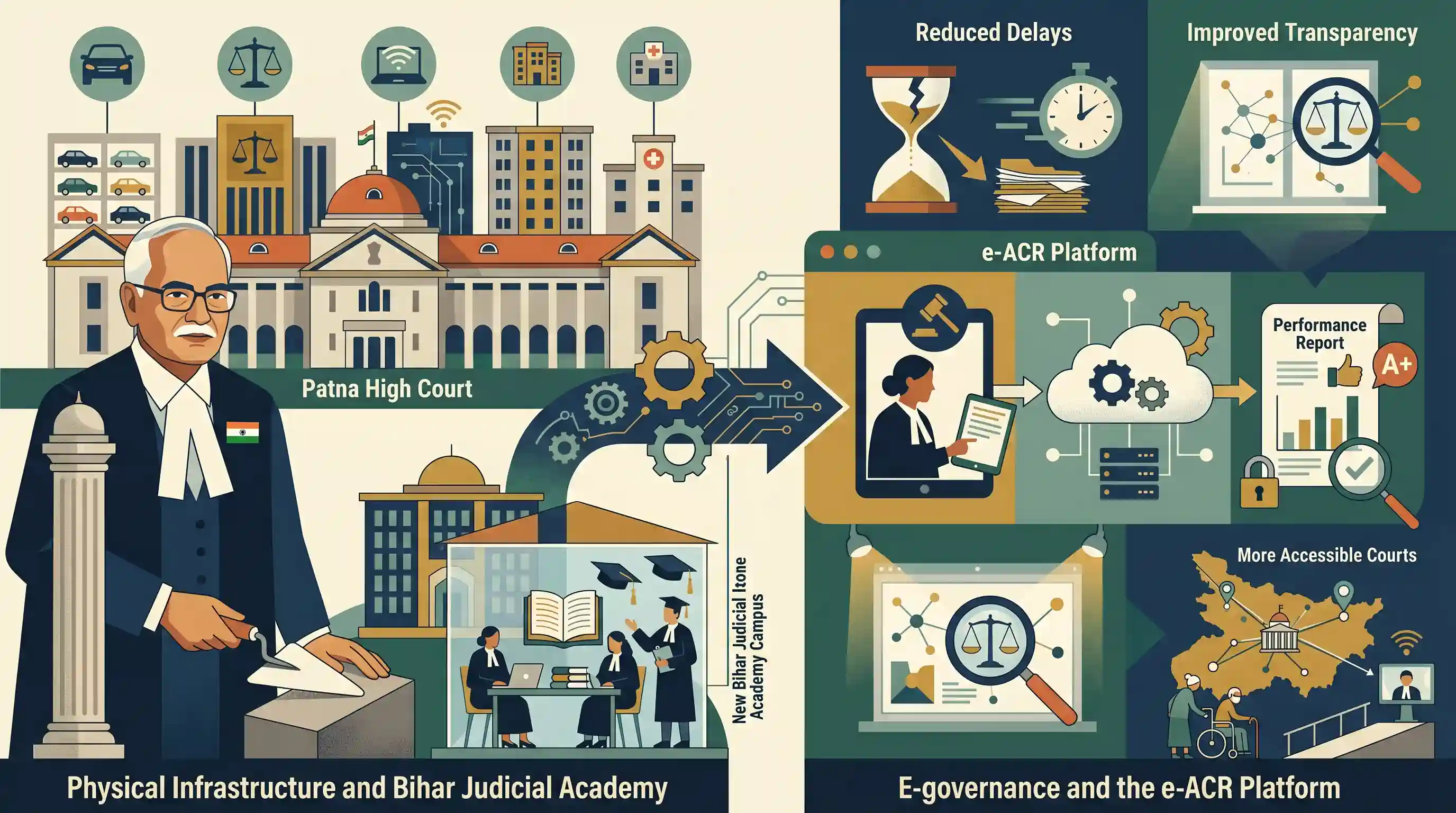
Chief Justice of India Surya Kant laid the foundation for multiple judicial infrastructure projects at the Patna High Court and the new Bihar Judicial Academy campus. Emphasizing the modernization of the justice delivery system, he launched the e-ACR platform for judicial officers. He stated that the effective use of technology is vital for reducing delays in justice delivery, improving transparency, and making courts more accessible to the public.
Key Points
- CJI Surya Kant inaugurated seven new infrastructure projects at the Patna High Court and the ground-breaking ceremony for the new Bihar Judicial Academy (BJA) campus in Bodh Gaya.
- He launched the e-ACR platform for digitizing the filing of Annual Confidential Reports for judicial officers.
- The CJI underscored that technology adoption in courts will reduce judicial delays, enhance transparency, and ensure better access to justice for the common man.
- The Bihar state government provided 112 acres of land for the BJA, reflecting efforts to augment judicial infrastructure and capacity building of judicial officers.
Important Terms
e-ACR platform

A digital portal for filing and processing Annual Confidential Reports (ACRs) of judicial officers, replacing paper-based assessments with a transparent, technology-driven appraisal system to improve administrative efficiency.
UPSC context
GS-2: Judiciary/Governance. Tests understanding of digital reforms for judicial accountability and the use of ICT in performance management.
Judicial Infrastructure
The physical and digital assets (courtrooms, ICT tools, residential facilities) necessary for justice delivery. It is a critical factor in reducing case pendency and ensuring accessible, citizen-friendly courts.
UPSC context
GS-2: Structure/Functioning of Judiciary. Highlights the relationship between modern facilities and efficient, timely justice delivery for all citizens.
Bihar Judicial Academy
A state-level institution responsible for the professional training and capacity building of judicial officers, focusing on legal expertise, ethics, and emerging challenges like cybercrime to sustain the justice system.
UPSC context
GS-2: Statutory/Regulatory Bodies/Judiciary. Tests knowledge of mechanisms for the continuous training and professional development of the subordinate judiciary.
Patna High Court
The apex judicial authority in Bihar, established in 1916 under Article 214 of the Constitution. It holds original and appellate jurisdiction and acts as a 'court of record' for the state.
UPSC context
GS-2: Structure, Organization and Functioning of the Judiciary. Tests knowledge of the constitutional status and powers of High Courts in India.
e-Governance (Judiciary)
The application of Information and Communication Technology (ICT) to judicial processes to enhance transparency, speed, and public accessibility, exemplified by initiatives like e-Courts and digital case management systems.
UPSC context
GS-2: E-governance applications/successes. Tests understanding of how digital tools overcome traditional judicial delays and improve citizen-centric services.
Alternative Dispute Resolution (ADR)
Methods like mediation and arbitration used to resolve legal disputes outside the traditional courtroom, designed to reduce litigation costs, save time, and ease the judicial burden.
UPSC context
GS-2: Dispute Redressal Mechanisms and Institutions. Tests knowledge of non-adversarial processes in reducing case pendency and improving judicial efficiency.
Prelims Trap
"The Supreme Court holds direct administrative control over the postings, promotions, and performance evaluations of subordinate judicial officers."
Under Article 235, the control over subordinate courts—including postings, promotions, and writing Annual Confidential Reports (ACRs)—is vested exclusively in the High Court, not the Supreme Court.
Static Concepts Connected
How is administrative control over the subordinate judiciary structured?
- Article 235: The control over district courts and courts subordinate thereto, including postings and promotions, is vested in the State's High Court.
- Article 233: Appointments, postings, and promotions of district judges are made by the State Governor in consultation with the High Court.
- State's Role: State governments play a key role in providing infrastructure (e.g., land for academies) and funding for subordinate courts.
What are the key pillars of the e-Courts Mission Mode Project?
- Phase III: Focuses on advanced digitization, including cloud hosting, paperless courts, and AI-assisted case tracking to reduce backlogs.
- NJDG: A comprehensive database of pending and disposed cases acting as a monitoring tool for judicial performance and transparency.
- Implementation: Monitored by the e-Committee of the Supreme Court and funded by the Department of Justice, Ministry of Law.
Cross-Topic Patterns
Judicial pendency + Enforcement of Contracts
E-governance in courts (NJDG, e-filing) is critical for improving India's ranking in 'Enforcement of Contracts', directly impacting the broader ease of doing business and economic growth (GS-3).
Digital Divide + Access to Justice
While virtual courts and e-platforms enhance administrative transparency, they raise GS-2 equity concerns regarding access for rural litigants lacking digital literacy or reliable internet.

Expect a Prelims question on NJDG's scope or a Mains question linking e-Courts Phase-III with 'Enforcement of Contracts'.
Linked PYQs · 3
Linked PYQs · 3
- 2023MainsGS2
e-governance, as a critical tool of governance, has ushered in effectiveness, transparency and accountability in governments. What inadequacies hamper the enhancement of these features ?
- 2024MainsGS2
e-governance is not just about the routine application of digital technology in service delivery process. It is as much about multifarious interactions for ensuring transparency and accountability. In this context evaluate the role of the 'Interactive Service Model' of e-governance.
- 2023MainsGS2
“Constitutionally guaranteed judicial independence is a prerequisite of democracy.” Comment.
