Rajasthan High Court Judicial Controversy and Collegium Due Process
Source:the-hans-india ↗
Why It Matters
This event illustrates the internal mechanisms for accountability and administrative oversight within the higher judiciary in India, particularly highlighting the role of the Supreme Court Collegium and consultee judges in the appointment and regulation of High Court Chief Justices. It is highly relevant for the Polity and Governance section in Civil Services exams.
Summary
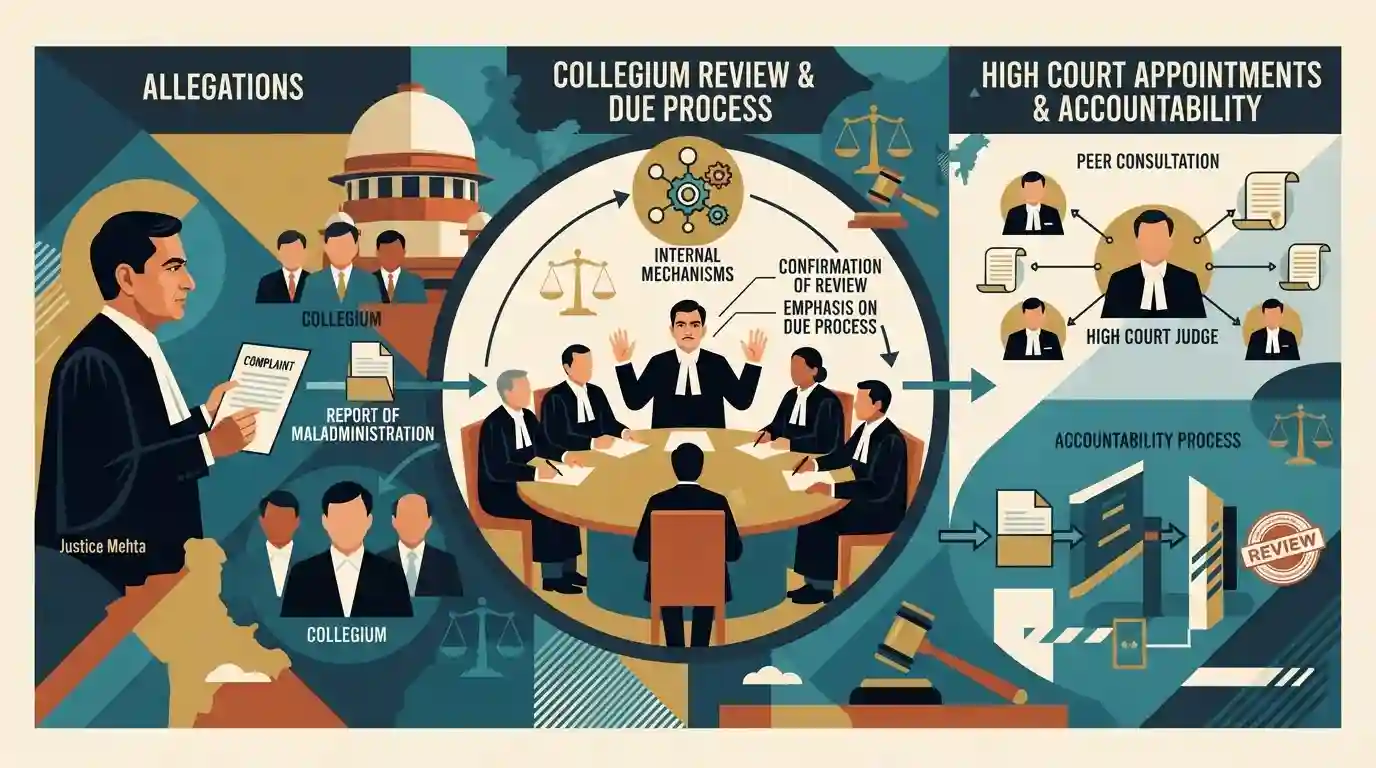
Chief Justice of India Surya Kant addressed the ongoing controversy involving Rajasthan High Court Acting Chief Justice Sanjeev Prakash Sharma, following a formal complaint by Supreme Court Justice Sandeep Mehta alleging maladministration. The CJI emphasized that due process will be followed and confirmed the Supreme Court Collegium is reviewing the matter. The situation underscores the internal mechanisms of judicial accountability and the Collegium's process of consulting peer feedback for appointments.
Key Points
- Chief Justice of India Surya Kant has emphasized the need for due process in addressing the controversy surrounding Rajasthan High Court Acting Chief Justice Sanjeev Prakash Sharma.
- The issue stems from a formal complaint by Supreme Court Judge Justice Sandeep Mehta, who alleged severe maladministration and irregularities at the Rajasthan High Court.
- CJI Kant confirmed that the Supreme Court Collegium has taken note of the complaint and is examining the matter.
- The incident highlights the role of the Collegium in gathering feedback from consultee judges and ensuring procedural fairness before finalizing judicial appointments.
Important Terms
Supreme Court Collegium

A system established by Supreme Court judgments where the Chief Justice of India and senior-most judges recommend the appointment and transfer of judges to the Supreme Court and High Courts.
UPSC context
Highly relevant for RPSC Indian Polity questions evaluating judicial independence, appointment mechanisms, and separation of powers.
Rajasthan High Court
Established in 1949, it is Rajasthan's highest judicial authority. It operates with a principal seat in Jodhpur and a permanent bench in Jaipur, exercising both appellate and writ jurisdictions.
UPSC context
A core topic in RPSC Rajasthan State Polity (RAS Pre & Mains) regarding state history, jurisdiction, and structure.
Acting Chief Justice
A High Court judge appointed by the President under Article 223 of the Constitution to temporarily perform the duties of the Chief Justice during a vacancy or absence.
UPSC context
Tested in RPSC Polity sections regarding constitutional provisions for state judiciaries and presidential appointment powers.
Judicial Accountability
The principle that judicial institutions must maintain high ethical and administrative standards, remaining answerable for their administrative conduct without compromising their independence in decision-making.
UPSC context
Essential for RPSC Mains GS Paper III covering governance, institutional transparency, and democratic checks and balances.
Prelims Trap
"The Acting Chief Justice of a High Court is appointed by the Governor of the state or the Chief Justice of India."
Under Article 223 of the Constitution, the President of India (not the Governor or CJI) appoints the Acting Chief Justice of a High Court.
Static Concepts Connected
What are the provisions for appointing an Acting Chief Justice of a High Court?
- Article 223: Empowers the President of India to appoint a High Court judge to perform the duties of the Chief Justice.
- Valid conditions: Triggered when the office is permanently vacant, or the Chief Justice is temporarily absent or unable to perform their duties.
What is the 'In-House Procedure' for complaints against High Court judges?
- Origin: Adopted by the Supreme Court in 1999 as an internal administrative mechanism to ensure judicial accountability without compromising independence.
- Mechanism: Empowers the Chief Justice of India (CJI) to examine serious complaints of misconduct against HC judges and form a peer inquiry committee.
- Final action: If misconduct is found, the CJI may withdraw judicial work from the judge and recommend the executive initiate formal impeachment.
Cross-Topic Patterns
Internal Accountability vs. Impeachment
Contrasts the judiciary's internal self-correction mechanism (In-House Procedure of 1999) with the formal legislative removal process under the Judges (Inquiry) Act, 1968.
Consultee Judges in the Collegium System
The SC Collegium heavily relies on 'consultee judges'—SC judges originating from the relevant High Court—whose administrative feedback is critical for finalizing elevations and transfers.

Expect a multi-statement question testing the difference in appointing authorities for regular HC Judges (Art 217) vs Acting CJ (Art 223).
Linked PYQs · 2
Linked PYQs · 2
- 2023RPSC_PRELIMSGS1
According to Article 217 (1) of the Constitution, the President shall make the appointment of a judge of the Rajasthan High Court (other than the Chief Justice) after consultation with whom?
- 2023RPSC_PRELIMSGS1
According to Article 217(1) of the Constitution, who does the President appoint on the advice of whom, other than the Chief Justice of the Rajasthan High Court?
