Digital Judicial Reforms and AI Integration in Court Systems
Source:The Hindu ↗
Why It Matters
Digital integration of the judiciary is a major governance theme. Initiatives like 'Su-Sahay' highlight a shift toward 'Interactive Service Models' in e-governance, helping address high judicial pendency and making the justice system more user-centric for ordinary citizens.
Summary
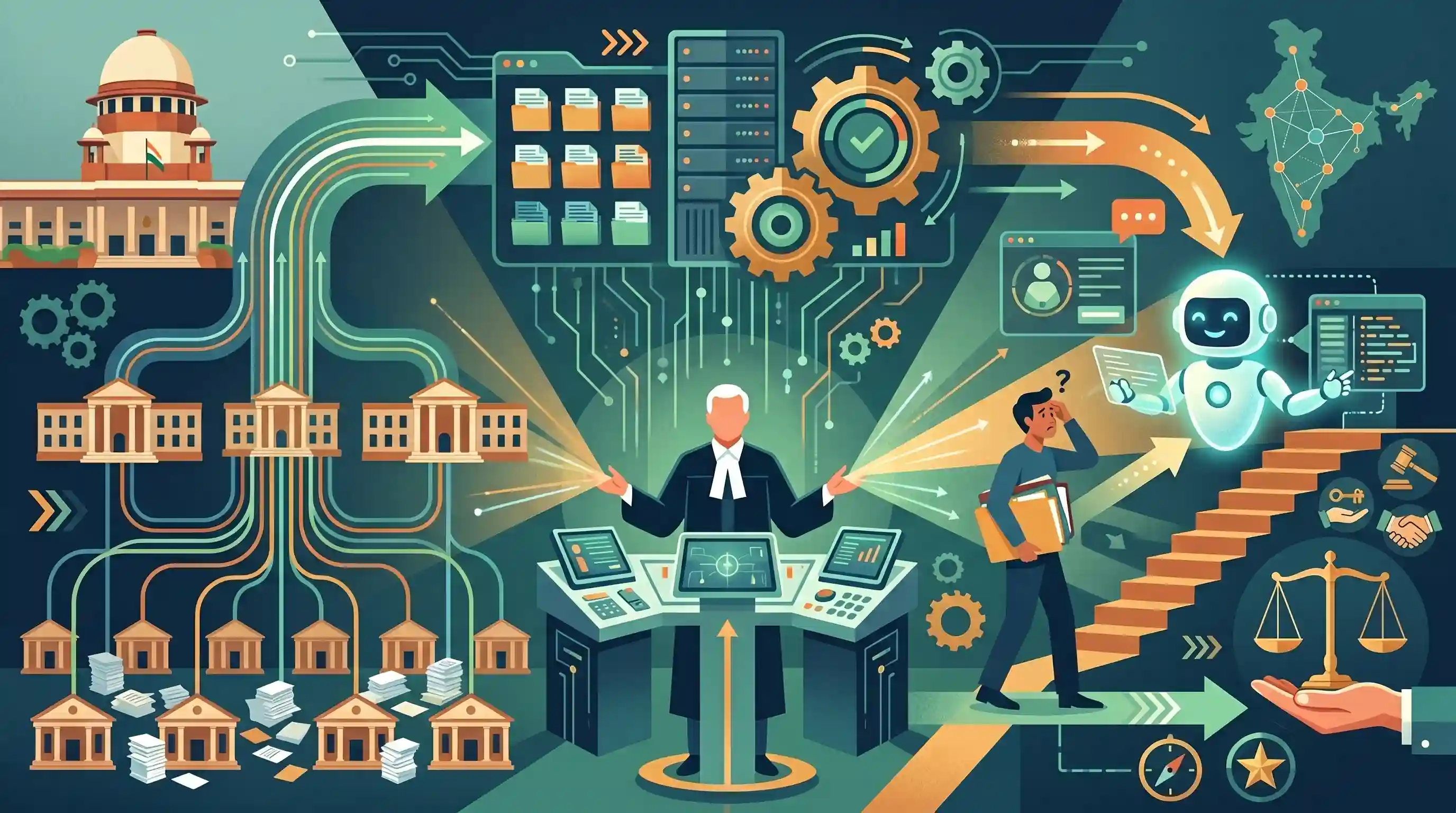
Chief Justice of India Surya Kant has launched two pioneering digital platforms—the 'One Case, One Data' initiative and the AI chatbot 'Su-Sahay'—to streamline judicial administration and improve access to justice. 'One Case, One Data' aims to integrate court data uniformly from the lowest taluka courts up to the apex court, enhancing case management. Meanwhile, 'Su-Sahay', co-developed with the NIC, offers an interactive, AI-driven service model to guide litigants through court procedures. These steps mark a significant leap in the e-Courts mission, utilizing e-governance to tackle institutional inefficiencies.
Key Points
- Chief Justice of India Surya Kant introduced two major digital initiatives aimed at modernizing the Indian judicial system.
- The 'One Case, One Data' initiative creates a unified digital architecture integrating judicial administration from taluka courts to the Supreme Court for seamless case management.
- The 'Su-Sahay' AI-powered chatbot was launched on the Supreme Court website to help litigants easily access justice and court-related services.
- These initiatives were developed collaboratively by the National Informatics Centre (NIC) and the Supreme Court Registry, reflecting a push toward a user-centric e-governance model in the judiciary.
Important Terms
One Case, One Data initiative

A 2026 judicial initiative integrating case information from the Supreme Court down to taluka courts into a unified digital system to streamline case management and data integrity.
UPSC context
GS Paper II: Judicial Reforms. Tests understanding of technological solutions for reducing administrative silos and enhancing court efficiency.
Su-Sahay AI chatbot
An AI-powered assistive chatbot developed by the NIC and Supreme Court Registry to provide litigants with an interactive interface for navigating court procedures and e-services.
UPSC context
GS Paper II & III: E-governance. Tests knowledge of AI applications in public service delivery and improving citizen access to justice.
e-Courts Mission Mode Project
A pan-India mission for the ICT enablement of the judiciary. Phase III focuses on creating digital, paperless courts and establishing a unified technology platform for all stakeholders.
UPSC context
GS Paper II: Governance/Judiciary. Essential for questions on judicial modernization and the National e-Governance Plan.
National Informatics Centre (NIC)
A premier government organization under the Ministry of Electronics and Information Technology (MeitY) providing the digital backbone and IT consultancy for India's e-governance and judicial systems.
UPSC context
GS Paper III: IT and Governance. Tests institutional knowledge of the primary agency driving India's digital public infrastructure.
Prelims Trap
AI tools like SUPACE and Su-Sahay are designed to generate predictive judgments for pending cases.
AI adoption in the Indian judiciary is strictly confined to data processing, translation, and administrative assistance. It is explicitly not authorized for automated decision-making or predictive rulings.
Static Concepts Connected
What is the e-Courts Mission Mode Project?
- Nodal bodies: Monitored and implemented by the Department of Justice in collaboration with the e-Committee of the Supreme Court.
- Primary scope: Aimed at computerizing district and subordinate courts across India, leading to the creation of the National Judicial Data Grid (NJDG).
- Phase III focus: Focuses on cloud architecture, AI integration, paperless courts, and the unified 'One Case, One Data' digital identity.
What are the major AI and Tech tools deployed in the Indian Judiciary?
- SUVAS: Supreme Court Vidhik Anuvaad Software translates judicial documents and judgments from English into vernacular languages.
- SUPACE: Supreme Court Portal for Assistance in Court's Efficiency is an AI tool that processes facts and extracts data to assist judges.
- Su-Sahay: An interactive, AI-driven chatbot co-developed with NIC to guide ordinary litigants through court procedures.
Cross-Topic Patterns
AI governance + Article 39A
Using chatbots like Su-Sahay to decode complex court procedures for laypersons directly operationalizes the constitutional mandate (Article 39A) for equal access to justice and legal aid.
Linguistic inclusion + Machine Learning
Translation tools like SUVAS bridge the gap between the English-dominated higher judiciary and vernacular litigants, mapping machine learning deployment to constitutional linguistic rights.

Match-the-following pairs featuring SUVAS, SUPACE, and Su-Sahay against their specific functions are highly probable in 2026 Prelims.
Linked PYQs · 4
Linked PYQs · 4
- 2025MainsGS2
e-governance projects have a built-in bias towards technology and back-end integration than user-centric designs. Examine.
- 2024MainsGS2
e-governance is not just about the routine application of digital technology in service delivery process. It is as much about multifarious interactions for ensuring transparency and accountability. In this context evaluate the role of the 'Interactive Service Model' of e-governance.
- 2023MainsGS2
e-governance, as a critical tool of governance, has ushered in effectiveness, transparency and accountability in governments. What inadequacies hamper the enhancement of these features ?
- 2023MainsGS3
Introduce the concept of Artificial Intelligence (AI). How does Al help clinical diagnosis? Do you perceive any threat to privacy of the individual in the use of Al in healthcare?
