CJI and SCBA Chief Flag Off Walkathon Promoting Justice for All
Source:The Hindu ↗
Why It Matters
While primarily a symbolic event, it touches upon the core constitutional ideal of equitable access to justice (Article 39A). It reflects the role of the Bar and the Bench in fostering public trust, legal awareness, and the broader social responsibilities of the legal fraternity in India.
Summary
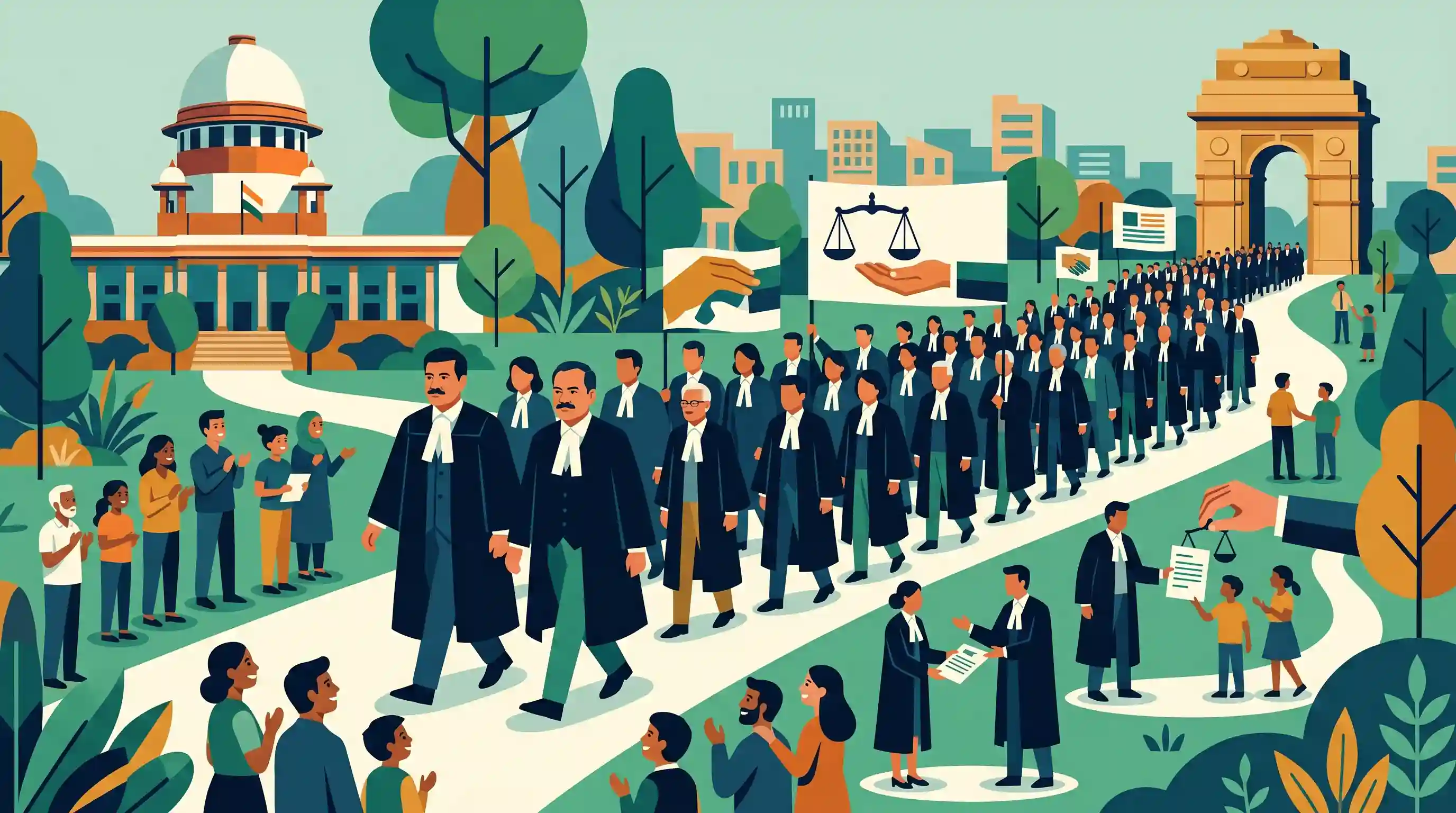
Chief Justice of India B.R. Gavai and Supreme Court Bar Association (SCBA) chief Vikas Singh flagged off a walkathon of lawyers in New Delhi. Themed 'Justice for All,' the event witnessed participation from hundreds of lawyers and senior apex court judges, marching from the Supreme Court to India Gate. The initiative symbolically highlights the legal fraternity's commitment to access to justice and public engagement.
Key Points
- A walkathon themed 'Justice for All' was organized by the Supreme Court Bar Association (SCBA).
- The event was flagged off by Chief Justice of India B.R. Gavai and SCBA President Vikas Singh.
- The march started from the Supreme Court premises and concluded at India Gate in New Delhi.
- Hundreds of lawyers and several senior Supreme Court judges participated, promoting the message of equitable legal access.
Important Terms
Chief Justice of India (CJI)

The highest-ranking officer of the Indian judiciary and head of the Supreme Court. Appointed by the President, the CJI oversees judicial administration and presides over constitutional benches.
UPSC context
GS Paper II: Polity. Covers the appointment, powers (Master of the Roster), and role in the Collegium system.
Supreme Court Bar Association (SCBA)
A voluntary association of lawyers practicing at the Supreme Court of India. It represents the interests of the Bar, manages lawyer welfare, and facilitates public-legal engagement.
UPSC context
GS Paper II: Judiciary. Relevant for understanding the role of legal fraternities in judicial reforms and access to justice.
Supreme Court of India
The apex judicial body in India under Article 124. It acts as the final court of appeal and the guardian of the Constitution with original, appellate, and advisory jurisdiction.
UPSC context
GS Paper II: Constitution and Judiciary. Essential for questions on judicial review, fundamental rights enforcement, and separation of powers.
Access to Justice
The fundamental principle that all individuals, regardless of socio-economic status, should have the ability to seek legal remedies through formal or informal justice mechanisms.
UPSC context
GS Paper II: Social Justice/Polity. Tests knowledge of inclusive governance and constitutional mandates under Articles 14, 21, and 39A.
Legal Aid
Free legal services provided to the poor and marginalized to ensure justice is not denied due to economic disabilities. Mandated by Article 39A and regulated by NALSA.
UPSC context
GS Paper II: Governance/Welfare Schemes. Important for topics on vulnerable sections and the Legal Services Authorities Act, 1987.
Master of the Roster
An administrative power of the Chief Justice of India to constitute benches and allocate cases to different judges of the Supreme Court.
UPSC context
GS Paper II: Judiciary. Frequently tested in the context of judicial transparency and administrative accountability of the CJI.
Prelims Trap
The Chief Justice of India serves as the Executive Chairman of the National Legal Services Authority (NALSA).
The CJI is actually the Patron-in-Chief of NALSA. The second senior-most judge of the Supreme Court serves as its Executive Chairman.
Static Concepts Connected
What are the core constitutional and statutory provisions for Free Legal Aid?
- Article 39A: Added by the 42nd Amendment (1976), it directs the State to provide free legal aid to ensure equal justice based on equal opportunity.
- LSA Act 1987: Enacted to constitute NALSA, organizing Lok Adalats and delivering comprehensive legal services to weaker sections of society.
- Fundamental Rights: The right to free legal aid is implicitly guaranteed as a fundamental right under Article 21 and Article 22(1) of the Constitution.
Who is entitled to free legal services under Section 12 of the LSA Act?
- Marginalized sections: Women, children, members of SC/ST communities, persons with disabilities, and victims of trafficking or mass disasters.
- Custody & Labour: Industrial workmen and individuals currently held in custody, including those in juvenile homes or psychiatric hospitals.
Cross-Topic Patterns
SCBA gender quota & Judiciary
The Supreme Court recently mandated one-third reservation for women in the SCBA executive committee, linking professional legal bodies to the broader push for gender representation in the judiciary.
Access to Justice & Prison Crowding
Symbolic pushes for 'Justice for All' tie directly into systemic prison reforms, where thousands of under-trials languish due to the poor ground-level implementation of statutory legal aid mechanisms.

NALSA's leadership structure and the specific Section 12 eligibility criteria for free legal aid remain highly probable Prelims targets.
Linked PYQs · 3
Linked PYQs · 3
- 2023MainsGS2
Who are entitled to receive free legal aid? Assess the role of the National Legal Services Authority (NALSA) in rendering free legal aid in India.
- 2013PrelimsGS1
With reference to National Legal Services Authority, consider the following statements : 1. Its objective is to provide free and competent legal services to the weaker sections of the society on the basis of equal opportunity. 2. It issues guidelines for the State Legal Services Authorities to implement the legal programmes and schemes throughout the country. Which of the statements given above is/are correct?
- 2020PrelimsGS1
In India, Legal Services Authorities provide free legal services to which of the following type of citizens? 1. Person with an annual income of less than ₹ 1,00,000 2. Transgender with an annual income of less than ₹ 2,00,000 3. Member of Other Backward Classes (OBC) with an annual income of less than ₹ 3,00,000 4. All Senior Citizens Select the correct answer using the code given below:
