National Judicial Policy and ADR needed for judicial reforms
Source:The Hindu ↗
Why It Matters
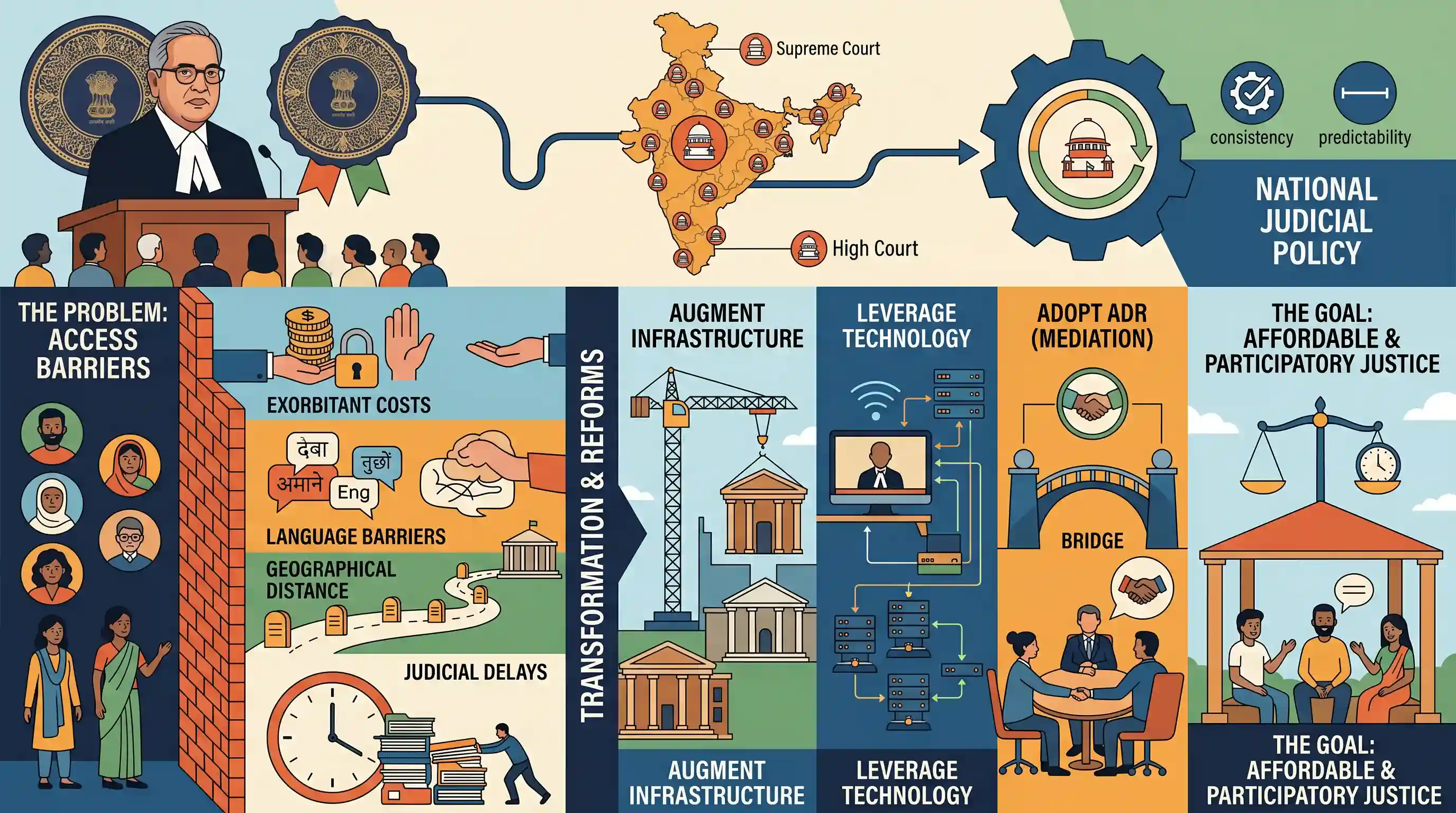
Judicial pendency and inconsistencies in judgments across different High Courts are persistent governance issues. The proposed National Judicial Policy and the emphasis on ADR mechanisms are direct solutions to GS-2 syllabus topics concerning the structure, organization, and functioning of the Judiciary and ensuring equitable access to justice.
Summary
Speaking on Constitution Day, Chief Justice of India Surya Kant advocated for a 'National Judicial Policy' to foster consistency and predictability in rulings across the Supreme Court and the 25 High Courts. Addressing the 'disquieting gap' in access to justice for marginalised communities, the CJI pointed to exorbitant costs, language barriers, geographical distance, and judicial delays as primary hurdles. To resolve these issues, he underscored the urgency of augmenting judicial infrastructure, leveraging technology, and adopting Alternative Dispute Resolution (ADR) mechanisms like mediation to make the justice delivery system more affordable and participatory.
Key Points
- CJI Surya Kant proposed a National Judicial Policy to ensure uniformity and predictability across the Supreme Court and 25 High Courts.
- He highlighted systemic barriers to access to justice for marginalised groups, including exorbitant costs, language barriers, geographical distance, and case delays.
- Bridging the access to justice gap requires augmenting judicial infrastructure and expanding the use of technology to overcome linguistic and geographic hurdles.
- Mediation and other Alternative Dispute Resolution (ADR) mechanisms were emphasized as cost-effective and participatory solutions.
Important Terms
National Judicial Policy

A proposed institutional framework aimed at harmonizing judicial reasoning and administrative standards across India's 25 High Courts and the Supreme Court to ensure predictability.
UPSC context
GS II: Judiciary. Relates to judicial reforms aimed at reducing inconsistency and 'discordant sounds' in legal interpretations.
Access to Justice
The practical ability of all citizens, particularly marginalized sections, to secure legal remedies despite hurdles like exorbitant costs, language barriers, and geographical distance.
UPSC context
GS II: Governance & Social Justice. Tests understanding of structural barriers and the 'disquieting gap' in the legal system.
Alternative Dispute Resolution (ADR)
Non-litigious methods like mediation and arbitration used to settle disputes outside traditional courtrooms, thereby reducing judicial pendency and making justice more participatory.
UPSC context
GS II: Judiciary/Governance. Vital for discussing judicial backlog and cost-effective legal remedies.
Judicial Infrastructure
The collective physical facilities (courtrooms) and digital systems (e-filing, virtual courts) required to support a modern, transparent, and efficient justice delivery system.
UPSC context
GS II: Judiciary. Essential for addressing delays and improving court reach in rural areas.
Article 39A
A Directive Principle of State Policy (DPSP) that mandates the State to provide free legal aid and ensure that justice is not denied by economic reasons.
UPSC context
GS II: Constitution. The constitutional bedrock for 'Access to Justice' and legal aid reforms.
Constitution Day (Samvidhan Divas)
Observed on November 26th to mark the 1949 adoption of the Constitution, serving as a reminder of constitutional values like liberty and equality.
UPSC context
GS II: Indian Constitution. Tests historical milestones and the foundational philosophy of the Indian State.
Prelims Trap
Awards passed by Lok Adalats are binding but can be appealed in higher courts under standard appellate jurisdiction.
Lok Adalat awards are final, binding, and deemed civil court decrees. No appeal lies against them in any court under standard appellate jurisdiction.
Static Concepts Connected
What is the constitutional and statutory basis for Free Legal Aid?
- Article 39A: Added by the 42nd Amendment, it directs the State to provide free legal aid to ensure justice is not denied due to economic or other disabilities.
- NALSA: Constituted under the Legal Services Authorities Act, 1987 to provide free legal services, monitor legal aid programs, and organize Lok Adalats.
- Beneficiaries: Includes women, children, SC/ST members, industrial workmen, victims of human trafficking, and persons below a prescribed income limit.
How do Lok Adalats differ from traditional courts?
- Broad Jurisdiction: They can take up both civil cases and compoundable criminal disputes, either at the pre-litigation stage or those already pending before regular courts.
- Finality of Awards: Awards are deemed as decrees of a civil court. They are completely final and binding on all parties, with no provision for appeal.
- No Court Fee: No court fee is payable. If a pending case is settled in a Lok Adalat, the original fee paid in the regular court is refunded.
Cross-Topic Patterns
E-Courts and AI Language Translation
Overcoming judicial language barriers links directly to AI-driven initiatives like SUVAS (Supreme Court Vidhik Anuvaad Software), which translates apex court judgments into vernacular languages.
ADR and Ease of Doing Business
Judicial pendency deters investment. Commercial Arbitration and Mediation Act reforms are heavily promoted to improve India's contract enforcement metrics and attract foreign direct investment.

A 2026 prelims question will likely test ADR mechanisms, specifically Lok Adalat finality, linked with Article 39A legal aid mandates.
Linked PYQs · 2
Linked PYQs · 2
- 2024MainsGS2
Explain and distinguish between Lok Adalats and Arbitration Tribunals. Whether they entertain civil as well as criminal cases ?
- 2023MainsGS2
Who are entitled to receive free legal aid? Assess the role of the National Legal Services Authority (NALSA) in rendering free legal aid in India.
