Retirement of Justice BR Gavai and Landmark Supreme Court Rulings
Source:The Hindu ↗
Why It Matters
The retirement of a Chief Justice provides an occasion to review landmark judgments that have a lasting impact on constitutional law. CJI Gavai's rulings on the 'creamy layer' for SCs, the unconstitutionality of the Tribunal Reforms Act 2021, and the balancing of environment and development are highly relevant for GS2 (Polity and Social Justice) and GS3 (Environment).
Summary
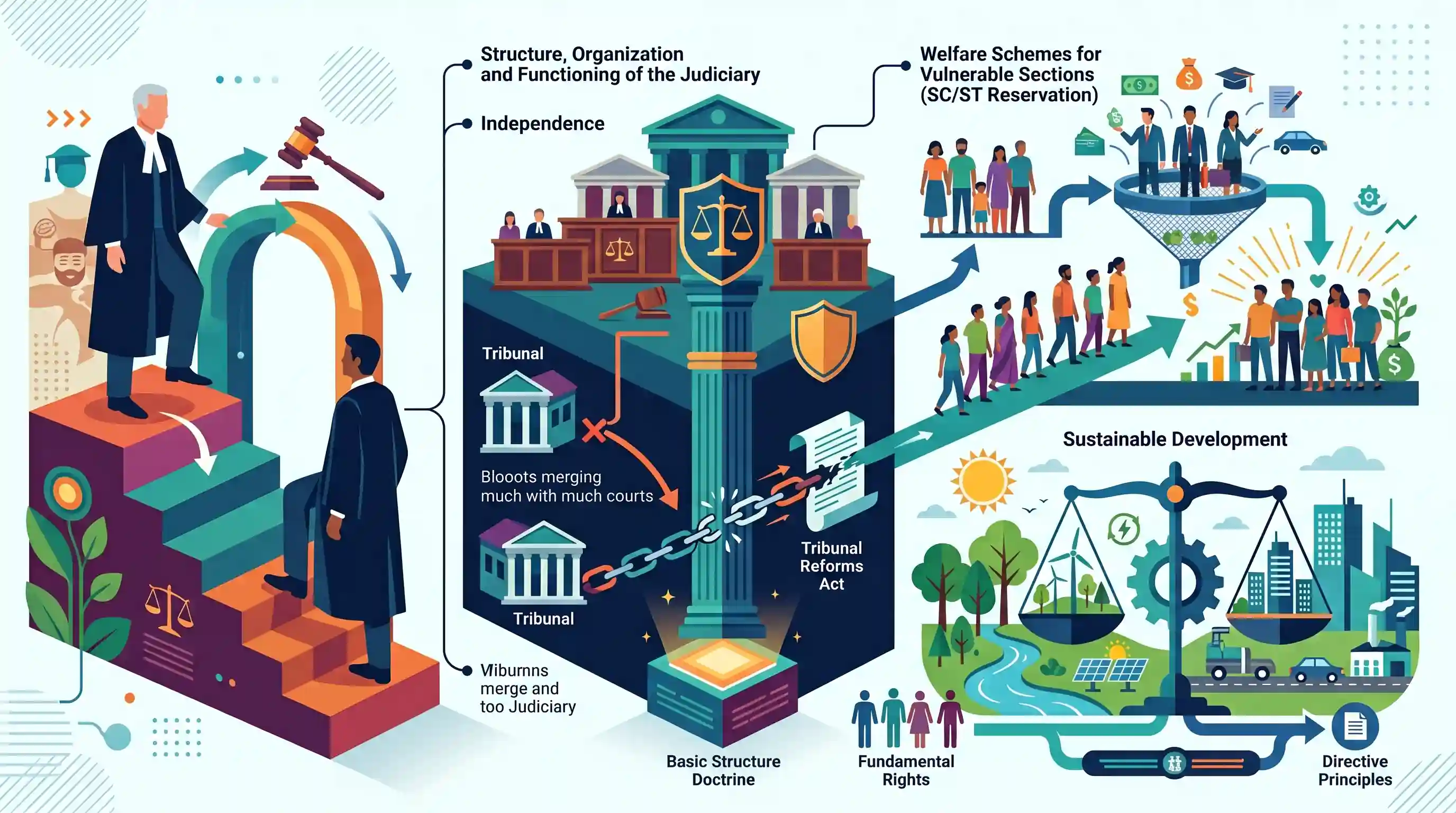
Chief Justice of India B.R. Gavai has retired, concluding a historic tenure as the first Buddhist and second Dalit head of the Indian judiciary. In his farewell address, he reflected on key judgments that shaped his legacy, including the controversial application of the 'creamy layer' concept to Scheduled Castes to ensure equitable distribution of reservation benefits. He also highlighted his firm stance on the independence of the judiciary, notably striking down the Tribunal Reforms Act of 2021 to uphold the basic structure doctrine. Furthermore, Gavai emphasized the need to balance environmental protection with developmental goals by harmonizing Fundamental Rights and Directive Principles. Justice Surya Kant will succeed him as the next CJI.
Key Points
- CJI B.R. Gavai retired from the Supreme Court, marking the end of his tenure as the first Buddhist and second Dalit Chief Justice of India.
- He highlighted his landmark judgment on the application of the 'creamy layer' principle to Scheduled Castes, ensuring reservation benefits reach the truly marginalized.
- Gavai underscored his ruling striking down provisions of the Tribunal Reforms Act of 2021 to protect the independence of the judiciary, which he reiterated as part of the Constitution's basic structure.
- He emphasized the judiciary's role in balancing environmental conservation with economic development, harmonizing Fundamental Rights with Directive Principles of State Policy.
Important Terms
Tribunal Reforms Act, 2021

Legislation enacted to dissolve specific appellate tribunals and standardize service conditions. Key provisions were struck down by the Supreme Court for infringing on judicial independence and the separation of powers.
UPSC context
GS Paper II: Judiciary/Polity; tests knowledge of "legislative override" and the structural independence of quasi-judicial bodies.
Creamy Layer (SC/ST Context)
A socio-economic ceiling used to exclude affluent members of backward classes from reservation benefits. Recent jurisprudence, supported by CJI Gavai, favors extending this concept to Scheduled Castes for equitable benefit distribution.
UPSC context
GS Paper II: Social Justice; focuses on Article 14-16 and the 2024 sub-classification judgment (State of Punjab v. Davinder Singh).
Basic Structure Doctrine
A judicial principle established in the Kesavananda Bharati case (1973) holding that the Parliament cannot amend the fundamental features of the Constitution, such as judicial review and the rule of law.
UPSC context
GS Paper II: Constitution; a core concept for questions on the limits of Parliament’s amending power under Article 368.
National Tribunals Commission (NTC)
A proposed independent umbrella body to oversee the recruitment, administration, and functioning of all tribunals in India, aimed at removing executive influence from the quasi-judicial process.
UPSC context
GS Paper II: Statutory/Quasi-judicial Bodies; relevant for reforms in the justice delivery system and reducing judicial pendency.
Chief Justice of India (CJI)
The head of the Indian judiciary and the Supreme Court. The role includes administrative powers as 'Master of the Roster' and is appointed by the President under Article 124(2).
UPSC context
GS Paper II: Judiciary; covers the appointment process, seniority convention, and the office's Ambedkarite and inclusive representation milestones.
Directive Principles of State Policy (DPSP)
Guidelines found in Part IV (Articles 36-51) that the State is expected to follow to achieve social, economic, and political justice, often balanced against Fundamental Rights in judicial reviews.
UPSC context
GS Paper II: Constitution; tests the 'harmonious construction' between individual liberties (Part III) and collective welfare (Part IV).
Prelims Trap
State legislatures can modify the Presidential list of Scheduled Castes to allow sub-classification.
States can sub-classify existing SC categories to grant preferential quotas, but only Parliament can add or remove castes from the Central list under Article 341.
Static Concepts Connected
How does the Supreme Court protect tribunal independence against legislative override?
- Judicial Review: The power of High Courts to review tribunal decisions is a Basic Structure feature that cannot be ousted (L. Chandra Kumar case).
- Curing Defects: Parliament cannot reenact a struck-down law just to bypass a ruling; it must fundamentally alter the legal basis of the judgment.
- Executive Autonomy: To prevent executive dominance over tribunals, the SC mandated an independent National Tribunals Commission (NTC) for appointments.
How has the 'creamy layer' principle evolved for Scheduled Castes and Tribes?
- Indra Sawhney: The 1992 judgment introduced the creamy layer exclusion solely for OBCs, explicitly exempting SCs and STs.
- Jarnail Singh: A 2018 Supreme Court ruling extended the creamy layer concept to SC/STs specifically in matters of promotion.
- 2024 Expansion: Recent constitutional bench rulings advocate applying the creamy layer exclusion to general SC/ST quotas to ensure equitable distribution of benefits.
Cross-Topic Patterns
Tribunals & Legislative Overrides
The Tribunal Reforms Act clash mirrors the NJAC standoff, showing how separation of powers restricts Parliament from overriding judicial rulings without curing legal defects.
Harmonizing FRs and DPSPs
Judicial balancing of environmental conservation with infrastructure forces courts to harmonize Article 21 (Right to Life) with Article 48A and economic DPSPs.

Expect a 2026 Mains question on limits of 'legislative override' or a Prelims MCQ on state powers for SC sub-classification.
Linked PYQs · 5
Linked PYQs · 5
- 2025MainsGS2
Comment on the need of administrative tribunals as compared to the court system. Assess the impact of the recent tribunal reforms through rationalization of tribunals made in 2021.
- 2023MainsGS2
“Constitutionally guaranteed judicial independence is a prerequisite of democracy.” Comment.
- 2018MainsGS2
How far do you agree with the view that tribunals curtail the jurisdiction of ordinary courts? In view of the above, discuss the constitutional validity and competency of the tribunals in India.
- 2020MainsGS3
Explain intra-generational and inter-generational issues of equity from the perspective of inclusive growth and sustainable development.
- 2018MainsGS2
Whether National Commission for Scheduled Castes (NCSC) can enforce the implementation of constitutional reservation for the Scheduled Castes in the religious minority institutions? Examine.
