Judicial decentralisation and access to justice infrastructure
Source:The Hindu ↗
Why It Matters
The establishment of circuit benches addresses the issue of pendency and physical accessibility in the Indian judicial system. It relates directly to the UPSC Polity syllabus regarding the structure, organization, and functioning of the judiciary, highlighting efforts to decentralize high courts for better administration of justice.
Summary
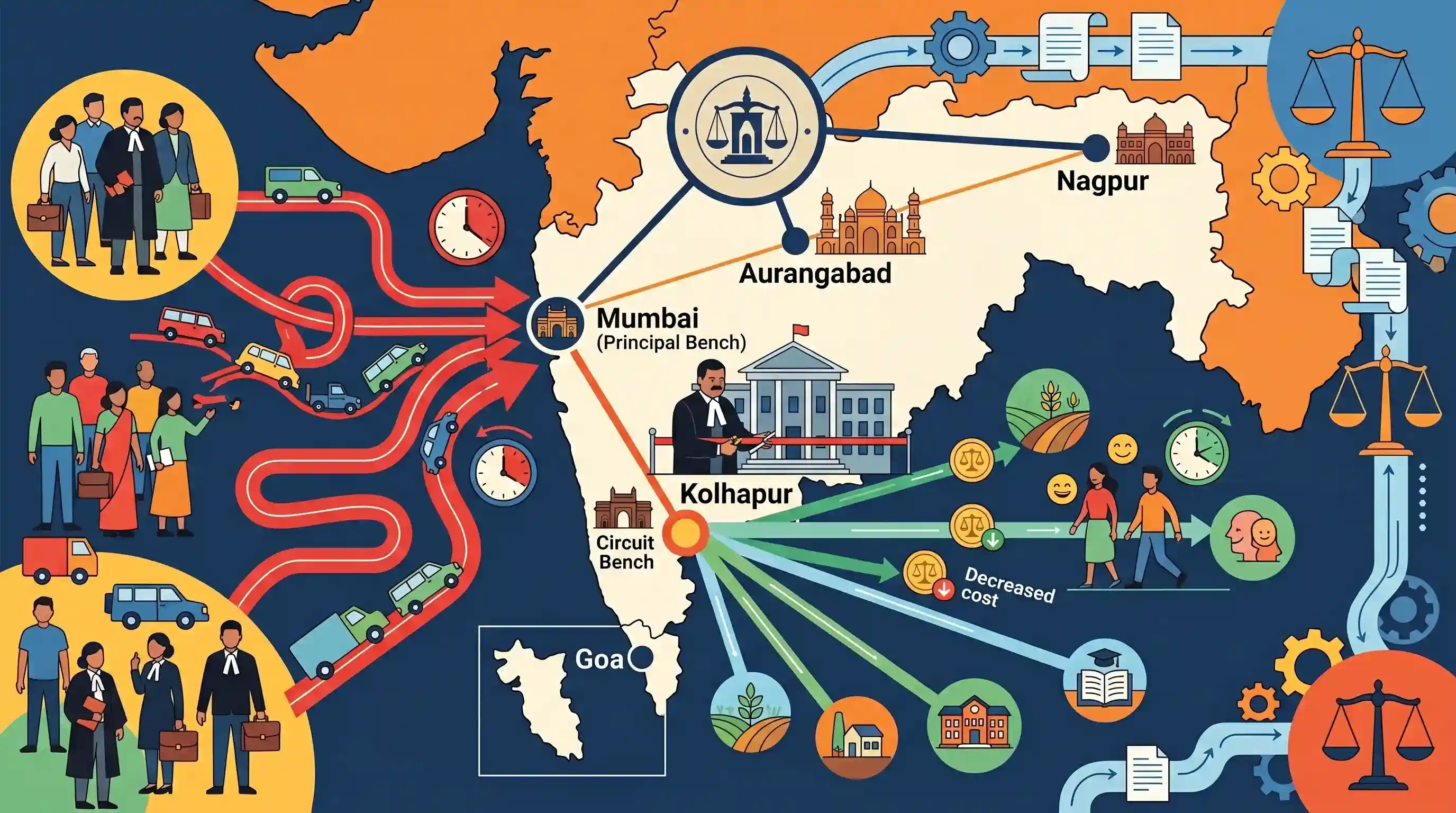
Chief Justice of India B.R. Gavai inaugurated a new circuit bench of the Bombay High Court in Kolhapur, which will serve six districts in Maharashtra. The move is designed to improve access to justice and alleviate the travel burden on litigants and lawyers who previously had to travel to Mumbai. The Bombay High Court currently oversees operations from its principal bench in Mumbai, along with benches in Nagpur, Aurangabad, and Goa. The establishment of decentralized benches represents a crucial element in expanding judicial infrastructure, improving efficiency, and ensuring affordable justice for citizens.
Key Points
- Chief Justice of India B.R. Gavai inaugurated a new circuit bench of the Bombay High Court in Kolhapur, Maharashtra.
- The Kolhapur circuit bench will exercise jurisdiction over six districts: Satara, Sangli, Solapur, Kolhapur, Ratnagiri, and Sindhudurg.
- The move aims to enhance access to justice by saving litigants and lawyers the time, cost, and difficulty of traveling to the principal bench in Mumbai.
- With this addition, the Bombay High Court now operates a principal bench in Mumbai, benches in Nagpur and Aurangabad, a bench in Goa, and the new circuit bench in Kolhapur.
- The bench commenced operations with one division bench and two single benches.
Important Terms
Circuit Bench

A temporary or part-time seat of a High Court established in a location away from its principal bench to hear regional cases, improving convenience for local litigants.
UPSC context
GS-II: Judiciary. Tests knowledge of judicial decentralization, accessibility, and the procedural differences between permanent and temporary benches.
Bombay High Court
Established in 1862, it is one of India's oldest High Courts, exercising jurisdiction over Maharashtra, Goa, and the UT of Dadra and Nagar Haveli and Daman and Diu.
UPSC context
GS-II: Indian Constitution. Important for understanding the 'Chartered High Courts' and the territorial jurisdiction of common High Courts for multiple states.
Judicial Infrastructure
The collective physical facilities (courtrooms, residential units) and digital resources (e-Courts, fiber connectivity) required for the efficient and timely delivery of justice.
UPSC context
GS-II: Issues relating to the Judiciary. Vital for mains answers on 'Pendency of Cases' and the proposed 'National Judicial Infrastructure Corporation (NJIC)'.
Access to Justice
The fundamental principle that legal remedies must be physically reachable, financially affordable, and timely for all citizens, regardless of their social or economic status.
UPSC context
GS-II: Governance and Constitution. A core theme for essays and polity questions regarding the Rule of Law and the effectiveness of the legal system.
Article 39A
A Directive Principle (DPSP) that mandates the State to provide free legal aid and ensure that justice is not denied to any citizen due to economic or other disabilities.
UPSC context
GS-II: Indian Constitution. Frequently tested in Prelims and used as a constitutional basis for judicial reforms and legal aid programs.
Territorial Jurisdiction
The specific geographical area over which a court has the legal authority to hear cases and exercise its powers.
UPSC context
GS-II: Judiciary. Relevant for understanding the distribution of judicial workload and the administrative powers of a High Court Chief Justice.
Prelims Trap
"Circuit benches of a High Court are established by the President of India, similar to the principal and permanent benches."
Permanent benches are created by the President, but circuit benches are established by the High Court's Chief Justice with the Governor's prior approval.
Static Concepts Connected
How are common High Courts established for multiple states?
- Constitutional Provision: Under Article 231 of the Constitution, Parliament may by law establish a common High Court for two or more States and a Union Territory.
- Bombay HC Scope: The Bombay High Court serves as a common high court covering Maharashtra, Goa, and the Union Territory of Dadra and Nagar Haveli and Daman and Diu.
Permanent vs. Circuit Bench of a High Court
- Creation Authority: Permanent benches are created by the President. Circuit benches are established by the HC Chief Justice with the Governor's approval (Section 51, States Reorganisation Act).
- Operational Nature: Permanent benches function year-round with stationed judges. Circuit benches are temporary/itinerant courts holding localized proceedings for specific periods to clear backlogs.
- Concurrent Jurisdiction: Establishing a regional bench does not automatically divest the principal seat (e.g., Mumbai) of its original territorial jurisdiction over those areas.
Cross-Topic Patterns
Article 39A and Access to Justice
Establishing regional benches aligns with the DPSP mandate for equal justice, mirroring the geographic decentralization rationale behind Gram Nyayalayas, Lok Adalats, and e-Courts initiatives.
Administrative Discretion vs. Fundamental Rights
The Supreme Court categorizes the establishment of decentralized benches as an administrative discretion based on case pendency, ruling that litigants cannot demand a local bench as a fundamental right.

Expect a Prelims statement comparing the establishment authority of permanent vs. circuit benches under the States Reorganisation Act.
Linked PYQs · 2
Linked PYQs · 2
- 2008PrelimsGS1
How many High Courts in India have jurisdiction over more than one State (Union Territories not included)?
- 2023MainsGS2
“Constitutionally guaranteed judicial independence is a prerequisite of democracy.” Comment.
