Supreme Court to Review In House Inquiry Process for Judges
Source:The Hindu ↗
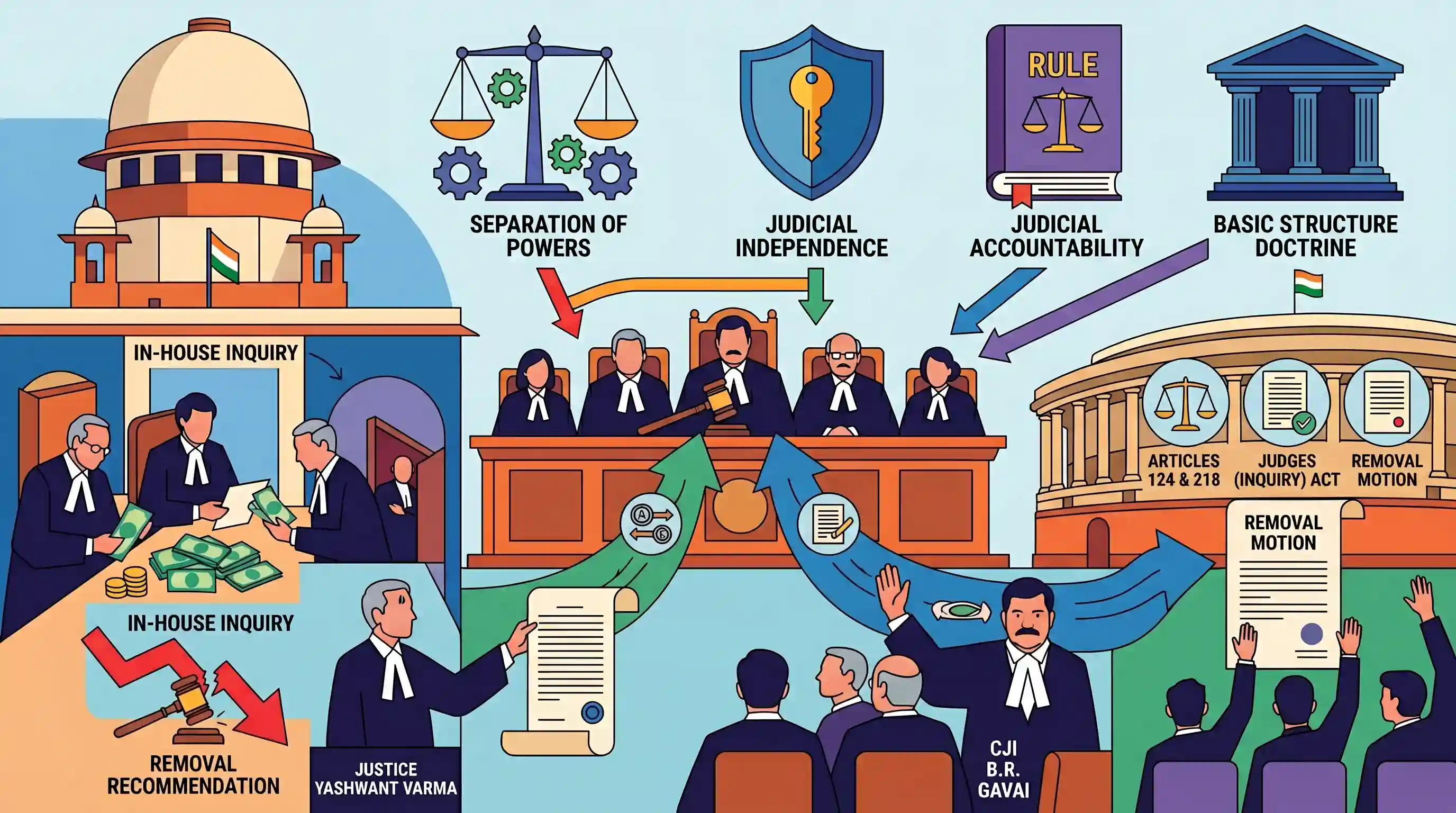
Why It Matters
This development forces a direct constitutional debate on how judges of higher courts are held accountable. It highlights the tension between the judiciary's internal mechanisms (in-house probes) and the formal, rigorous Parliamentary impeachment process laid down in the Constitution, directly touching upon the core UPSC themes of separation of powers and judicial independence.
Summary
The Supreme Court of India is set to examine the constitutional validity of the "in-house inquiry process" used to investigate sitting judges, following a petition filed on behalf of Allahabad High Court judge Justice Yashwant Varma. Former CJI Sanjiv Khanna had recommended Justice Varma's removal after an in-house probe found unaccounted cash at his residence. The petition argues that this internal procedure is a parallel, extra-constitutional mechanism that encroaches upon Parliament's exclusive power to remove judges as mandated by Articles 124 and 218 of the Constitution and the Judges (Inquiry) Act, 1968. It raises significant questions regarding judicial independence, separation of powers, and the Basic Structure doctrine. Meanwhile, a formal removal motion has also been initiated in Parliament, and CJI B.R. Gavai recused himself from the case due to his prior involvement in the consultations.
Key Points
- The Supreme Court agreed to form a Bench to hear a petition challenging the 'in-house inquiry process' used against Allahabad High Court judge Justice Yashwant Varma.
- An in-house inquiry committee found unaccounted cash at Justice Varma's official residence, prompting former CJI Sanjiv Khanna to recommend his removal to the President and PM.
- The petition argues that the in-house mechanism is an extra-constitutional parallel process that unlawfully usurps Parliament's exclusive authority to remove judges under Articles 124 and 218.
- Advocates for the petition contend that subjecting judges to internal probes without statutory backing violates the separation of powers and judicial independence, which are part of the Basic Structure.
- A formal removal motion against the judge has simultaneously been initiated in both the Lok Sabha and Rajya Sabha.
- CJI B.R. Gavai recused himself from hearing the plea because he was part of the internal consultations regarding the matter.
Important Terms
Article 124

Constitutional provision governing the Supreme Court's establishment and the removal of judges by the President on grounds of 'proved misbehaviour' or 'incapacity' following a parliamentary address.
UPSC context
GS Paper II: Essential for understanding judicial accountability, removal procedures, and the independence of the higher judiciary.
Article 218
Constitutional provision that extends the removal procedure applicable to Supreme Court judges (as detailed in Article 124) to the judges of High Courts.
UPSC context
GS Paper II: Tests knowledge of the unified constitutional framework for judicial removals across higher courts.
Judges (Inquiry) Act, 1968
Statutory law that regulates the procedure for investigating allegations of misbehaviour or incapacity against judges and the subsequent presentation of an address to the President for removal.
UPSC context
GS Paper II: Key statutory mechanism operationalizing constitutional removal provisions; frequent topic regarding judicial reforms.
In-House Procedure
An internal peer-review mechanism adopted by the Supreme Court in 1999 to examine complaints against judges, acting as a precursor to formal removal proceedings.
UPSC context
GS Paper II: Relates to judicial transparency, accountability, and the debate over extra-constitutional vs. statutory mechanisms.
Separation of Powers
The constitutional principle that the executive, legislature, and judiciary have distinct functions and should not encroach upon each other’s powers.
UPSC context
GS Paper II: Fundamental concept often tested in the context of judicial appointments and removal disputes.
Basic Structure Doctrine
A judicial doctrine holding that certain core features of the Constitution, such as judicial independence, are beyond the amending power of Parliament.
UPSC context
GS Paper II: Critical for analyzing the limits of legislative power and the preservation of judicial independence.
Prelims Trap
"The In-House Procedure for judges is mandated by the Judges (Inquiry) Act, 1968."
The In-House Procedure is an internal mechanism created by a 1999 SC resolution. It lacks explicit statutory or constitutional backing, unlike formal impeachment.
Static Concepts Connected
What is the constitutional procedure for removing a High Court or Supreme Court Judge?
- Constitutional Grounds: Articles 124(4) and 218 restrict the removal of SC/HC judges strictly to the grounds of "proved misbehaviour or incapacity."
- Parliamentary Approval: Removal requires an address by both Houses of Parliament passed by a special majority in the same session.
- Statutory Framework: The Judges (Inquiry) Act, 1968, governs the actual investigation and proof of the judge's misbehaviour during the parliamentary process.
What is the 'In-House Procedure' adopted by the Supreme Court?
- Origin: Adopted via a 1999 Supreme Court resolution as a peer-review mechanism to investigate complaints against sitting higher judiciary judges.
- Legal Status: It operates without formal statutory or constitutional backing, leading to debates over its validity vis-a-vis Parliament's impeachment powers.
- Actionable Outcomes: The inquiry committee can recommend the CJI to ask the judge to resign or advise the executive to initiate removal.
Cross-Topic Patterns
Basic Structure vs. Internal Regulation
The tension between judicial self-regulation (In-House mechanism) and legislative oversight (impeachment) directly tests the Separation of Powers, a core element of the Basic Structure doctrine.
Judicial Recusal Conventions
CJI Gavai’s recusal highlights India’s uncodified, convention-driven judicial recusal practices, which are governed by principles of natural justice rather than explicit statutory rules.

A Prelims question contrasting the statutory Judges (Inquiry) Act 1968 with the non-statutory 1999 In-House Procedure is highly likely.
Linked PYQs · 3
Linked PYQs · 3
- 2019PrelimsGS1
Consider the following statements: 1. The motion to impeach a Judge of the Supreme Court of India cannot be rejected by the Speaker of the Lok Sabha as per the Judges (Inquiry) Act, 1968. 2. The Constitution of India defines and gives details of what constitutes 'incapacity and proved misbehaviour' of the Judges of the Supreme Court of India. 3. The details of the process of impeachment of the Judges of the Supreme Court of India are given in the Judges (Inquiry) Act, 1968. 4. If the motion for the impeachment of a Judge is taken up for voting, the law requires the motion to be backed by each House of the Parliament and supported by a majority of total membership of that House and by not less than two-thirds of total members of that House present and voting. Which of the statements given above is/are correct?
- 2023MainsGS2
“Constitutionally guaranteed judicial independence is a prerequisite of democracy.” Comment.
- 2020MainsGS2
Judicial Legislation is antithetical to the doctrine of separation of powers as envisaged in the Indian Constitution. In this context justify the filing of large number of public interest petitions praying for issuing guidelines to executive authorities.
