Civil Society Concerns Over Digital Censorship and IT Rules
Source:The Hindu ↗
Why It Matters
The debate over the proposed amendments to the IT Rules, 2021 highlights the ongoing tension between state regulation of digital spaces (often justified by security or misinformation concerns) and the protection of fundamental rights like freedom of speech and expression under Article 19. It also underscores the critical role of civil society organizations in advocating for digital rights and ensuring democratic accountability in the face of executive overreach.
Summary
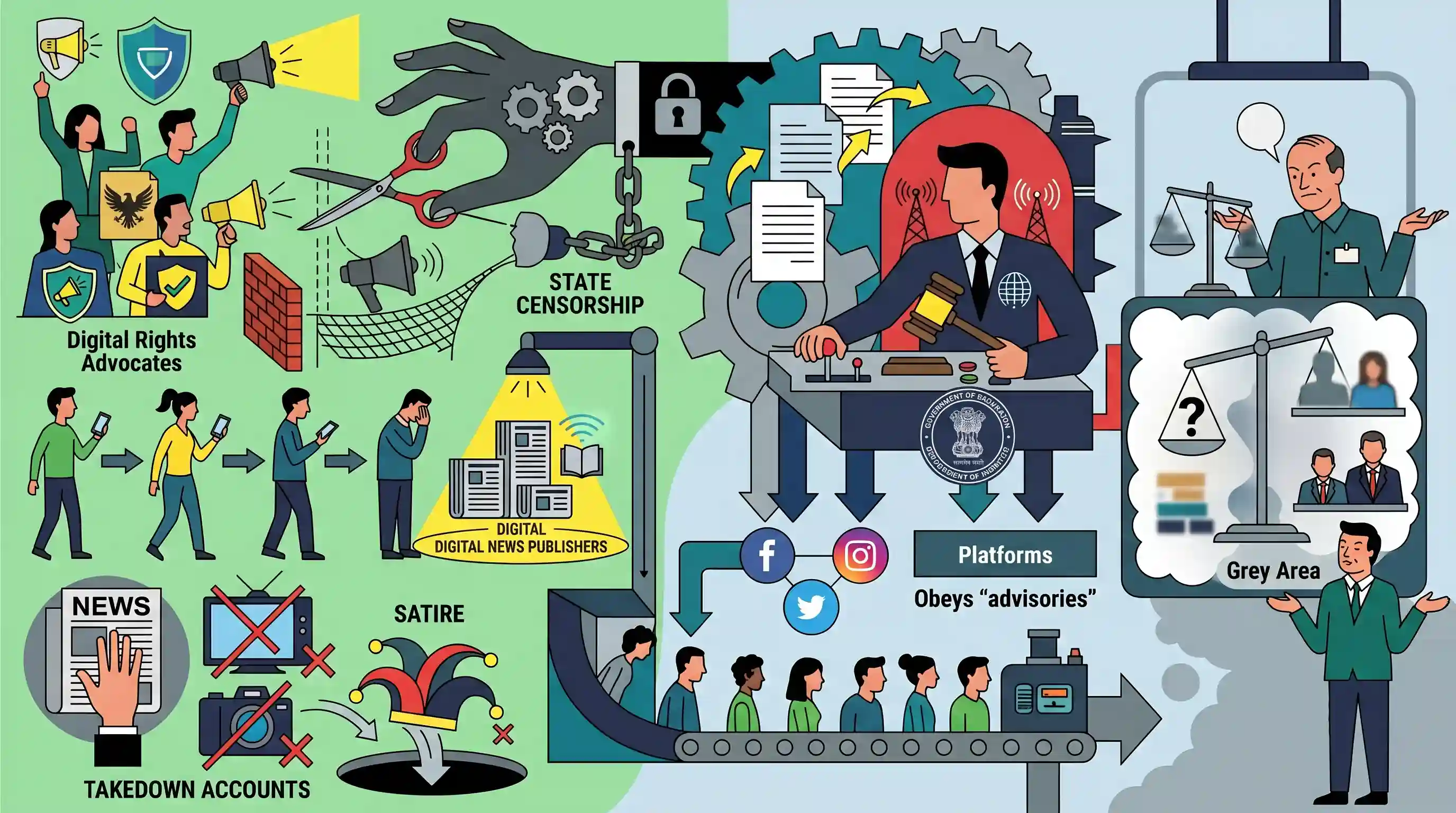
Civil society organizations and digital rights advocates have raised alarms over proposed amendments to the Information Technology Rules, 2021, warning of escalating state censorship. The draft rules aim to empower the Ministry of Information and Broadcasting (MIB) to regulate individual social media users similarly to digital news publishers and mandate platforms to follow IT Ministry "advisories." Groups like the Internet Freedom Foundation (IFF) and MediaNama argue this creates a framework for mass censorship, pointing to recent government takedowns of independent media and satirical accounts. Meanwhile, government officials downplayed the concerns, citing a "grey area" between regular users and dedicated commentators.
Key Points
- Civil society groups strongly opposed proposed amendments to the IT Rules, 2021, warning that they create an infrastructure for mass censorship.
- The draft rules would grant the Ministry of Information and Broadcasting (MIB) powers to regulate individual social media users as news publishers.
- The amendments would also mandate social media platforms to comply with ad-hoc "advisories" issued by the IT Ministry.
- Advocacy groups pointed to recent arbitrary takedowns of independent news outlets, satirical accounts, and anti-establishment content as evidence of growing censorship.
- The IT Secretary dismissed these concerns, stating there is a "grey area" between ordinary users and current affairs commentators, and downplayed the impact of who issues takedown notices.
Important Terms
IT Rules, 2021

Secondary legislation under the IT Act, 2000, regulating social media intermediaries, OTT platforms, and digital news through mandatory due diligence and a three-tier grievance redressal mechanism.
UPSC context
GS Paper 2/3: Governance and Internal Security; tests understanding of regulatory frameworks for digital media and fundamental rights.
Ministry of Electronics and Information Technology (MeitY)
The nodal Union ministry for digital infrastructure and internet governance; it administers Part II of the IT Rules regarding intermediary due diligence and platform compliance.
UPSC context
GS Paper 2: Statutory and Executive bodies; tests knowledge of jurisdictional roles in digital regulation.
Ministry of Information and Broadcasting (MIB)
The Union ministry responsible for regulating broadcasting and digital media; it oversees the 'Code of Ethics' for digital news and OTT platforms under Part III.
UPSC context
GS Paper 2: Government policies; relevant for debates on digital censorship and media freedom.
Internet Freedom Foundation (IFF)
An Indian digital rights NGO advocating for online liberty, privacy, and net neutrality; it represents civil society in legal and policy challenges against state surveillance.
UPSC context
GS Paper 2: Role of Civil Society; tests the function of pressure groups in upholding constitutional values.
Safe Harbour Provision
Legal immunity under Section 79 of the IT Act protecting platforms from liability for third-party content, provided they comply with government-mandated due diligence.
UPSC context
GS Paper 3: IT and Communication; tests knowledge of legal protections and responsibilities of tech intermediaries.
Section 69A of the IT Act
A legal provision empowering the Central Government to block public access to online information in the interest of national sovereignty, security, or public order.
UPSC context
GS Paper 2: Constitution and Polity; critical for understanding 'reasonable restrictions' on freedom of speech.
Prelims Trap
The Ministry of Electronics and IT (MeitY) exclusively regulates digital news publishers and OTT platforms under the IT Rules 2021.
Regulatory power under the IT Rules 2021 is bifurcated. MeitY regulates social media intermediaries, while the Ministry of Information and Broadcasting (MIB) oversees digital news and OTT platforms.
Static Concepts Connected
What is the 'Safe Harbour' protection under the Information Technology Act?
- Section 79 immunity: Section 79 grants social media platforms and ISPs immunity from legal liability for third-party user-generated content hosted on their networks.
- Conditional protection: Immunity applies only if platforms act as mere conduits and strictly observe due diligence guidelines mandated by the Central Government.
- Loss of immunity: Platforms lose this protection if they fail to expeditiously remove unlawful content upon receiving a valid government order or court directive.
How did the Shreya Singhal v. Union of India (2015) judgment shape digital speech?
- Section 66A struck down: The Supreme Court invalidated Section 66A of the IT Act for being overbroad, vague, and causing a 'chilling effect' on free speech.
- Section 69A upheld: The Court upheld the government's power to block websites under Section 69A because it contains procedural safeguards like committee reviews and written reasons.
- Advocacy vs. Incitement: The ruling differentiated between advocacy and incitement, protecting offensive speech unless it directly incites imminent violence or public disorder.
Cross-Topic Patterns
Delegated Legislation vs. Free Speech
IT Rules represent executive rule-making. Mains questions frequently test whether such rules bypass parliamentary scrutiny to arbitrarily curb Article 19(1)(a) freedoms without passing the Article 19(2) necessity test.
Role of CSOs in Digital Rights
Links GS2 Governance (role of NGOs/CSOs) with Constitutional rights, highlighting how groups like IFF use strategic litigation (PILs) to act as checks against digital mass surveillance and censorship.

Expect a 2026 Prelims question mapping regulatory domains (MeitY vs MIB) to platform types, combined with Section 69A blocking provisions.
Linked PYQs · 5
Linked PYQs · 5
- 2024MainsGS3
Social media and encrypting messaging services pose a serious security challenge. What measures have been adopted at various levels to address the security implications of social media? Also suggest any other remedies to address the problem.
- 2016MainsGS3
Use of Internet and social media by non-state actors for subversive activities is a major security concern. How have these been misused in the recent past? Suggest effective guidelines to curb the above threat.
- 2014MainsGS2
What do you understand by the concept "freedom of speech and expression"? Does it cover hate speech also ? Why do the films in India stand on a slightly different plane from other forms of expression ? Discuss.
- 2025MainsGS2
Civil Society Organizations are often perceived as being anti-State actors than non-State actors. Do you agree? Justify.
- 2021MainsGS2
Can Civil Society and Non-Governmental Organizations present an alternative model of public service delivery to benefit the common citizen? Discuss the challenges of this alternative model.
