Civil Services Preliminary Examination Pattern and Reforms
Source:The Hindu ↗
Why It Matters
Understanding the evolving pattern of the UPSC examination is crucial as it reflects the changing expectations from future administrators and highlights the need for continuous reforms in civil services recruitment to ensure that the best-suited candidates are selected for nation-building.
Summary
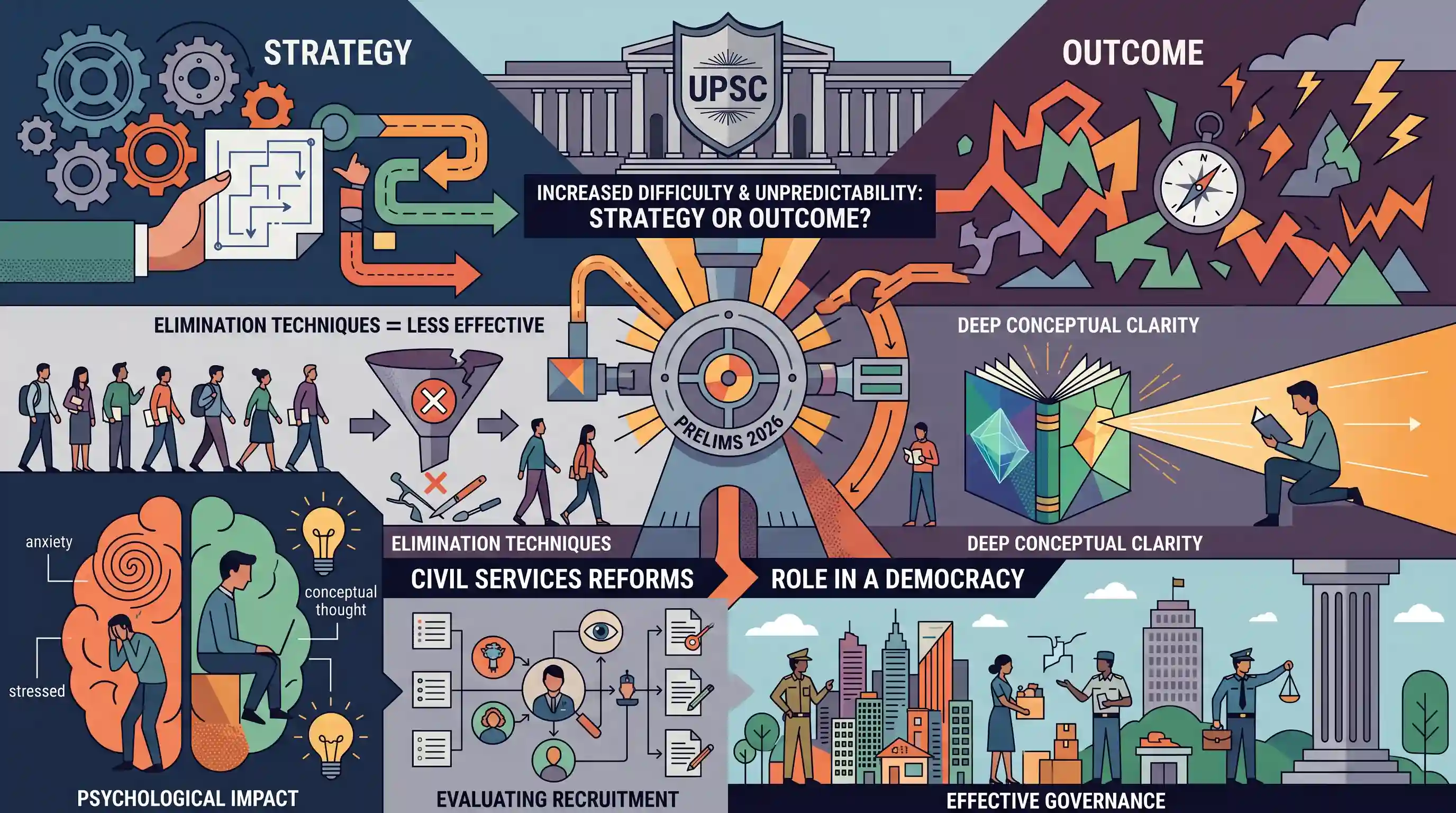
The article analyzes the Civil Services Preliminary Examination 2026, exploring whether its increased difficulty and unpredictability are deliberate strategies by the UPSC or accidental outcomes. It discusses the changing nature of the exam, where traditional elimination techniques are becoming less effective, thereby forcing aspirants to rely on deep conceptual clarity. The piece also raises questions about the psychological impact on candidates and the broader need for evaluating how civil servants are recruited to ensure effective governance.
Key Points
- Evaluates the unpredictability and heightened difficulty level of the UPSC Civil Services Preliminary Examination 2026.
- Debates whether the toughness of the exam is a deliberate structural shift ('by design') or an unintentional consequence of the question-setting process ('by default').
- Highlights the diminishing effectiveness of traditional test-taking strategies like elimination techniques, necessitating a shift towards deeper conceptual understanding.
- Touches upon the broader implications of the evolving examination pattern on civil services recruitment and the mental health of aspirants.
Important Terms
Union Public Service Commission (UPSC)

India’s central recruiting agency, established under Articles 315-323 of the Constitution. It conducts the Civil Services Examination (CSE) to recruit for prestigious services like IAS, IPS, and IFS.
UPSC context
GS Paper II (Governance) & Statutory/Constitutional Bodies. Tests understanding of independent institutions maintaining the meritocratic 'steel frame' of India.
Preliminary Examination
The first stage of the CSE, comprising two objective-type papers. It serves as a qualifying screening test to filter candidates for the Mains examination.
UPSC context
Relevant to the CSE cycle. Recent trends show a shift from factual to analytical testing, challenging traditional preparation methods.
Civil Services Aptitude Test (CSAT)
Qualifying Paper-II of the Preliminary exam, testing logical reasoning, numeracy, and comprehension. Candidates must score at least 33% to advance to the Mains stage.
UPSC context
GS Paper II (Prelims). Its increasing difficulty sparked debates on fairness and the urban-rural divide in civil service recruitment.
Conceptual Clarity
A deep understanding of the 'why' and 'how' behind subjects, rather than rote memorization. It is now essential for answering UPSC’s application-oriented and statement-based questions.
UPSC context
Core preparation strategy for all stages. Tests analytical depth and the ability to apply static knowledge to dynamic current affairs.
Elimination Techniques
Logical reasoning strategies used in MCQs to discard incorrect options. UPSC has recently countered these by introducing 'Only one/two/three' options and paired formats.
UPSC context
Prelims Strategy. Reflects the cat-and-mouse game between the examiner and candidates, testing adaptability and logical reduction under pressure.
Civil Services Reforms
Structural changes in recruitment, training, and management of bureaucrats (e.g., Mission Karmayogi). These aim to transform civil servants from 'rule-based' to 'role-based' professionals.
UPSC context
GS Paper II (Governance). Essential for understanding how the recruitment process evolves to meet 21st-century administrative challenges.
Prelims Trap
"The recommendations made by the UPSC for civil service appointments are binding on the Union Government."
UPSC is essentially an advisory body. Its recommendations are not binding, though the government must present a memorandum to Parliament explaining any reasons for non-acceptance.
Static Concepts Connected
How does the Constitution safeguard the independence of the UPSC?
- Security of tenure: The Chairman and members can only be removed by the President for misbehaviour after an inquiry by the Supreme Court.
- Charged expenditure: The entire expense of the UPSC, including salaries and pensions, is charged on the Consolidated Fund of India and is not subject to a parliamentary vote.
- Post-retirement restrictions: The Chairman is ineligible for further government employment after retirement, preventing conflicts of interest and ensuring impartial functioning.
What were the major landmarks in Indian Civil Services reform committees?
- Kothari Committee (1976): Recommended the foundational three-stage examination process (Preliminary, Main, and Interview) that structurally defined modern civil services recruitment.
- Hota Committee (2004): Advocated for the introduction of aptitude and leadership tests for selection, emphasizing modern competencies over rote memorization.
- Baswan Committee (2016): Suggested reducing the upper age limit and the number of attempts to catch candidates young and adaptable to administrative training.
Cross-Topic Patterns
Recruitment meets Mission Karmayogi
The shift towards testing deeper competencies in recruitment directly aligns with Mission Karmayogi's post-selection mandate to transform India's bureaucracy from a 'rule-based' to a 'role-based' system.
Hyper-competition and mental health governance
The psychological toll of unpredictable hyper-competitive exams connects to GS2 social justice debates regarding youth mental health, structural education flaws, and the National Suicide Prevention Strategy.

Expect a GS2 Mains question linking pre-recruitment UPSC pattern shifts with post-recruitment capacity building like Mission Karmayogi.
Linked PYQs · 2
Linked PYQs · 2
- 2020MainsGS2
Institutional quality is a crucial driver of economic performance". In this context suggest reforms in Civil Service for strengthening democracy.
- 2024MainsGS2
The Doctrine of Democratic Governance makes it necessary that the public perception of the integrity and commitment of civil servants becomes absolutely positive. Discuss.
