Citizenship Amendment Act implementation for cross-border refugees
Source:uni-india ↗
Why It Matters
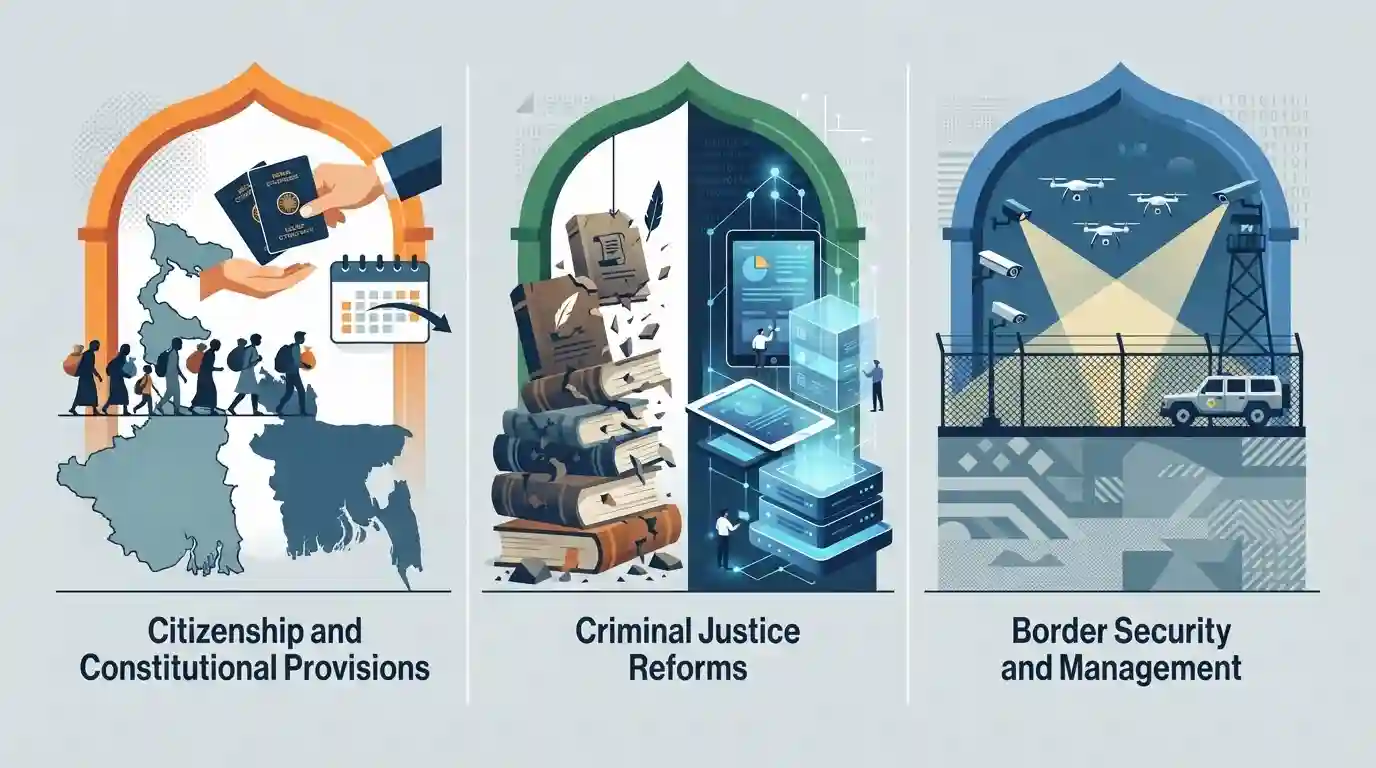
The operationalization of the CAA shapes the demographic and electoral dynamics of border states like West Bengal, while the introduction of the new criminal laws marks a historic overhaul of India's criminal justice system, shifting from colonial paradigms to technology-driven modern frameworks.
Summary
Union Home Minister Amit Shah announced that refugees from Bangladesh residing in West Bengal will be granted Indian citizenship within six months under the Citizenship Amendment Act (CAA). The announcement was made during the inauguration of an exhibition on India's three new criminal laws, which aim to modernize the justice system by replacing colonial-era statutes with frameworks emphasizing technology and transparency. Shah also highlighted concerns over demographic shifts caused by illegal immigration across the Indo-Bangladesh border, framing it as a critical national security issue.
Key Points
- Union Home Minister Amit Shah stated that eligible refugees of Bangladesh origin in West Bengal will receive Indian citizenship under the CAA within six months.
- Shah inaugurated an exhibition detailing the transition to the new criminal justice system that replaces the Indian Penal Code, CrPC, and the Indian Evidence Act.
- The new criminal laws—Bharatiya Nyaya Sanhita, Bharatiya Nagarik Suraksha Sanhita, and Bharatiya Sakshya Adhiniyam—are grounded in technology, transparency, and strict timelines.
- The Union government emphasized that demographic changes caused by infiltration across international borders pose a significant challenge to national security.
Important Terms
Citizenship Amendment Act (CAA)

A 2019 law providing an expedited path to Indian citizenship for persecuted religious minorities (excluding Muslims) from Pakistan, Bangladesh, and Afghanistan who entered India before December 31, 2014.
UPSC context
WBCS Paper V (Constitution); tests understanding of citizenship laws, constitutional provisions, and contemporary socio-political issues.
Bharatiya Nyaya Sanhita (BNS)
India's new primary criminal code, effective July 2024. It replaces the colonial-era Indian Penal Code (IPC) of 1860, modernizing the definitions of criminal offenses and their respective punishments.
UPSC context
WBCS Paper V (Constitution) and Paper IV; tests awareness of major legislative and criminal justice reforms in India.
Bharatiya Nagarik Suraksha Sanhita (BNSS)
The updated procedural criminal law in India, effective July 2024, replacing the Code of Criminal Procedure (CrPC) 1973. It governs the entire process from FIR filing and investigations to trials.
UPSC context
WBCS Paper V (Constitution); tests knowledge of the administrative and procedural framework of India's modernized legal system.
Bharatiya Sakshya Adhiniyam (BSA)
India's modern law on evidence, replacing the Indian Evidence Act of 1872. Implemented in July 2024, it establishes rules for admitting evidence in courts, with a strong focus on digital records.
UPSC context
WBCS Paper V (Constitution) and Paper IV; tests understanding of judicial reforms and the integration of technology in law.
Border Security Force (BSF)
India's primary border-guarding force responsible for securing the international boundaries with Pakistan and Bangladesh. It prevents illegal immigration, cross-border smuggling, and manages border security during peacetime.
UPSC context
WBCS Paper IV (Current Affairs/GK); tests knowledge of internal security, border management, and demographic challenges in border states.
Prelims Trap
"CAA 2019 grants Indian citizenship to all persecuted religious minorities from India's neighboring countries."
CAA applies only to 6 specific minority groups from 3 specific countries (Pakistan, Bangladesh, Afghanistan) who entered by Dec 31, 2014. It is not a universal refugee law.
Static Concepts Connected
How does the Indian Constitution govern the framework of citizenship?
- Part II (Articles 5-11): Deals with citizenship at the commencement of the Constitution, establishing a single Indian citizenship.
- Article 11: Empowers the Parliament to regulate the right of citizenship by law, which led to the Citizenship Act, 1955.
- Executing Authority: The Ministry of Home Affairs regulates citizenship acquisition (birth, descent, registration, naturalization, incorporation of territory).
What are the three new criminal justice statutes and the laws they replace?
- Bharatiya Nyaya Sanhita (BNS): Replaces the Indian Penal Code (IPC) of 1860, updating substantive criminal offenses and adding provisions for organized crime.
- Bharatiya Nagarik Suraksha Sanhita: Replaces the Code of Criminal Procedure (CrPC) of 1973, bringing technological integration and timelines to investigations.
- Bharatiya Sakshya Adhiniyam: Replaces the Indian Evidence Act of 1872, expanding the scope and admissibility of electronic and digital records.
Cross-Topic Patterns
CAA & Border Management Challenges
The implementation of CAA is intimately linked with internal security challenges, specifically demographic shifts and illegal immigration across the porous Indo-Bangladesh border.
Digital Evidence & Cyber Security
The new Bharatiya Sakshya Adhiniyam (replacing the Evidence Act) modernizes digital evidence admissibility, directly linking criminal justice reform to India's expanding cybercrime and e-governance landscape.

Expect a multi-statement Polity question testing the specific cut-off date of CAA alongside the exact colonial codes replaced by BNS/BNSS.
Linked PYQs · 2
Linked PYQs · 2
- 2016WBCS_PRELIMSGS1
Which part of the Constitution deals with citizenship ?
- 2015WBCS_PRELIMSGS1
West Bengal has international boundaries on
