Supreme Court Guidelines on Citizenship and Due Process
Source:Indian Express ↗
Why It Matters
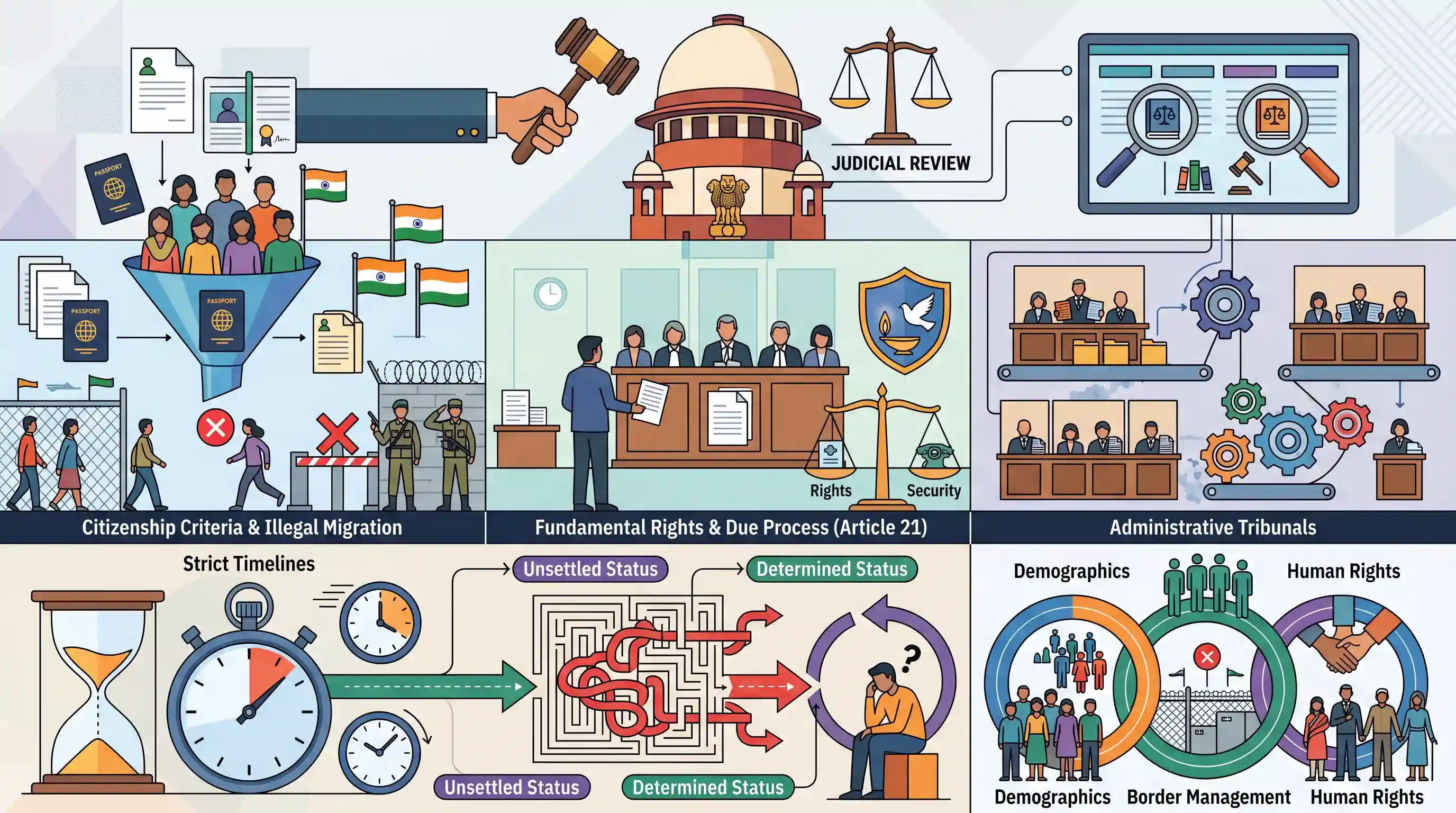
Determining citizenship and managing undocumented migrants is a critical constitutional and internal security challenge. The Supreme Court's emphasis on 'due process' establishes that even administrative or quasi-judicial actions (such as those by Foreigners Tribunals) are firmly bound by fundamental constitutional safeguards, which is essential for aspirants analyzing governance, human rights, and internal security.
Summary
The Supreme Court has mandated three pivotal issues—citizenship criteria, due process, and strict timelines—for a commission probing matters related to citizenship and illegal immigration. Highlighting the balance between national security and constitutional rights, the apex court insisted that the legal determination of an individual's citizenship status must strictly adhere to the principles of natural justice and constitutional safeguards (such as Article 21). Furthermore, establishing clear timelines is deemed essential for resolving the status of suspected migrants without subjecting them to indefinite administrative delays. The judgment underscores the complex interplay between demographic stability, border management, and human rights in India's ongoing citizenship debates.
Key Points
- The Supreme Court has delineated three core areas—citizenship determination, due process of law, and strict timelines—for the commission examining matters related to citizenship.
- Accurate identification of citizens versus undocumented migrants remains a complex challenge requiring adherence to statutory frameworks and historical accords.
- The court emphasized that quasi-judicial mechanisms (like tribunals) must ensure procedural fairness and abide by the principles of natural justice and Article 21.
- Time-bound resolution is crucial to mitigate administrative limbo, prevent protracted statelessness, and address demographic and internal security concerns in border areas.
Important Terms
Citizenship Act, 1955

The 1955 statute providing the primary legal framework for the acquisition, determination, and termination of Indian citizenship, recently central to debates over Section 6A and the CAA.
UPSC context
GS Paper II: Essential for understanding Constitutional provisions (Articles 5-11) and legislative powers concerning national identity and migration.
Assam Accord
The 1985 tripartite Memorandum of Settlement that ended the Assam Agitation and introduced Section 6A to the Citizenship Act, establishing specific cut-off dates for citizenship in Assam.
UPSC context
GS Paper II & III: Critical for issues of federalism, ethnic identity, internal security, and border management.
Foreigners Tribunals (FTs)
Quasi-judicial bodies established under the Foreigners (Tribunals) Order, 1964, to determine whether a person is a foreigner. They are currently operational primarily in Assam.
UPSC context
GS Paper II: Relevant for quasi-judicial mechanisms, administrative law, and protection of individual rights against arbitrary state action.
Election Commission of India (ECI)
A constitutional body under Article 324 empowered to manage electoral rolls; recently scrutinized by the SC regarding its authority to verify citizenship during voter list revisions.
UPSC context
GS Paper II: Core topic on Constitutional Bodies and the integrity of the democratic electoral process.
Due Process of Law
A fundamental legal requirement that the state must respect all legal rights owed to a person, ensuring fairness and transparency before depriving them of life or liberty (Article 21).
UPSC context
GS Paper II: Central to Fundamental Rights and Judicial Review; tests understanding of procedural vs. substantive justice.
Special Intensive Revision (SIR)
An exhaustive door-to-door enumeration process to rebuild electoral rolls from scratch, conducted when existing lists are deemed highly inaccurate or outdated.
UPSC context
GS Paper II: Relevant for election management and the administrative hurdles in maintaining accurate democratic records.
Prelims Trap
Fundamental rights under Article 21 are exclusively available to Indian citizens, meaning illegal migrants lack due process protections.
Article 21 applies to all persons—citizens and aliens alike. Only specific rights like Articles 15, 16, 19, 29, and 30 are restricted solely to citizens.
Static Concepts Connected
Which Fundamental Rights distinguish citizens from non-citizens?
- Exclusive to citizens: Articles 15, 16, 19, 29, and 30 (e.g., non-discrimination, public employment, freedom of speech/movement/residence).
- Available to all: Articles 14, 20, 21, 21A, 22-28 (e.g., equality before law, protection of life and personal liberty, religious freedom).
What is the legal basis of Foreigners Tribunals in India?
- Statutory backing: Constituted via the Foreigners (Tribunals) Order, 1964, deriving authority from the Foreigners Act, 1946.
- Burden of proof: Section 9 of the 1946 Act uniquely places the burden of proving Indian citizenship squarely on the accused individual, not the State.
- Procedural nature: They are quasi-judicial bodies bound by the principles of natural justice (audi alteram partem), rather than the strict procedural rules of the Indian Evidence Act.
Cross-Topic Patterns
Border demographics & Article 21
The GS-3 challenge of illegal trans-border migration must be balanced against GS-2 constitutional protections, as indefinite detention of suspected migrants violates 'due process' under Article 21.
Statelessness vs. Refugee policy
Since India is not a signatory to the 1951 Refugee Convention, local tribunals and the Citizenship Act carry the entire burden of managing undocumented migrations without a dedicated asylum framework.

Expect a mixed GS-2/GS-3 question linking Article 21 rights of foreigners with the demographic & security challenges of border migration.
Linked PYQs · 3
Linked PYQs · 3
- 2014MainsGS3
How does illegal transborder migration pose a threat to India's security? Discuss the strategies to curb this, bringing out the factors which give impetus to such migration.
- 2025MainsGS2
Comment on the need of administrative tribunals as compared to the court system. Assess the impact of the recent tribunal reforms through rationalization of tribunals made in 2021.
- 2022MainsGS2
“Right of movement and residence throughout the territory of India are freely available to the Indian citizens, but these rights are not absolute.” Comment.
