Citizens demand stricter Western Ghats ecological safeguards
Source:timesofindia-indiatimes ↗
Why It Matters
The Western Ghats Ecologically Sensitive Area draft is a critical policy issue regarding environmental conservation, sustainable development, and biodiversity protection in western and southern India, making it vital for MPSC environmental geography and governance questions.
Summary
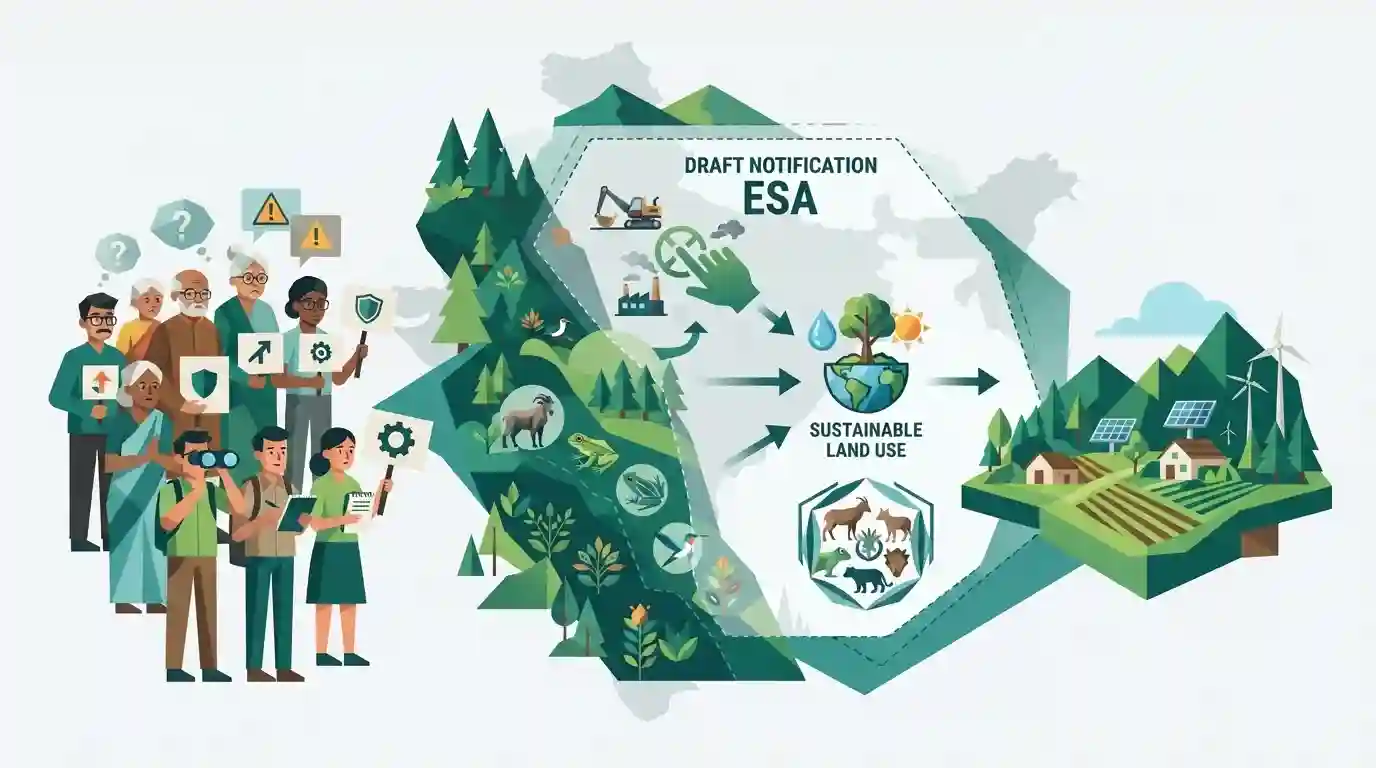
Citizens and environmentalists have raised concerns and demanded stricter regulatory safeguards within the draft notification for the Ecologically Sensitive Area (ESA) of the Western Ghats, emphasizing biodiversity conservation and sustainable land use.
Key Points
- Citizens and environmental groups are demanding tighter safeguards in the latest Western Ghats Ecologically Sensitive Area (ESA) draft notification.
- The Western Ghats span across six states including Maharashtra and are globally recognized as a major biodiversity hotspot.
- Protection of the Western Ghats involves balancing developmental activities with environmental conservation as recommended by panels like the Gadgil and Kasturirangan committees.
Important Terms
Ecologically Sensitive Area (ESA) Draft

A policy notification issued under the Environment (Protection) Act, 1986, to restrict developmental activities like mining, quarrying, and red-category industries within vulnerable tracts of the Western Ghats to protect biodiversity.
UPSC context
MPSC Paper 1 (Geography) and Paper 3 (Environment): Tests understanding of environmental conservation, sustainable development, and ecological policies in India.
Gadgil Committee Report
A 2011 panel report led by Madhav Gadgil that recommended designating the entire Western Ghats as an Ecologically Sensitive Area, advocating a decentralized, ecocentric regulatory framework.
UPSC context
MPSC Environment and Ecology: Important for questions on committees, biodiversity protection strategies, and developmental versus environmental trade-offs in India.
Kasturirangan Committee Report
A 2013 high-level working group report chaired by K. Kasturirangan that recommended designating roughly 37% of the Western Ghats as an ESA while safeguarding human habitations and plantations.
UPSC context
MPSC Geography and Environment: Tests policy frameworks for balancing regional socio-economic development with fragile ecosystem protection.
Ministry of Environment and Forests
The central government ministry responsible for planning, promoting, and implementing environmental and forestry programs, including framing ESA notifications for fragile regions like the Western Ghats.
UPSC context
MPSC Governance and Polity: Frequently tested regarding union environmental bodies, statutory frameworks, and national policy execution.
Prelims Trap
The Kasturirangan Committee recommended declaring the entire Western Ghats mountain range as an Ecologically Sensitive Area.
Aspirants often confuse the 37% ESA coverage proposed by the Kasturirangan Committee with the Gadgil Committee's recommendation to declare the entire Western Ghats range as ecologically sensitive.
Static Concepts Connected
What are the core recommendations of the Gadgil and Kasturirangan Committees on the Western Ghats?
- Gadgil Committee: Chaired by Madhav Gadgil; recommended designating the entire Western Ghats as an Ecologically Sensitive Area divided into three ESZs with strict curbs on developmental projects.
- Kasturirangan Committee: Chaired by K. Kasturirangan; recommended bringing only 37% of the Western Ghats under ESA, permitting progressive green activities while banning mining and red industries.
Cross-Topic Patterns
Western Ghats ESA vs. Konkan Infrastructure
MPSC frequently juxtaposes the developmental recommendations of the Kasturirangan report against the conservation-heavy Gadgil report while examining Maharashtra's district-level land use patterns in the Konkan region.

Expect a statement-based MPSC question contrasting Gadgil (WGEEP) and Kasturirangan committee thresholds on mining and ESA percentage.
Linked PYQs · 1
Linked PYQs · 1
- 2017MPSC_PRELIMSGS1
Which of the following mountains are considered as one of the top biodiversity hot spots ?
