CISF Aviation Security Deployment at Noida International Airport
Source:The Hindu ↗
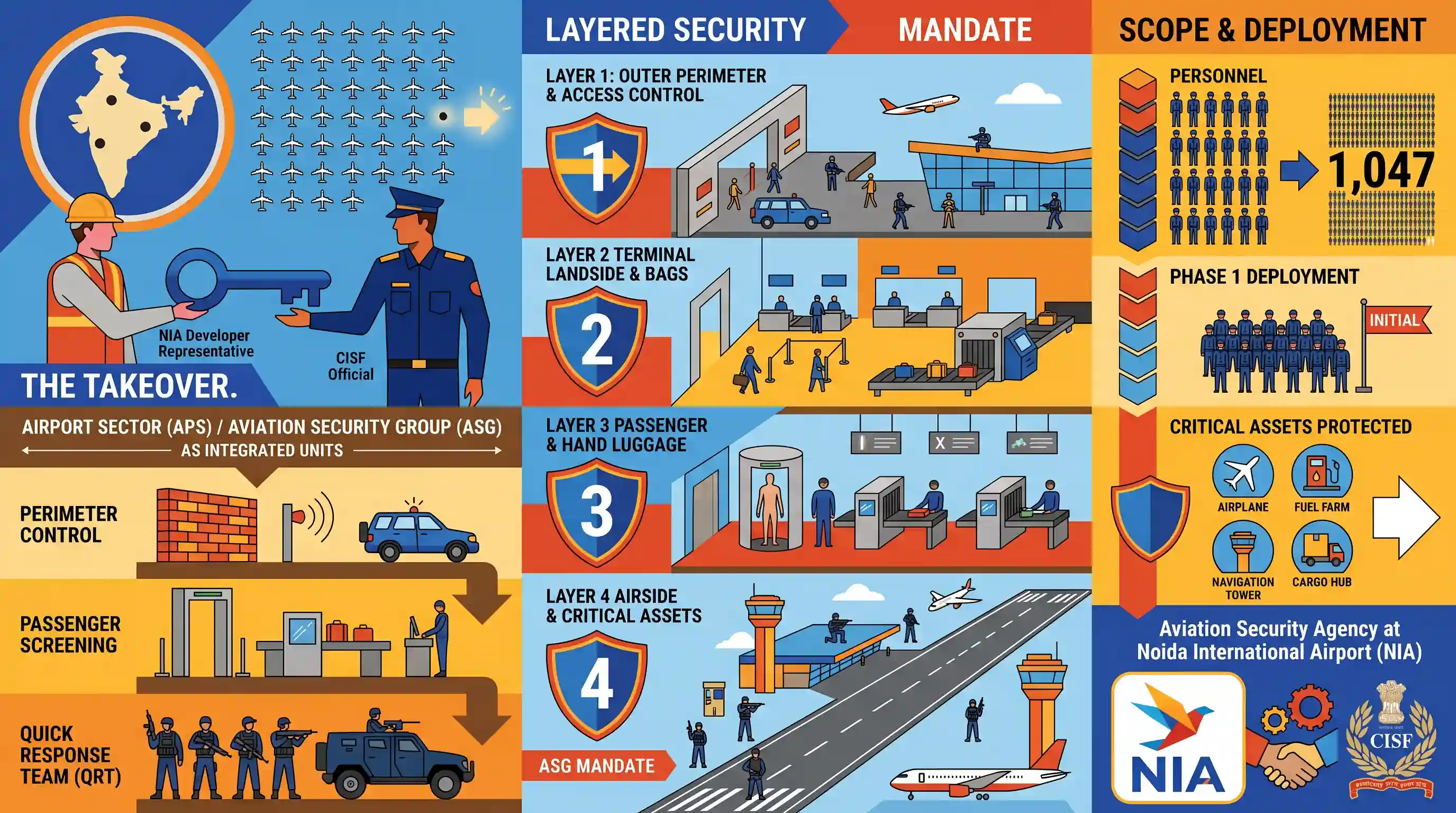
Why It Matters
It highlights the institutional security frameworks deployed to protect critical infrastructure (airports) in India, relevant to the GS3 syllabus covering security forces and their mandate, as well as the rapid expansion of India\'s aviation infrastructure.
Summary
The Central Industrial Security Force (CISF) has taken over the security operations of the upcoming Noida International Airport (NIA) in Jewar, Uttar Pradesh. The NIA is the 70th airport in India to be protected by the CISF. For the initial phase, 1,047 personnel will be deployed under the CISF\'s Aviation Security Group to handle comprehensive layered security, including perimeter control, passenger screening, and Quick Response Teams (QRTs), ensuring the protection of critical aviation assets.
Key Points
- The Central Industrial Security Force (CISF) has been officially inducted as the designated aviation security agency at the upcoming Noida International Airport (NIA) at Jewar, Uttar Pradesh.
- The Noida facility becomes the 70th airport in India to come under the protective cover of the CISF.
- Security operations will include perimeter and access control, passenger and baggage screening, terminal security, and the deployment of Quick Response Teams (QRTs).
- During the first phase of operations, 1,047 CISF personnel will be deployed under the leadership of a Chief Aerodrome Security Officer (CASO), with future scaling planned as passenger traffic grows.
Important Terms
Central Industrial Security Force (CISF)

A Central Armed Police Force (CAPF) established in 1969 to secure vital industrial installations, airports, metros, and government buildings across India.
UPSC context
GS Paper III: Internal Security; tests knowledge of various security forces and their specific mandates.
Aviation Security Group (ASG)
A specialized wing of the CISF exclusively responsible for providing security cover, including anti-hijacking and counter-terror measures, at Indian civil airports.
UPSC context
GS Paper III: Internal Security; focuses on specialized wings of security agencies and civil aviation safety.
Noida International Airport (NIA)
An upcoming greenfield international airport in Jewar, Uttar Pradesh, designed to decongest Delhi's IGI Airport and serve as a major logistics hub.
UPSC context
GS Paper III: Infrastructure; tests knowledge of mega-projects, PPP models, and regional connectivity.
Bureau of Civil Aviation Security (BCAS)
The regulatory authority for civil aviation security in India, responsible for laying down standards and monitoring security at all Indian airports.
UPSC context
GS Paper II: Statutory/Regulatory Bodies; GS Paper III: Internal Security (Aviation Safety).
Quick Response Team (QRT)
Tactical mobile units within security forces trained for immediate response to neutralize threats, manage breaches, or handle emergencies in real-time.
UPSC context
GS Paper III: Internal Security; tests understanding of tactical operational capabilities of security agencies.
Greenfield Airport
A new airport project constructed from scratch on undeveloped land, unlike "brownfield" projects which involve upgrading existing infrastructure.
UPSC context
GS Paper III: Economy and Infrastructure; relevant for classification of infrastructure development projects.
Prelims Trap
"The CISF acts as the sole regulatory authority and standard-setting body for aviation security across all airports in India."
BCAS (Bureau of Civil Aviation Security) is the actual regulatory authority framing aviation security policies. CISF is the operational armed force executing these protocols.
Static Concepts Connected
What is the core mandate of the Central Industrial Security Force (CISF)?
- Original Mandate: Created in 1969 via an Act of Parliament primarily to provide integrated security cover to Public Sector Undertakings (PSUs).
- Private Sector Cover: Post the 2008 Mumbai attacks, the CISF Act was amended to allow deployment at private corporate establishments (like Infosys or Reliance) for a fee.
- Critical Infrastructure: Protects strategic national assets including nuclear installations, space research facilities, major seaports, airports, and urban mass transit (Delhi Metro).
What distinguishes Greenfield airports from Brownfield airports under India's aviation policy?
- Greenfield Airports: Built from scratch on undeveloped land without existing infrastructure. Executed under the Greenfield Airports Policy, 2008 to decongest major hubs (e.g., Jewar, Mopa).
- Brownfield Airports: Involves the remodeling, expansion, or upgrading of already existing and operational airport facilities (e.g., the modernization of Delhi's Indira Gandhi International Airport).
- Clearance Mechanism: Greenfield projects require a two-stage clearance (Site Clearance and In-Principle Approval) directly from the Ministry of Civil Aviation's Steering Committee.
Cross-Topic Patterns
Sovereign security at foreign-built infrastructure
Jewar is a PPP developed by a Swiss entity. Deploying sovereign armed forces (CISF) at foreign-developed infrastructure highlights the intersection of FDI promotion and national internal security mandates.
CISF corporatization and private deployment
Linking CAPF mandates to economic liberalization. Post-2008, CISF actively provides consultancy services and physical security to private corporate entities on a cost-reimbursement basis, deviating from its original PSU-only mandate.

Expect a 2026 CAPF mandate question mixing up CISF’s operational role at private assets/airports with BCAS’s regulatory authority.
Linked PYQs · 2
Linked PYQs · 2
- 2023MainsGS3
What are the internal security challenges being faced by India? Give out the role of Central Intelligence and Investigative Agencies tasked to counter such threats.
- 2017MainsGS3
Examine the development of Airports in India through joint ventures under Public-Private Partnership (PPP) model. What are the challenges faced by the authorities in this regard?
