Circular Economy Model Aimed at Boosting Dairy Farmer Incomes
Source:The Hindu ↗
Why It Matters
The article directly maps to GS3 themes of doubling farmers' income, the economics of animal-rearing, and alternative energy sources (biogas). It provides excellent case study material (Banas Dairy model) for answers related to rural development, cooperative societies, and the circular economy.
Summary
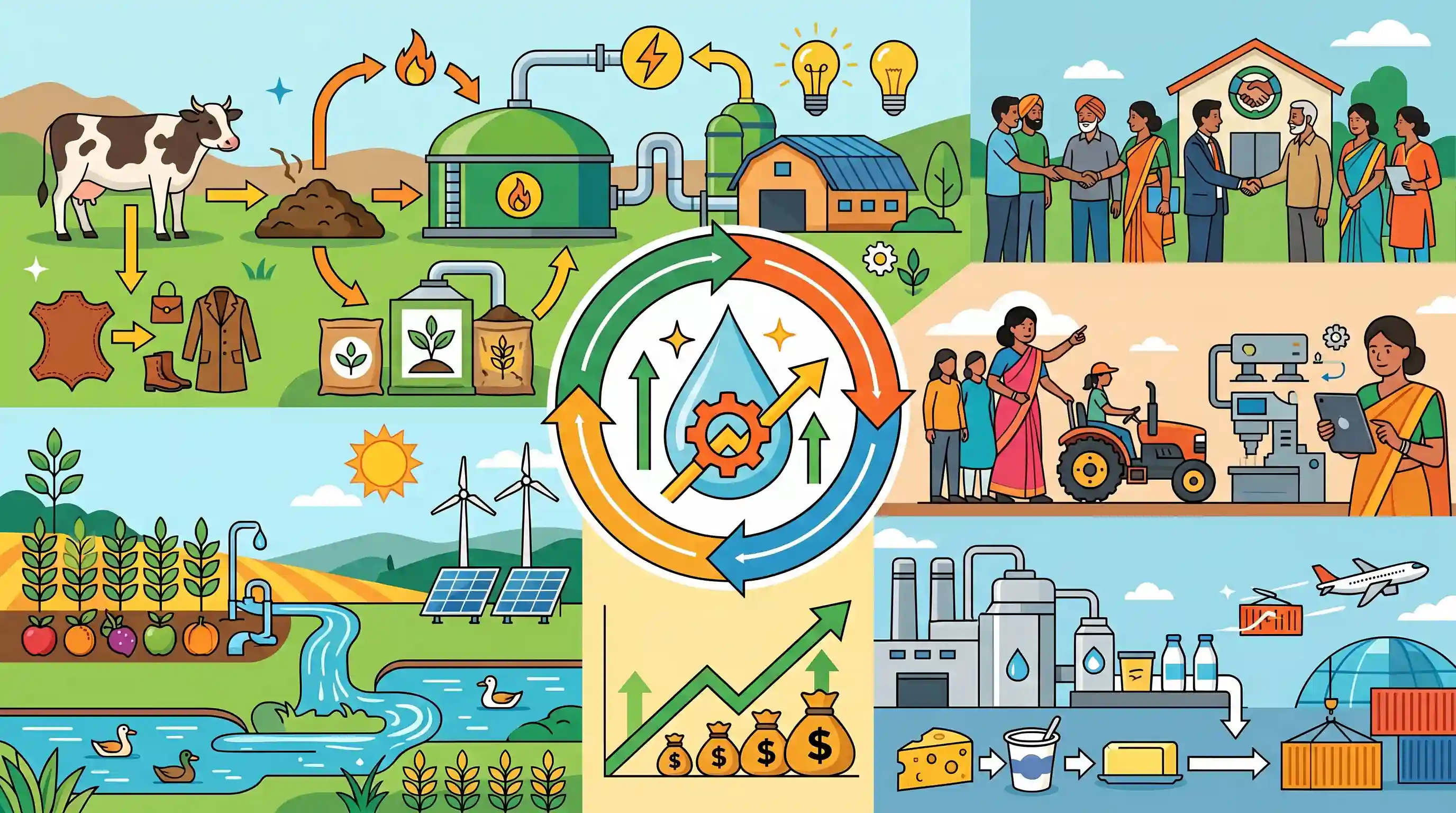
Union Home and Cooperation Minister Amit Shah emphasized that integrating a circular economy model within the dairy sector could increase dairy farmers' incomes by 20% over the next five years. Citing the success of Banas Dairy in Gujarat, he highlighted practices like converting cattle dung into biogas and bio-fertilizer, and producing leather from cattle that die natural deaths. These efforts are part of the 'White Revolution 2.0' initiative, which aims to strengthen grassroots cooperatives, empower rural women, and produce dairy products with high global demand. He also lauded accompanying water conservation initiatives, such as Amrit Sarovars, that enable such growth in arid regions.
Key Points
- A circular economy model in the dairy sector—including biogas, bio-fertilizers, and leather from natural cattle deaths—is projected to boost dairy farmers' incomes by 20% in five years.
- The initiative aligns with 'White Revolution 2.0', aimed at establishing primary-level cooperatives for both agriculture and dairy, and producing globally demanded dairy products.
- Banas Dairy in Gujarat's Banaskantha district was praised for implementing this model, empowering rural women in a water-scarce region.
- Water conservation efforts, such as the construction of check-dams and Amrit Sarovars, were highlighted for successfully raising the groundwater table to sustain these agricultural activities.
Important Terms
White Revolution 2.0

A 2024 initiative aiming to boost cooperative milk procurement by 50% in five years, focusing on women’s empowerment, technological modernization (like IVF), and expanding the dairy cooperative network.
UPSC context
GS Paper III (Agriculture); focuses on rural employment, food security, and dairy value-chain modernization.
National Dairy Development Board (NDDB)
A statutory body established in 1965 to promote producer-owned cooperatives. It spearheaded "Operation Flood," turning India into the world’s largest milk producer through the "Anand Pattern."
UPSC context
GS Paper II & III; relevant for statutory bodies and institutional support for the rural economy.
Circular Economy (Dairy)
A sustainable "waste-to-wealth" model in dairying that converts cattle dung into bio-CNG and organic fertilizers, while utilizing hides of naturally deceased cattle for leather production.
UPSC context
GS Paper III (Environment/Economy); tests resource efficiency, sustainable agriculture, and doubling farmers' income.
Amrit Sarovar
A 2022 mission to construct or rejuvenate 75 water bodies (ponds) in every Indian district to combat water scarcity and support rural livelihoods through irrigation and fisheries.
UPSC context
GS Paper I & III; critical for water resource management and climate-resilient rural development.
Banas Dairy
Asia’s largest dairy cooperative, located in Gujarat, which serves as the national blueprint for a circular economy by integrating bio-energy and organic fertilizer production into dairy farming.
UPSC context
GS Paper III (Agriculture); exemplifies successful cooperative models and rural entrepreneurship for inclusive growth.
Prelims Trap
Mission Amrit Sarovar mandates the construction or rejuvenation of at least 75 water bodies in every gram panchayat.
The target is 75 water bodies per *district*, not per gram panchayat. UPSC frequently alters the administrative unit (block/panchayat/district) to create plausible-sounding numerical traps.
Static Concepts Connected
What are the core principles of a Circular Economy in agriculture?
- Resource Recovery: Converting agricultural waste and animal dung into valuable products like biogas and bio-fertilizers.
- Waste Minimization: Designing systems where the byproduct of one process becomes the input for another, closing the loop.
- Soil Regeneration: Using organic outputs like digestate to restore soil health, substituting chemical fertilizers.
What distinguishes Compressed Biogas (CBG) from traditional CNG?
- Source Origin: CBG is renewable, produced via anaerobic digestion of biomass like dung. CNG is extracted from fossil fuel reserves.
- Chemical Parity: Both are primarily methane (>90%), making CBG functionally identical and a direct green replacement for automotive CNG.
- Agricultural Byproducts: CBG production yields nutrient-rich digestate usable as bio-fertilizer; CNG extraction provides no such agricultural benefit.
Cross-Topic Patterns
CBG & the SATAT Initiative
The dairy sector's shift to Bio-CNG directly overlaps with the SATAT scheme, which incentivizes entrepreneurs to set up CBG plants and supply oil marketing companies.
Ministry of Cooperation Jurisdiction
With White Revolution 2.0 driven by the Ministry of Cooperation, watch for questions linking dairy to the Multi-State Cooperative Societies Act and PACS expansion.

Expect a 2026 prelims question linking White Revolution 2.0, SATAT (Bio-CNG) targets, and the expanded mandate of PACS.
Linked PYQs · 4
Linked PYQs · 4
- 2015MainsGS3
Livestock rearing has a big potential for providing non-farm employment and income in rural areas. Discuss suggesting suitable measures to promote this sector in India.
- 2017MainsGS3
Explain various types of revolutions, took place in Agriculture after independence in India. How these revolutions have helped in poverty alleviation and food security in India?
- 2014MainsGS3
In the villages itself no form of credit organization will be suitable except the cooperative society. -All India Rural Credit Survey. Discuss this statement in the background of agricultural finance in India. What constraints and challenges do financial institutions supplying agricultural finance face? How can technology be used to better reach and serve rural clients?
- 2023MainsGS3
Discuss several ways in which microorganisms can help in meeting the current fuel shortage.
