Data Driven Governance Training for Civil Services in Bihar
Source:patna-press ↗
Why It Matters
It illustrates the collaborative administrative reforms between NITI Aayog and state governments (State Support Mission) to introduce modern data analytics and evidence-based planning into state-level civil service operations.
Summary
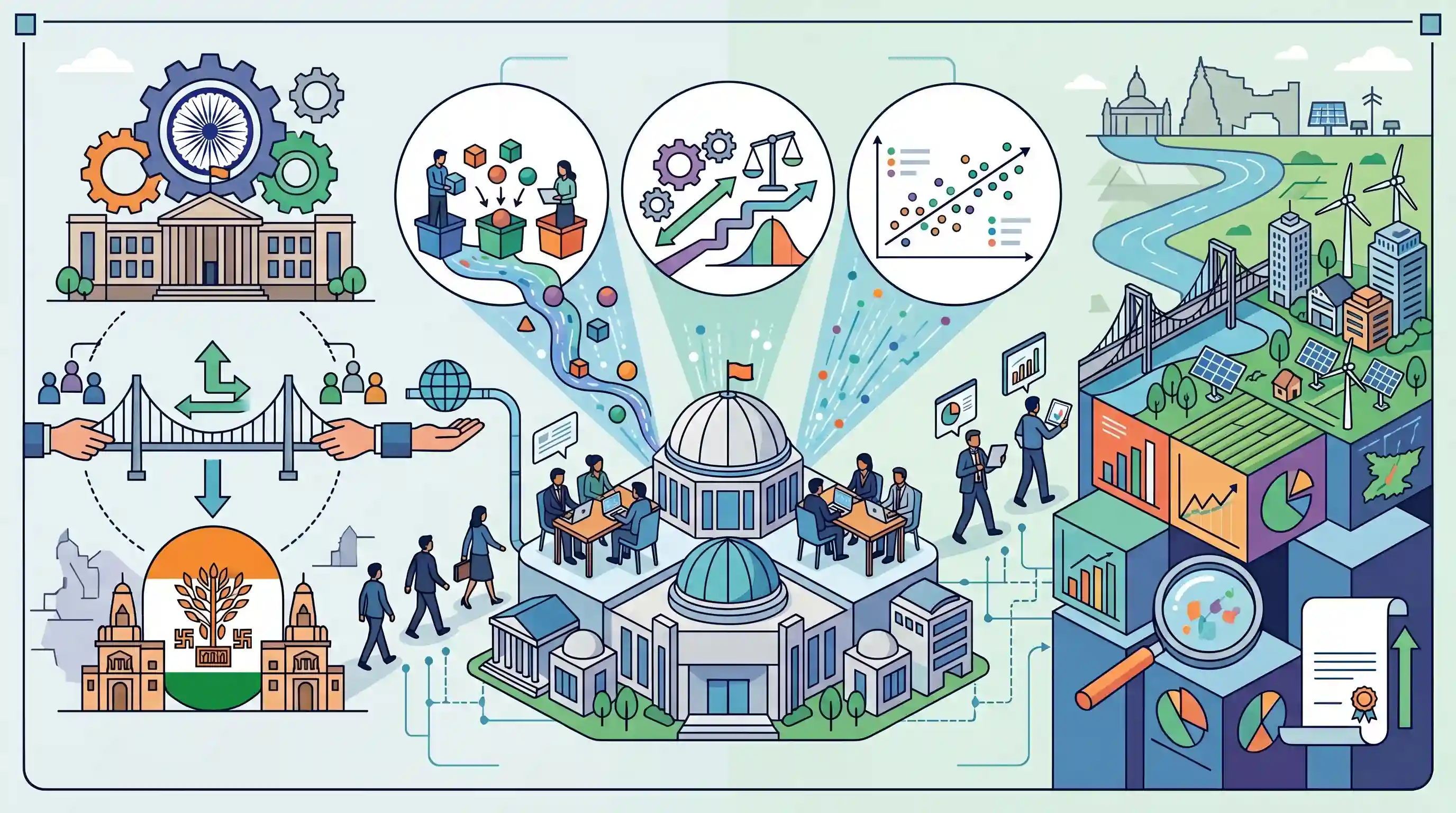
The Chandragupt Institute of Management Patna (CIMP) hosted a Management Development Programme on Quantitative Techniques for Bihar government officials. In collaboration with the state's Planning and Development Department and NITI Aayog's State Support Mission, the initiative focused on training civil servants in data classification, optimization, and regression analysis to foster evidence-based policy planning and data-driven governance in Bihar.
Key Points
- Chandragupt Institute of Management Patna (CIMP) hosted a three-day Management Development Programme (MDP) focused on Quantitative Techniques.
- The MDP was organized in collaboration with the Planning and Development Department of Bihar under NITI Aayog's State Support Mission.
- The training aimed to enhance data-driven governance and evidence-based policy-making in Bihar.
- 25 government officials, including Joint Directors and Deputy Directors, were trained on topics such as data visualization, regression analysis, optimization methods, and decision tree methodologies.
Important Terms
NITI Aayog

The premier policy think tank of India established in 2015 to replace the Planning Commission, focusing on bottom-up policy formulation and cooperative federalism.
UPSC context
GS Paper II: Statutory/Constitutional bodies; marks shift from centralized to collaborative planning.
State Support Mission (SSM)
A NITI Aayog initiative helping States/UTs build 'NITI-style' planning bodies and strengthening data analytical systems to achieve socio-economic goals by 2047.
UPSC context
GS Paper II: Governance and Federalism; tests NITI Aayog’s role in institutionalizing state-level planning.
Cooperative Federalism
A model where the Union and States collaborate as 'Team India' to solve national problems, moving away from a traditional command-and-control relationship.
UPSC context
GS Paper II: Indian Constitution—Functions and responsibilities of the Union and the States.
Data-Driven Governance
An administrative approach using real-time data and statistical tools to design policies, track scheme performance, and improve transparency in public service delivery.
UPSC context
GS Paper II: E-governance; relates to evidence-based policy making and administrative reforms.
Capacity Building
The process of enhancing the skills, knowledge, and technological capabilities of government officials to improve administrative efficiency and policy implementation.
UPSC context
GS Paper II: Role of civil services in a democracy; central to Mission Karmayogi.
State Institution for Transformation (SIT)
Multidisciplinary resource centers established by states under the SSM to replace traditional planning boards and drive strategic, long-term development strategies.
UPSC context
GS Paper II: Institutional reforms in governance; part of India’s decentralization agenda.
Prelims Trap
NITI Aayog's State Support Mission allocates financial grants to state governments for capacity building.
NITI Aayog functions without fund-allocation powers. The Mission provides technical and strategic support to build State Institutions for Transformation (SITs), not direct funding.
Static Concepts Connected
NITI Aayog vs Planning Commission: Key differences?
- Financial Powers: NITI Aayog has no fund-allocation powers (this rests with the Finance Ministry), unlike the erstwhile Planning Commission.
- Approach: NITI Aayog emphasizes a bottom-up approach and cooperative federalism, replacing the centralized top-down planning model.
- Mandate: Functions purely as an apex think tank providing strategic, technical, and data-backed advisories.
What are the core objectives of Mission Karmayogi?
- Role-based Framework: Shifts civil services from a 'rule-based' to a 'role-based' human resource management system.
- Continuous Learning: Provides online, continuous capacity building through the iGOT-Karmayogi digital platform.
- Competency Mapping: Aligns work allocation by matching officials' specific competencies (like data analytics) to post requirements.
Cross-Topic Patterns
Capacity Building + E-Governance
Training officials in regression and data optimization ensures that large datasets generated by e-governance initiatives actually translate into predictive, evidence-based policy rather than mere record-keeping.
Cooperative Federalism via SITs
NITI Aayog’s push for State Institutions for Transformation (SITs) mirrors a decentralization of the think-tank model, enabling state-specific, localized policy interventions.

Expect Prelims statements blending Mission Karmayogi's 'role-based' paradigm with the mandate of NITI Aayog's State Support Mission.
Linked PYQs · 3
Linked PYQs · 3
- 2018BPSC_PRELIMSGS1
In Government of India's NITI Aayog, which is an economic policy-making think tank, what is the full form of NITI?
- 2022BPSC_PRELIMSGS1
The 'Digital India Award, 2020' was given to the Bihar Government for
- 2022BPSC_PRELIMSGS1
The new ministry proposed in the Bihar Budget for the year 2021-22 focuses on
