CII launches Clean Mysuru drive against plastic pollution
Source:The Hindu ↗
Why It Matters
Provides a practical example of corporate and civil society collaboration in urban waste management, relevant for answers on plastic pollution, smart cities, and mitigating urban flooding through infrastructure maintenance.
Summary
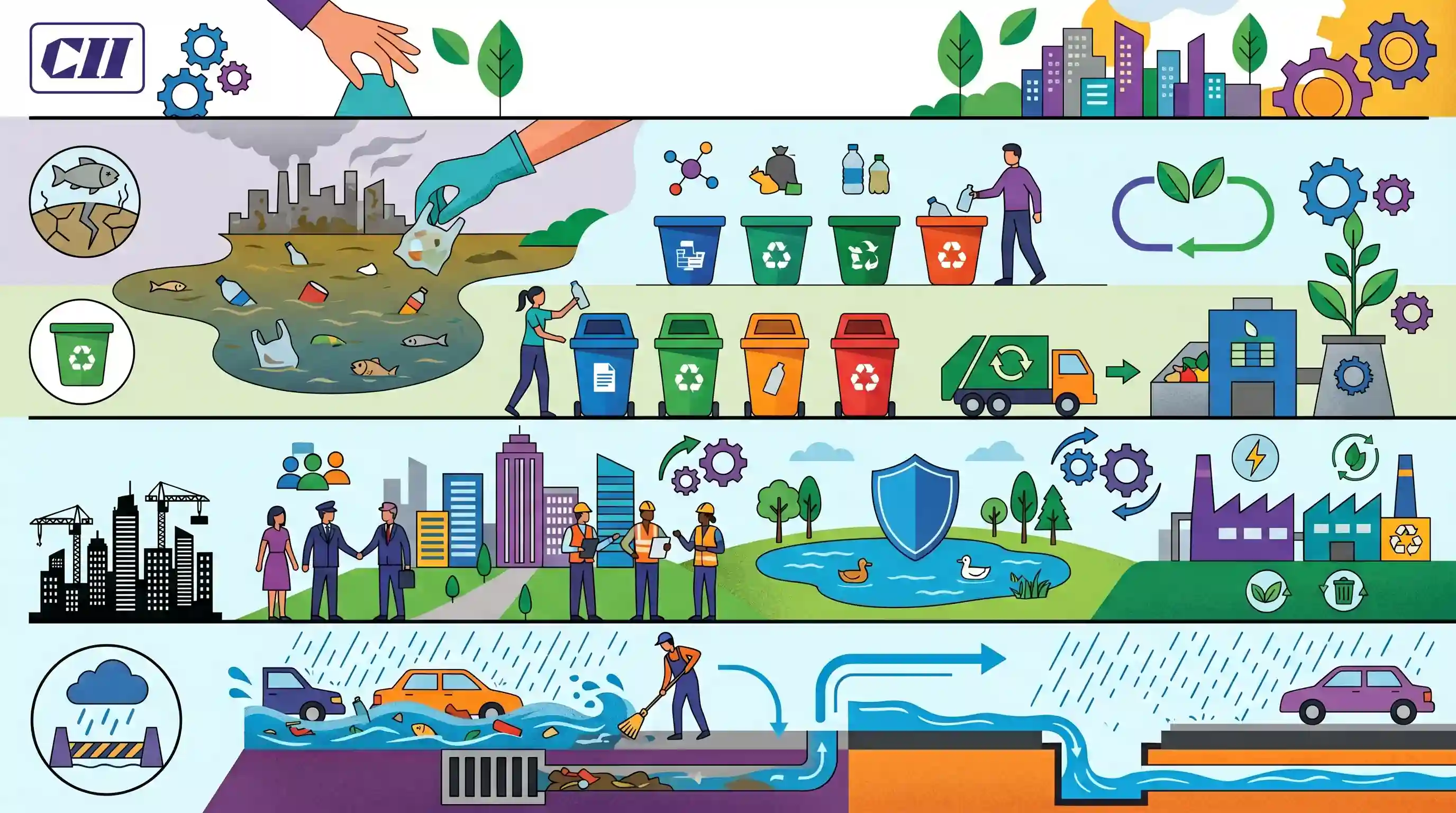
The Confederation of Indian Industry (CII) has launched the 'Clean Mysuru' initiative to address plastic pollution and promote sustainable urban development. By combining public clean-up drives with zero-waste segregation methods, the campaign highlights multi-stakeholder efforts to reduce single-use plastics. Furthermore, CII urged the local civic body to prioritize lake protection, desilt stormwater drains, and improve waste infrastructure in industrial zones, touching upon crucial aspects of urban governance, solid waste management, and flood prevention.
Key Points
- The CII launched the 'Clean Mysuru' initiative to tackle plastic pollution through a large-scale clean-up drive on World Environment Day.
- Waste collected during the drive will be managed using zero waste segregation methods and sent to recycling units for eco-friendly disposal.
- The initiative emphasizes reducing single-use plastics and promoting sustainable practices among citizens, students, and NGOs.
- CII submitted a memorandum to the Mysuru City Corporation (MCC) advocating for the maintenance of lakes, desilting of stormwater drains, and preventing sewage inflow.
- The drive aims to make Mysuru a model for sustainable urban development through multi-stakeholder participation and improved waste infrastructure in industrial zones.
Important Terms
Confederation of Indian Industry (CII)

A non-government, not-for-profit, industry-led organization founded in 1895. It partners with government and civil society to facilitate development through advisory and consultative processes on policy, environment, and industrial growth.
UPSC context
GS Paper 2 & 3: Important for roles of non-state actors in governance and sustainable industrial development.
Clean Mysuru initiative
A campaign by the CII Mysuru chapter to tackle plastic pollution through public clean-up drives, zero-waste segregation, and advocacy for infrastructure improvements like lake protection and desilting.
UPSC context
GS Paper 3: Relevant for environmental pollution and examples of multi-stakeholder urban sustainability models.
Solid Waste Management Rules, 2016
Statutory framework mandating waste generators to segregate waste into three categories: biodegradable, dry, and domestic hazardous. It places responsibility on local bodies for processing and industrial townships for infrastructure.
UPSC context
GS Paper 3: Essential for questions on urban waste management and environmental legislation.
Extended Producer Responsibility (EPR)
A policy where producers are responsible for the entire lifecycle of products, particularly the take-back and recycling of plastic packaging to promote a circular economy and reduce pollution.
UPSC context
GS Paper 3: Key concept in environmental ethics and industrial responsibility (Polluter Pays Principle).
Urban Flooding
A disaster occurring when intense rainfall exceeds the drainage capacity of an urban area, frequently worsened by unplanned construction, encroachment on wetlands, and poorly maintained stormwater drains.
UPSC context
GS Paper 3: Crucial for disaster management and urbanization problems; focuses on anthropogenic causes and mitigation.
Plastic Waste Management (Amendment) Rules, 2024
2024 amendments to the 2016 rules that introduce stricter criteria for 'biodegradable' plastics, broaden producer definitions, and mandate annual plastic waste assessments by local bodies.
UPSC context
GS Paper 3: Tests knowledge of evolving environmental regulations and India's fight against single-use plastics.
Prelims Trap
The 'Clean Mysuru' initiative is a flagship statutory programme launched by the Ministry of Housing and Urban Affairs under Swachh Bharat Mission.
Aspirants often assume "Clean [City]" initiatives are statutory Swachh Bharat missions led by MoHUA. This specific initiative is driven by an industry body (CII), not the government.
Static Concepts Connected
What are the key provisions for Single-Use Plastics (SUP) under the PWM Rules?
- SUP Ban: Prohibits the manufacture, import, stocking, distribution, sale, and use of identified SUP items that have low utility and high littering potential.
- Thickness Criteria: Increased the minimum allowable thickness of plastic carry bags to 120 microns (as of 2022) to facilitate easier collection and recycling.
- Extended Producer Responsibility: Mandates producers, importers, and brand owners to manage the end-of-life disposal of plastic waste generated by their products.
How do poor solid waste management practices contribute to urban flooding?
- Drain Clogging: Unsegregated waste, particularly non-biodegradable plastics, accumulates in and blocks stormwater drains, drastically reducing their carrying capacity during intense rainfall.
- Wetland Degradation: Unregulated dumping of solid waste into urban lakes and wetlands reduces their water-holding capacity, destroying natural flood-absorption zones.
- Sewerage Chokes: Solid waste dumped into open channels often mixes with sewage, choking underground sewerage networks and causing toxic backflows into city streets.
Cross-Topic Patterns
Corporate ESG and Urban Governance
Industry bodies like CII are increasingly stepping into civic governance (desilting drains, lake conservation) through CSR and ESG mandates, crossing over from economic advocacy to urban environmental management.
Solid Waste Management as Flood Mitigation
Connects urban flooding (GS3) directly to municipal solid waste failures (GS2), showing how plastic pollution is not just an ecological issue but a severe disaster-management hazard due to clogged drains.

Multi-statement questions linking Plastic Waste Management Rules with urban flooding and corporate CSR mandates are likely in 2026.
Linked PYQs · 4
Linked PYQs · 4
- 2018MainsGS3
What are the impediments in disposing the huge quantities of discarded solid wastes which are continuously being generated? How do we remove safely the toxic wastes that have been accumulating in our habitable environment?
- 2020MainsGS1
Account for the huge flooding of million cities in India including the smart ones like Hyderabad and Pune. Suggest lasting remedial measures.
- 2021MainsGS1
What are the environmental implications of the reclamation of water bodies into urban land use ? Explain with examples.
- 2024PrelimsGS1
Consider the following statements : Statement-I: Many chewing gums found in the market are considered a source of environmental pollution. Statement-II : Many chewing gums contain plastic as gum base. Which one of the following is correct in respect of the above statements?
