Gandhinagar hosts CIDSCON 2026 focusing on AMR and AI in medicine
Source:medgatetoday ↗
Why It Matters
Antimicrobial Resistance (AMR) is declared by the WHO as one of the top 10 global public health threats. Understanding India's response (such as Gujarat's GUJSAR-N and Antimicrobial Stewardship programs) and the role of emerging tech (AI, phage therapy) is highly relevant for Science & Technology questions in GPSC Prelims and Mains.
Summary
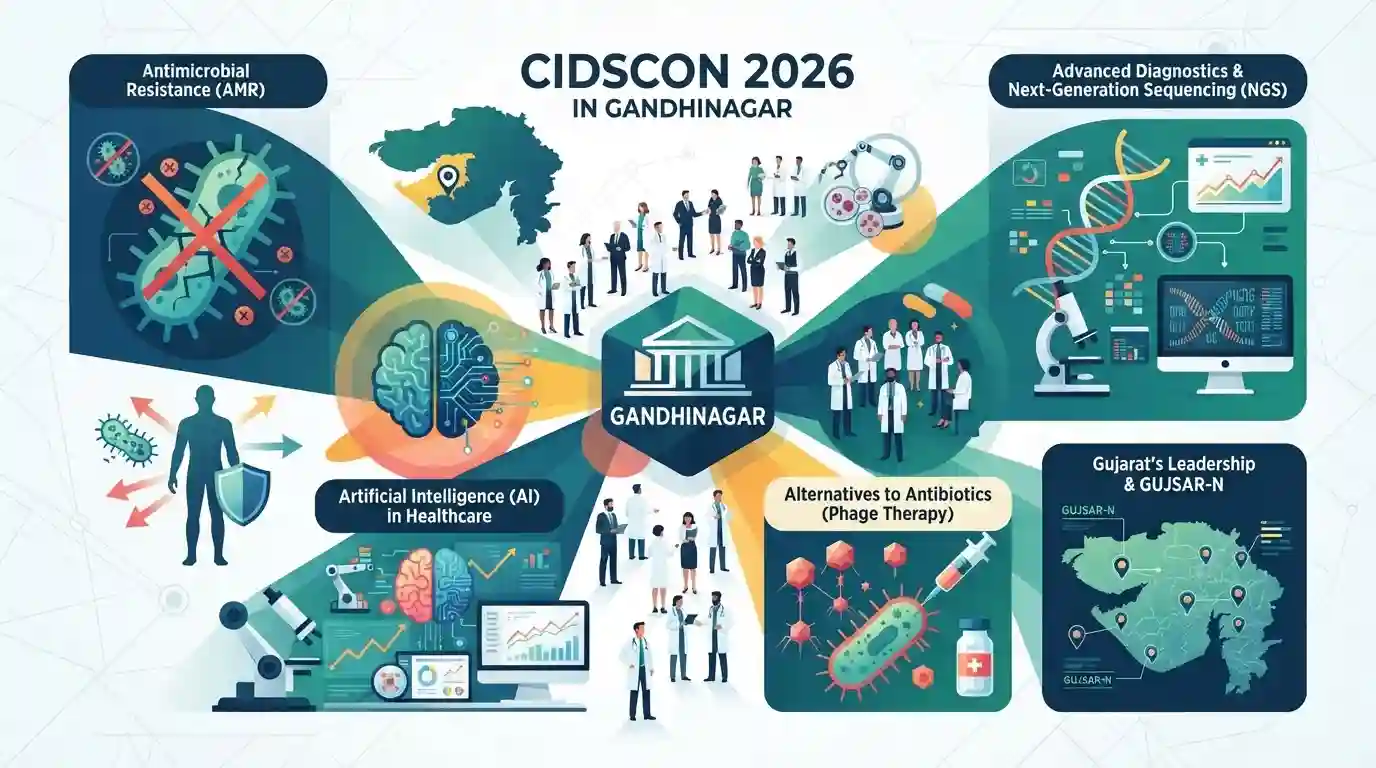
Gandhinagar is hosting CIDSCON 2026, a major gathering of over 950 infectious disease experts focused on tackling Antimicrobial Resistance (AMR) and integrating Artificial Intelligence into healthcare. The conference, themed 'Addressing AMR: From Awareness to Action', delves into advanced diagnostics like next-generation sequencing and explores alternatives to antibiotics, including phage therapy. The event also highlights Gujarat's leadership in AMR monitoring through initiatives like the GUJSAR-N.
Key Points
- CIDSCON 2026, the 16th Annual Conference of the Clinical Infectious Diseases Society, is being hosted in Gandhinagar, Gujarat, bringing together over 950 global infectious disease experts.
- The theme of the conference is 'Addressing AMR: From Awareness to Action', emphasizing the critical global health challenge of Antimicrobial Resistance.
- Key discussions focus on the integration of Artificial Intelligence in diagnostics, next-generation sequencing, and antimicrobial stewardship (AMS).
- The event also highlights alternative treatments to antibiotics, such as phage therapy, to combat multi-drug resistant superbugs.
- Gujarat's proactive AMR framework, including the GUJSAR-N initiative, is showcased as a model for regional AMR monitoring.
Important Terms
Antimicrobial Stewardship (AMS)

Coordinated strategies to optimize the use of antimicrobial agents—ensuring the right drug, dose, and duration—to improve patient outcomes, stem overuse, and reduce drug resistance.
UPSC context
Crucial for Science/Health sections; tests knowledge on combating AMR, preserving antibiotic efficacy, and national/state healthcare strategies.
Clinical Infectious Diseases Society (CIDS)
A professional medical organization for infectious disease specialists in India that fosters scientific exchange, advanced clinical research, and best practices in treating communicable diseases.
UPSC context
Relevant for Health and Governance; highlights institutional frameworks for managing emerging infectious diseases and driving medical innovation.
Gujarat State AMR Surveillance Network (GUJSAR-N)
A state-level initiative in Gujarat designed to monitor and contain antimicrobial resistance through an AMR dashboard, laboratory-data-based disease surveillance, and antimicrobial stewardship tracking.
UPSC context
Highly important for GPSC specific health policies; tests awareness of regional initiatives combating the critical threat of antimicrobial resistance.
U.N. Mehta Institute of Cardiology and Research Centre
A premier, government-promoted autonomous cardiac teaching hospital and research center in Ahmedabad, Gujarat, providing advanced cardiovascular care at highly concessional rates or free of cost.
UPSC context
Key state health infrastructure topic for GPSC; reflects Gujarat's public health commitments, equitable healthcare access, and medical education advancements.
Prelims Trap
Phage therapy is an emerging treatment that uses advanced, targeted antibiotics to kill specific viral infections.
Phage therapy uses bacteriophages (which are viruses) to treat bacterial infections, not viral infections. It is a biological alternative to antibiotics, not an antibiotic itself.
Static Concepts Connected
How does Phage Therapy function as an alternative to antibiotics?
- Viral Agents: It utilizes naturally occurring viruses called bacteriophages that exclusively infect, replicate within, and destroy bacterial cells.
- Target Specificity: Unlike broad-spectrum antibiotics, phages only kill specific bacterial strains, thereby preserving the body's beneficial microbiome.
- Combating AMR: It is increasingly researched as a critical tool to treat multi-drug-resistant (MDR) bacterial infections, commonly known as superbugs.
What are the core components of Antimicrobial Stewardship (AMS)?
- Rational Use: Coordinated interventions designed to improve and measure the appropriate use of antimicrobials by promoting optimal drug regimen selection.
- Primary Objective: Aims to slow the spread of AMR, reduce adverse effects, and lower healthcare costs while improving patient outcomes.
- Diagnostic Integration: Integrates rapid diagnostic tools (like NGS or AI) to ensure accurate detection before prescribing antibiotics.
Cross-Topic Patterns
State-led digital health surveillance
GUJSAR-N illustrates decentralized, state-led health surveillance. This mirrors Gujarat's broader administrative push towards digital health records and AI-driven epidemiology under the National Digital Health Mission.
Red Biotech tackling AMR superbugs
Phage therapy and next-gen sequencing are prime examples of Red Biotechnology bridging the gap where traditional pharmaceuticals and broad-spectrum antibiotics fail against superbugs.

Statements linking AI applications, Next-Gen Sequencing, and phage therapy mechanisms to tackle AMR are highly probable in Science & Tech.
Linked PYQs · 1
Linked PYQs · 1
- 2026GPSC_PRELIMSGS1
In the context of modern healthcare, what is the primary objective of Nano-shells or Nano-bullets in cancer treatment?
