CIDCO Navi Mumbai Railway Stations Handover To Central Railway
Source:remumbai ↗
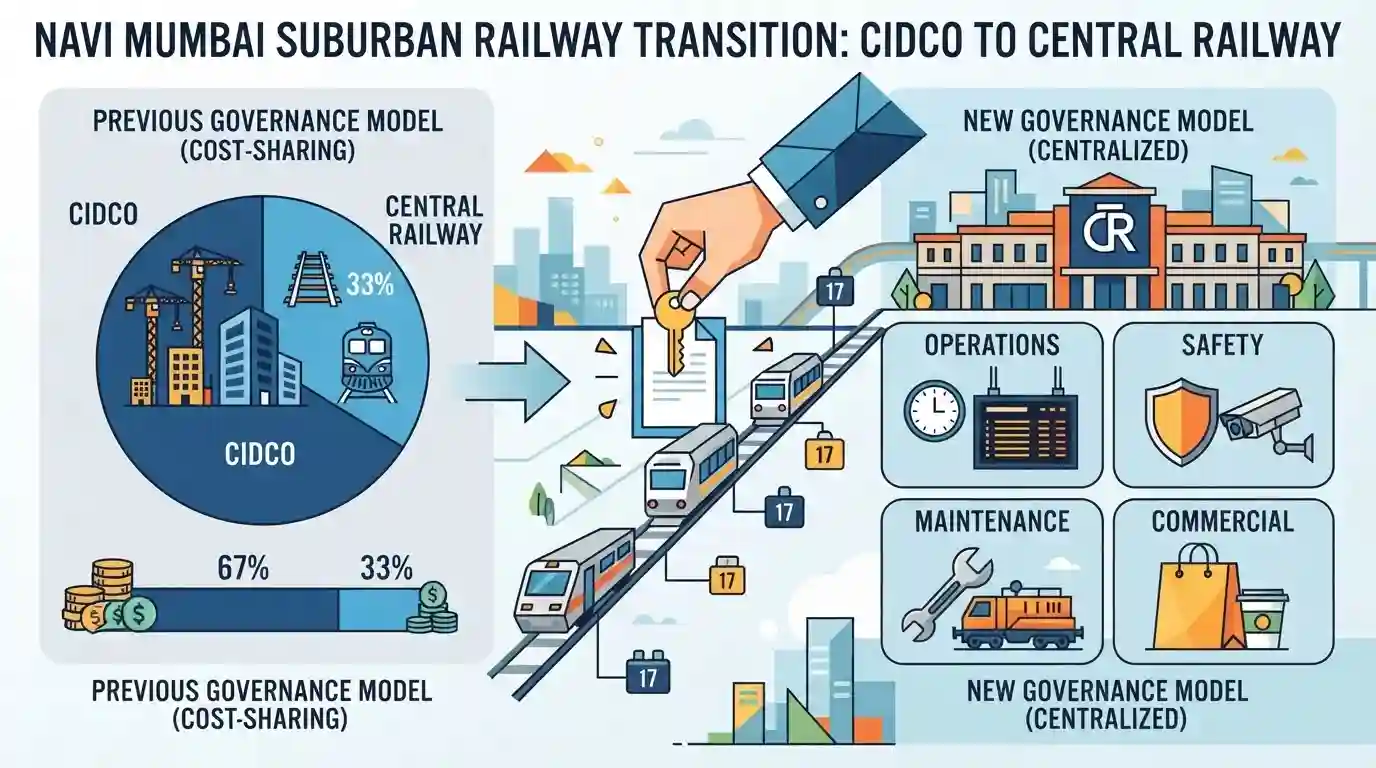
Why It Matters
It highlights the practical execution of inter-agency coordination (between a state-level urban planning body and a central utility) and cost-sharing models (67:33) crucial for developing and maintaining large-scale public transport infrastructure.
Summary
The City and Industrial Development Corporation (CIDCO) has finalized the handover of 17 railway stations in Navi Mumbai to the Central Railway. This transition shifts the responsibility of statutory operations, commuter safety, track maintenance, and commercial activities to the Central Railway, aiming to streamline administration for local commuters. Historically, the development of these stations was funded through a joint cost-sharing model where CIDCO bore 67% of the expenses and Central Railway covered the remaining 33%.
Key Points
- CIDCO has successfully handed over 17 railway stations in Navi Mumbai to the Central Railway.
- The transfer aims to unify the administrative and operational frameworks for the suburban railway network in the region.
- Central Railway is now responsible for passenger safety, track upkeep, statutory operations, and commercial activities at these stations.
- The railway projects were historically funded via a cost-sharing model, with CIDCO contributing 67% and Central Railway contributing 33%.
Important Terms
City and Industrial Development Corporation (CIDCO)

A city planning and new town development agency established in 1970 by the Government of Maharashtra. It is responsible for large-scale infrastructure and urban development projects, notably the planning and development of Navi Mumbai.
UPSC context
Important for MPSC GS-2 and GS-3 (Governance and Infrastructure). Highlights state-level public administration, urban development bodies, and public infrastructure management.
Central Railway (CR)
One of the 19 zones of Indian Railways, headquartered at Chhatrapati Shivaji Maharaj Terminus (CSMT) in Mumbai. It operates significant passenger and freight lines primarily in Maharashtra, including the Mumbai suburban network.
UPSC context
Relevant for MPSC GS-3 (Infrastructure - Railways). Illustrates railway administration, zonal operations, and inter-agency coordination in urban transport projects.
Prelims Trap
"Navi Mumbai's suburban railway network was fully funded and developed by the Central Railway."
Aspirants often assume suburban railways are exclusively funded by the Ministry of Railways. In Navi Mumbai, CIDCO (a state entity) bore the majority 67% cost.
Static Concepts Connected
What is CIDCO and what is its primary mandate in Maharashtra?
- Establishment: Formed in 1970 as a company wholly owned by the Government of Maharashtra under the Companies Act.
- Primary Mandate: Originally created to develop Navi Mumbai to decongest Mumbai; functions as a New Town Development Authority.
- Expanded Scope: Acts as a Special Planning Authority for broader infrastructure zones, including NAINA and the Navi Mumbai International Airport.
Which Indian Railway Zones have their headquarters in Maharashtra?
- Central Railway (CR): Headquartered at Chhatrapati Shivaji Maharaj Terminus (CSMT), Mumbai. It operates the Navi Mumbai suburban lines.
- Western Railway (WR): Headquartered at Churchgate, Mumbai. Handles the western suburban corridor and major routes towards Gujarat and North India.
- Konkan Railway Corporation: Also headquartered at CBD Belapur in Navi Mumbai, though it functions as a public sector undertaking (PSU) rather than a standard railway zone.
Cross-Topic Patterns
Center-State cost sharing in urban transit
Like CIDCO's 67:33 railway model, modern transit projects (like Maha Metro) operate on 50:50 equity sharing between State and Centre, highlighting the shift toward collaborative Center-State urban infrastructure financing.
Urban decongestion and transit-oriented development
CIDCO's role has evolved from merely planning a satellite city to executing mega-transit hubs, directly linking the Navi Mumbai International Airport (NMIA) and NAINA with suburban rail connectivity.

Expect a multi-statement question on CIDCO's functions, testing the 67:33 suburban rail funding ratio and its Special Planning Authority status.
Linked PYQs · 1
Linked PYQs · 1
- 2025MPSC_PRELIMSGS1
As per the 2011 Census, 13% of the total urban population of the country was living in which of the following cities in 2011 ? a. Mumbai b. Chennai c. Kolkata d. Delhi
