Karnataka CID Busts Cyber Financial Mule Account Racket
Source:Indian Express ↗
Why It Matters
It provides a concrete case study on the mechanics of modern cyber-financial crimes, specifically illustrating how 'mule accounts' serve as the critical infrastructure for money laundering in the digital age. This is highly relevant for GS-3 answers discussing the intersection of cyber threats, organized crime, and the challenges of policing digital financial ecosystems.
Summary
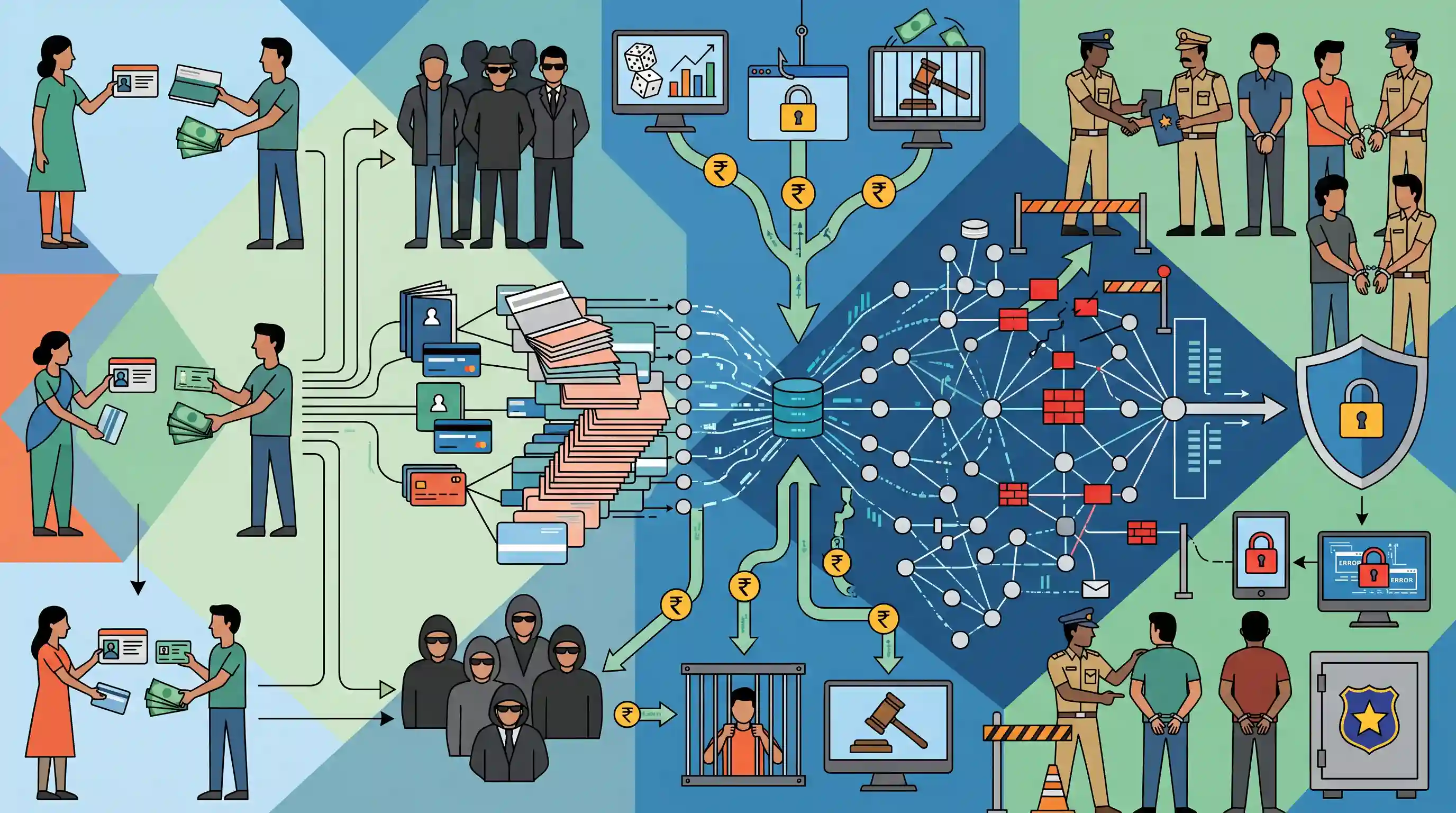
The Karnataka Criminal Investigation Department (CID) busted a massive cyber fraud network, arresting 12 individuals and identifying over 42,000 'mule' bank accounts. Operated by intermediaries known as "mule herders," the racket involved procuring KYC documents from ordinary citizens in exchange for small cash payments to open bank accounts. These accounts were then sold or leased to organized cybercriminals who used them to route and launder illicit funds from online scams, illegal betting, and "digital arrest" frauds. This incident highlights the evolving nexus between cybercrime and money laundering, demonstrating how criminal networks exploit economically vulnerable individuals to obscure financial trails and evade law enforcement.
Key Points
- Modus Operandi: "Mule herders" paid individuals Rs 10,000–Rs 20,000 for their identity documents to open bank accounts, collecting ATM cards and cheque books to lease or sell to cybercriminals.
- Scale of Operation: Over 42,000 mule bank accounts were identified and 12 masterminds were arrested during simultaneous raids across more than 29 districts in Karnataka.
- Crime Typology: These accounts were critical infrastructure for laundering money generated from online scams, illegal betting operations, and 'digital arrest' frauds, allowing criminals to conceal financial trails.
- Victim Vulnerability: Unsuspecting citizens whose documents were used face severe legal and financial consequences, highlighting a lack of digital financial literacy.
- Law Enforcement Action: The statewide drive by Karnataka CID's Cyber Command demonstrates proactive targeting of the financial supply chains that sustain organized cybercrime networks.
Important Terms
Mule Account

Bank accounts used to receive and transfer funds from illegal activities on behalf of others, effectively distancing criminals from the proceeds of their crimes.
UPSC context
GS Paper 3: Internal Security. Tests understanding of money laundering mechanisms and financial system vulnerabilities.
Cyber Command
A specialized, unified police unit (pioneered in Karnataka) that coordinates cybercrime investigations, cybersecurity, and misinformation management under a single Director General of Police.
UPSC context
GS Paper 3: Cybersecurity/Internal Security. Tests knowledge of state-level institutional reforms against technology-driven crimes.
Digital Arrest
A cyber-extortion tactic where scammers impersonate law enforcement via video/phone calls to "digitally" restrain victims and extort money under false threats of prosecution.
UPSC context
GS Paper 3: Cyber Security. Focuses on evolving cybercrime trends and public safety challenges in a digital economy.
CEN Police Stations
Specialized law enforcement units focused on Cyber, Economic, and Narcotics crimes, recently integrated into Karnataka's unified Cyber Command to streamline complex digital investigations.
UPSC context
GS Paper 3: Internal Security. Relates to the architecture of specialized police forces and state-level internal security measures.
Money Laundering
The illegal process of concealing the origin of 'dirty money' through complex financial transactions to make it appear as 'clean' or legitimate wealth.
UPSC context
GS Paper 3: Internal Security/PMLA. Core topic regarding organized crime, financial integrity, and its link to terrorism/cybercrime.
Prelims Trap
"Digital arrest is a recognized preventive detention provision under the Information Technology Act."
"Digital arrest" is actually a cyber-extortion scam where criminals impersonate law enforcement over video calls. It holds absolutely no legal validity under any Indian statute.
Static Concepts Connected
What are the three standard stages of Money Laundering?
- Placement: Injecting illicit cash into the formal financial system, often using 'mule' bank accounts to deposit small amounts.
- Layering: Masking the origin of funds through complex, multiple domestic or international wire transfers to evade detection.
- Integration: Returning the laundered funds back into the economy so they appear as legitimate wealth or assets.
What is the mandate of the Indian Cyber Crime Coordination Centre (I4C)?
- Nodal Agency: An attached office established under the Ministry of Home Affairs (MHA) for a coordinated national cybercrime response.
- Financial Fraud: Operates the '1930' Citizen Financial Cyber Fraud Reporting helpline to facilitate rapid freezing of illicit digital transfers.
- Intelligence Sharing: Works with the Financial Intelligence Unit (FIU-IND) to merge cybercrime registries with Suspicious Transaction Reports (STRs).
Cross-Topic Patterns
PMLA + Cyber Fraud Nexus
The use of mule accounts to layer scam proceeds brings local cybercrimes directly under the Prevention of Money Laundering Act (PMLA) ambit, bridging cyber security and financial law.
AI in Law Enforcement
RBIH's 'MuleHunter.AI' demonstrates the growing utility of Artificial Intelligence in flagging illicit financial trails, connecting GS3 Science & Tech with Internal Security.

Expect a multi-statement Prelims 2026 question linking 'money mules' or 'digital arrest' to PMLA and the mandate of I4C.
Linked PYQs · 4
Linked PYQs · 4
- 2020MainsGS3
Discuss different types of cyber crimes and measures required to be taken to fight the menace.
- 2021MainsGS3
Discuss how emerging technologies and globalisation contribute to money laundering. Elaborate measures to tackle the problem of money laundering both at national and international levels.
- 2022MainsGS3
Discuss the types of organised crimes. Describe the linkages between terrorists and organised crime that exist at the national and transnational levels.
- 2013MainsGS3
Money laundering poses a serious security threat to a country's economic sovereignty. What is its significance for India and what steps are required to be taken to control this menace?
