Federal implications of recent assembly elections and central laws
Source:Indian Express ↗
Why It Matters
The article provides an analytical perspective on highly relevant UPSC themes, including electoral reforms (simultaneous elections), the implications of delimitation on regional representation, and the constitutional balance between unitary tendencies and federalism.
Summary
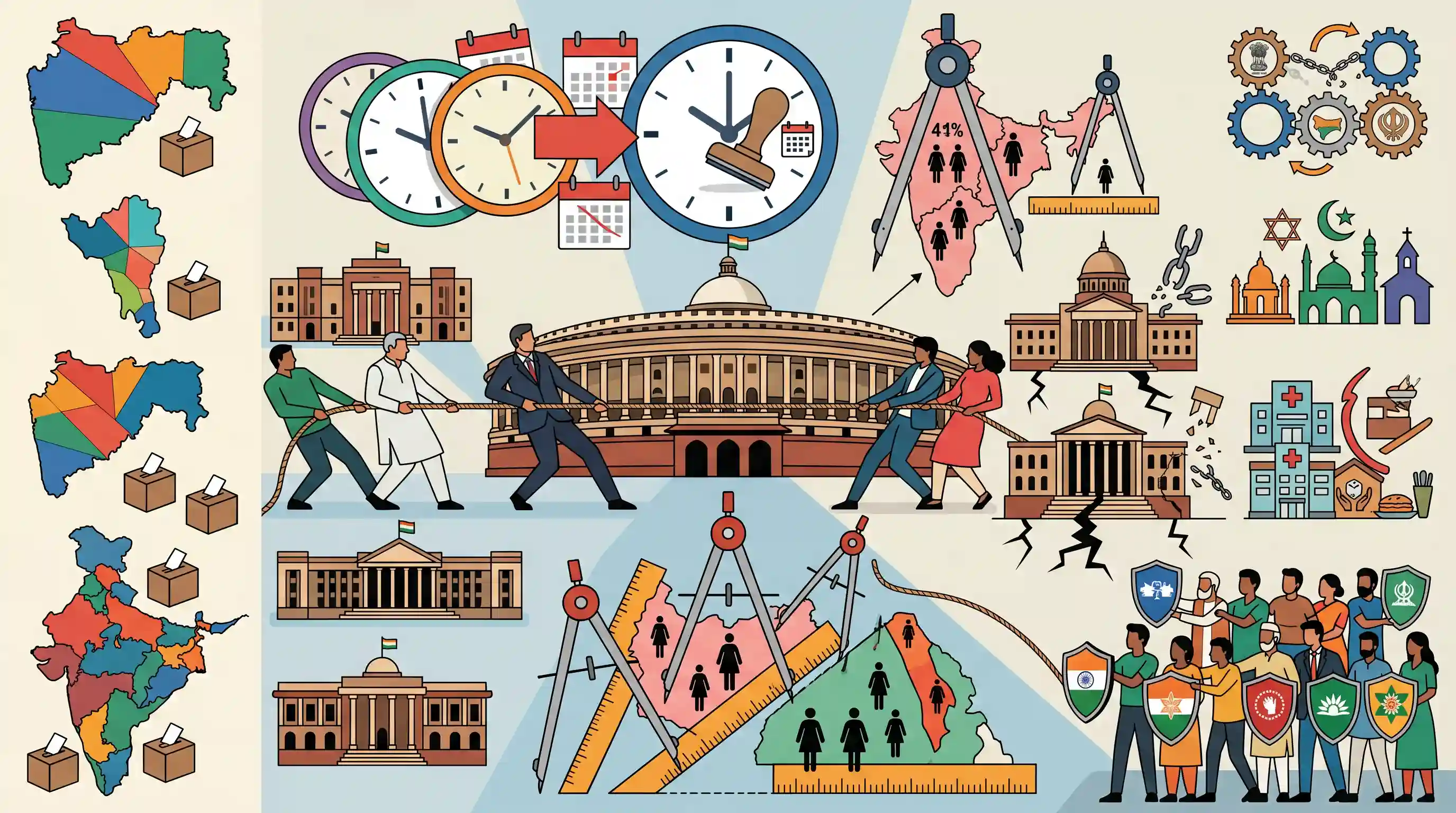
P Chidambaram analyses the outcomes of the 2026 assembly elections in five states, emphasizing the ongoing political tug-of-war between national centralization and regional autonomy. He points out that despite lacking an absolute single-party majority, the central government continues to advance significant legislative and constitutional changes—such as 'One Nation One Election,' and delimitation tied to the Women's Reservation Bill. The author cautions that these structural shifts risk eroding India's federalism, secularism, and welfare-state model, calling on the I.N.D.I.A. bloc and regional parties to present a united front to safeguard democratic pluralism.
Key Points
- The recent assembly elections highlight shifting political landscapes, notably the BJP's rise to power in West Bengal and the emergence of new regional forces like TVK in Tamil Nadu.
- Despite lacking a single-party absolute majority, the BJP continues to pass key legislation, demonstrating effective parliamentary maneuvering to advance its agenda.
- Proposed structural changes such as 'One Nation One Election' and the linking of the Women's Reservation Bill to delimitation are viewed by critics as mechanisms to consolidate central power and alter regional representation in the Lok Sabha.
- The author argues that the ruling party aims to shift India toward a unitary constitution, potentially undermining core principles like federalism, secularism, and the welfare state.
- A cohesive and unified opposition via the I.N.D.I.A bloc is presented as essential to counterbalance centralizing tendencies and protect India's pluralistic democratic framework.
Important Terms
One Nation One Election

Proposal to synchronize elections for the Lok Sabha and all State Legislative Assemblies to occur simultaneously, aiming to reduce expenditure and governance disruptions from frequent polls.
UPSC context
GS-II: Elections, Federalism; tests understanding of constitutional challenges and administrative feasibility of simultaneous polling.
Women's Reservation Bill
Formally the Constitution (106th Amendment) Act, 2023, it reserves one-third of seats for women in the Lok Sabha and State Legislative Assemblies for 15 years.
UPSC context
GS-II: Governance, Social Justice; tests knowledge of affirmative action and constitutional implementation (census/delimitation link).
Wakf (Amendment) Bill
Legislation (2024) proposing reforms to the 1995 Act, including non-Muslim representation on Wakf boards and empowering government officials to adjudicate property status disputes.
UPSC context
GS-II: Secularism, Minority Rights; tests understanding of State-religion relations and management of religious endowments.
Delimitation
The process of redrawing boundaries of Lok Sabha and State Assembly seats based on census data to ensure equal representation for equal population segments.
UPSC context
GS-II: Elections, Federalism; tests impact of population-based seat redistribution on North-South political representation.
J&K Local Bodies (Amendment) Bill
Legislative change providing reservation for Other Backward Classes (OBCs) in J&K local bodies and empowering the State Election Commission to conduct these polls.
UPSC context
GS-II: Local Governance, Special Status (Post-370); tests knowledge of decentralized governance and reservation policies in UTs.
I.N.D.I.A bloc
A multi-party opposition alliance formed to present a unified front against the ruling NDA, emphasizing secularism, federalism, and social justice.
UPSC context
GS-II: Political Parties, Coalition Politics; tests the role of the opposition and dynamics of parliamentary democracy.
Prelims Trap
The 106th Constitutional Amendment Act immediately operationalizes 33% women's reservation in the current Lok Sabha and State Assemblies.
The 106th CAA is not yet active. Its operationalization is explicitly deferred until a delimitation exercise is conducted based on the first Census published after the Act's passage.
Static Concepts Connected
What are the constitutional provisions for the Delimitation Commission?
- Article 82: Under Article 82, Parliament enacts a Delimitation Act after every Census to readjust Lok Sabha seats.
- Article 170: Mandates the division of State Assemblies into territorial constituencies based on the latest census figures.
- Judicial Immunity: Orders of the Commission have the force of law and cannot be questioned before any court, ensuring finality.
How is federalism protected under the Basic Structure doctrine?
- S.R. Bommai Case (1994): The Supreme Court ruled that states are not mere appendages of the Union, declaring federalism a part of the Basic Structure.
- Constitutional Mandate: Article 1 defines India as a 'Union of States,' ensuring that state governments derive their authority directly from the Constitution, not the Centre.
Cross-Topic Patterns
ONOE + Local Body Elections
One Nation One Election debates often overlook Panchayats. Integrating local bodies requires amending Articles 243K and 243ZA, linking macro-federalism disputes directly to grassroots democratic structures.
Demographics + Southern Parliamentary Representation
Linking the Women's Reservation Bill to future delimitation punishes Southern states for successful population control, bridging demographic transitions (Geography) directly with constitutional representation (Polity).

Expect a Mains GS2 question linking the operationalization of the Women's Reservation Bill to the impending North-South delimitation row.
Linked PYQs · 4
Linked PYQs · 4
- 2024MainsGS2
Examine the need for electoral reforms as suggested by various committees with particular reference to "one nation one election" principle.
- 2017MainsGS2
Simultaneous election to the Lok Sabha and the State Assemblies will limit the amount of time and money spent in electioneering but it will reduce the government's accountability to the people." Discuss.
- 2024MainsGS2
What changes has the Union Government recently introduced in the domain of Centre-State relations ? Suggest measures to be adopted to build the trust between the Centre and the States and for strengthening federalism.
- 2022MainsGS2
“While the national political parties in India favour centralisation, the regional parties are in favour of State autonomy.” Comment.
