Church backed cancer care initiative launched in Lucknow
Source:catholicconnect ↗
Why It Matters
This article underscores the essential role of civil society and faith-based organizations in supplementing state efforts for public healthcare and disease prevention in Uttar Pradesh. State-specific public health schemes and NGO collaborations are highly relevant for UPPSC Prelims and Mains (GS Paper 2).
Summary
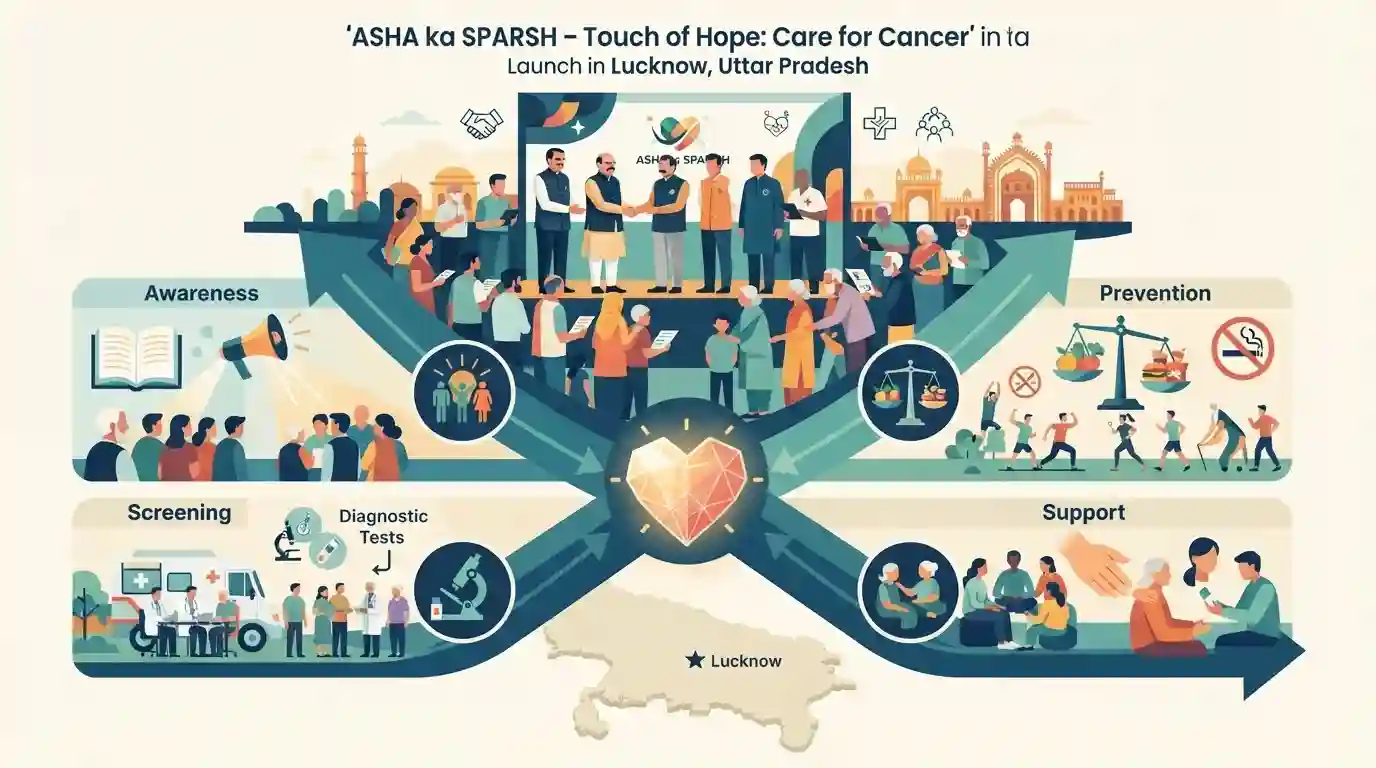
A major Church-backed community health initiative, 'ASHA ka SPARSH – Touch of Hope: Care for Cancer', was launched in Lucknow, Uttar Pradesh. Spearheaded by UKSVK and DSWS, the launch was inaugurated by UP Deputy Chief Minister Brajesh Pathak. The initiative aims to enhance cancer prevention, awareness, early screening, and continuous support for patients and families across the region. Anchored on four pillars—Awareness, Prevention, Support, and Hope—the program promotes a healthy lifestyle while aiming to reduce the burden of cancer through civil society intervention and government collaboration.
Key Points
- A new cancer care initiative named 'ASHA ka SPARSH – Touch of Hope: Care for Cancer' was launched in Lucknow, Uttar Pradesh on July 15, 2026.
- The initiative was launched by Uttar Kshetriya Samaj Vikas Kendra (UKSVK), Agra, in collaboration with the Diocesan Social Welfare Society (DSWS), Lucknow.
- UP Deputy Chief Minister Brajesh Pathak inaugurated the campaign, highlighting its role in acting as a bridge between communities and accessible healthcare services.
- The program is based on four foundational pillars: Awareness, Prevention, Support, and Hope, with a major focus on early detection, screening, and promoting healthy lifestyles.
Important Terms
ASHA ka SPARSH – Touch of Hope: Care for Cancer

A community-based cancer care campaign in Uttar Pradesh built on four pillars—Awareness, Prevention, Support, and Hope. It aims to reduce cancer burden through civil society intervention, early screening, and healthcare collaboration.
UPSC context
Relevant for GS Paper II (Issues relating to development and management of Social Sector/Health) and GS Paper III (Public health).
Uttar Kshetriya Samaj Vikas Kendra (UKSVK)
A registered non-governmental organization established in 1988, serving as an association of Diocesan Social Service Societies in northern India. It coordinates regional development, disaster management, rural welfare, and healthcare initiatives.
UPSC context
Relevant for GS Paper II (Role of NGOs, SHGs, and civil society groups in development processes).
Diocesan Social Welfare Society (DSWS)
A registered non-profit charitable society based in Lucknow, established in 1989. It focuses on empowering marginalized populations, facilitating healthcare access, infant-maternal health awareness, and executing grassroots social welfare programmes.
UPSC context
Relevant for GS Paper II (Welfare schemes for vulnerable sections, and NGO-driven grassroots developmental interventions).
Prelims Trap
ASHA ka SPARSH is a new national health scheme managed under the Union Ministry of Health and Family Welfare using ASHA workers.
'ASHA' here means 'Hope'; it is a faith-based civil society cancer initiative in UP, not a centrally sponsored MoHFW scheme using public health activists.
Static Concepts Connected
What is the NP-NCD and what are its key target diseases?
- Nodal Ministry: Managed under the Ministry of Health and Family Welfare (MoHFW) to combat non-communicable diseases.
- Target Diseases: Focuses on cancer, diabetes, cardiovascular diseases, and stroke (previously under the NPCDCS framework).
- Screening Mandate: Facilitates population-based screening for oral, breast, and cervical cancers for individuals aged 30 and above.
How do CSOs bridge the gap in preventive healthcare delivery?
- Last-mile Reach: Penetrates remote or conservative communities where government machinery faces trust deficits or physical gaps.
- Awareness and Screening: Addresses socio-cultural taboos and low health literacy regarding early-stage diagnostic screenings.
Cross-Topic Patterns
CSO-State Collaboration in Health Infrastructure
Traces how collaborative public-private-NGO models in healthcare alleviate the fiscal burden on state governments while improving preventive care indicators under GS-2.
NCDs vs. Communicable Disease Funding
Shows the shift in India's double burden of disease, where NCDs cause 60%+ deaths, requiring civil society to pivot resources from infectious diseases to cancer/lifestyle screenings.

UPSC may test the NP-NCD screening age-limits and core target diseases alongside the role of CSOs in preventive health.
Linked PYQs · 3
Linked PYQs · 3
- 2023UPPSC_PRELIMSGS1
Which of the following scheme/s is/are related to Uttar Pradesh? (1) Anuthee Uphar Scheme (2) Matra Shakti Udyamita Scheme (3) Kaushalya Matritva Scheme (4) Stree Nidhi Scheme Select the 'correct' answer using the code given below -
- 2021UPPSC_PRELIMSGS1
Which of the following Schemes in Uttar Pradesh were introduced in Budget of 2021-22? I. Atmanirbhar Krishak Samanvit Vikas Yojna II. Mukhya Mantri Saksham Suposhan Yojna III. Mukhya Mantri Pravasi Shramik Udyamita Vikas Yojna IV. Yuva Udyamita Vikas Abhiyan Select the correct answer from the codes given below.
- 2024UPPSC_PRELIMSGS1
What is R21/Matrix-M?
