Chola Era Nataraja Bronze Idols Unearthed in Nagapattinam
Source:The Hindu ↗
Why It Matters
Finds like Chola-era bronzes are direct manifestations of India's glorious sculptural heritage, frequently appearing in both Prelims (metallurgy, styles) and Mains (contributions of the Chola period to art and architecture).
Summary
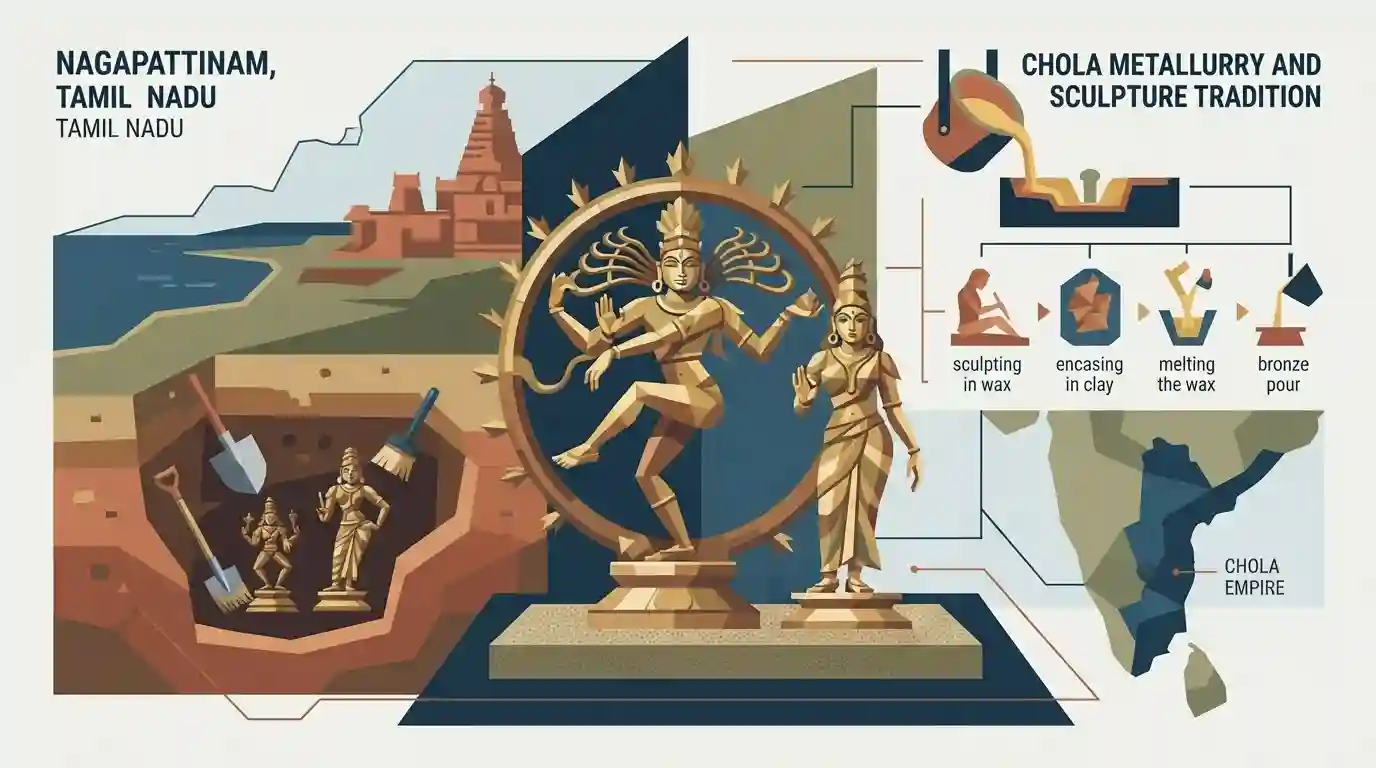
Chola-era bronze alloy idols of Lord Nataraja and Goddess Sivakami have been unearthed in Nagapattinam, Tamil Nadu, reinforcing the historical and artistic significance of Chola metallurgy and sculpture traditions.
Key Points
- Chola-era bronze alloy idols of Lord Nataraja and Goddess Sivakami were unearthed in Nagapattinam district, Tamil Nadu.
- The discovery highlights the rich legacy of Chola bronze metallurgy and sculpture artistry, particularly the 'lost-wax' casting method.
- Such archaeological finds underscore the importance of preserving and studying India's ancient temple heritage and historical art forms.
Important Terms
Archaeological Survey of India

The premier governmental organization under the Ministry of Culture responsible for archaeological research, excavation, and the preservation of cultural heritage and ancient monuments in India.
UPSC context
UPSC Paper I (Art and Culture / Ancient History): Tests knowledge of statutory bodies, heritage conservation laws, and historical preservation in India.
Prelims Trap
Chola bronze idols were installed as permanent stone sanctum sanctorum deities for daily temple worship.
Aspirants often assume Nataraja and all Chola bronzes were installed as permanent stone sanctum deities, missing that they were primarily processional icons (utsava-murtis).
Static Concepts Connected
What are the core technical and iconographic features of Chola-era bronze sculptures?
- Casting Technique: Cast predominantly using the 'lost-wax' (cire perdue) method, allowing for intricate detailing and dynamic postures.
- Processional Purpose: Served primarily as processional icons (utsava-murtis) for temple festivals rather than stationary sanctum deities.
- Canonical Guidelines: Adhered strictly to canonical proportions and iconographic texts like the Shilpa Shastras and Agamas.
- Cosmic Philosophy: Nataraja icon symbolizes cosmic cycles through specific mudras, the damaru, fire, and the crushed demon Apasmara.
Cross-Topic Patterns
Chola Bronzes & Southeast Asian Trade Networks
Chola maritime expansion (Srivijaya campaign) and temple patronage intersected, turning bronze icons into both spiritual focal points and instruments of imperial legitimacy across Southeast Asia.
Antiquity Protection & International Cultural Diplomacy
Archaeological discoveries under the Ancient Monuments Act connect directly to heritage tourism policies and the repatriation of antiquities under international cultural property conventions.

Expect statement-based questions on the technical nuances of the lost-wax (cire perdue) technique and Chola iconographic canons.
Linked PYQs · 5
Linked PYQs · 5
- 2025PrelimsGS1
The famous female figurine known as 'Dancing Girl', found at Mohenjo-daro, is made of
- 2026PrelimsGS1
Which of the following statements on the Amaravati Stupa and its relief sculpture is/are correct ? 1. It was located in the lower Krishna valley. 2. In India, it was next only to the Sanchi Stupa in size. 3. The Amaravati school of sculpture made a lasting impact on the later South Indian sculpture, and its products were carried to Sri Lanka and South-east Asia. Select the answer using the code given below :
- 2025PrelimsGS1
Who among the following led a successful military campaign against the kingdom of Srivijaya, the powerful maritime State, which ruled the Malay Peninsula, Sumatra, Java and the neighbouring islands?
- 2024MainsGS1
Though the great Cholas are no more yet their name is still remembered with great pride because of their highest achievements in the domain of art and architecture. Comment.
- 2022MainsGS1
Discuss the main contributions of Gupta period and Chola period to Indian heritage and culture.
