India Pakistan Cross Border Security and Diplomatic Stance
Source:The Hindu ↗
Why It Matters
Understanding India\'s military and diplomatic responses to cross-border terrorism (like Operation Sindoor) is crucial for GS-2 (IR) and GS-3 (Security). The mention of the Indus Waters Treaty highlights a continuing diplomatic dispute that frequently appears in UPSC examinations.
Summary
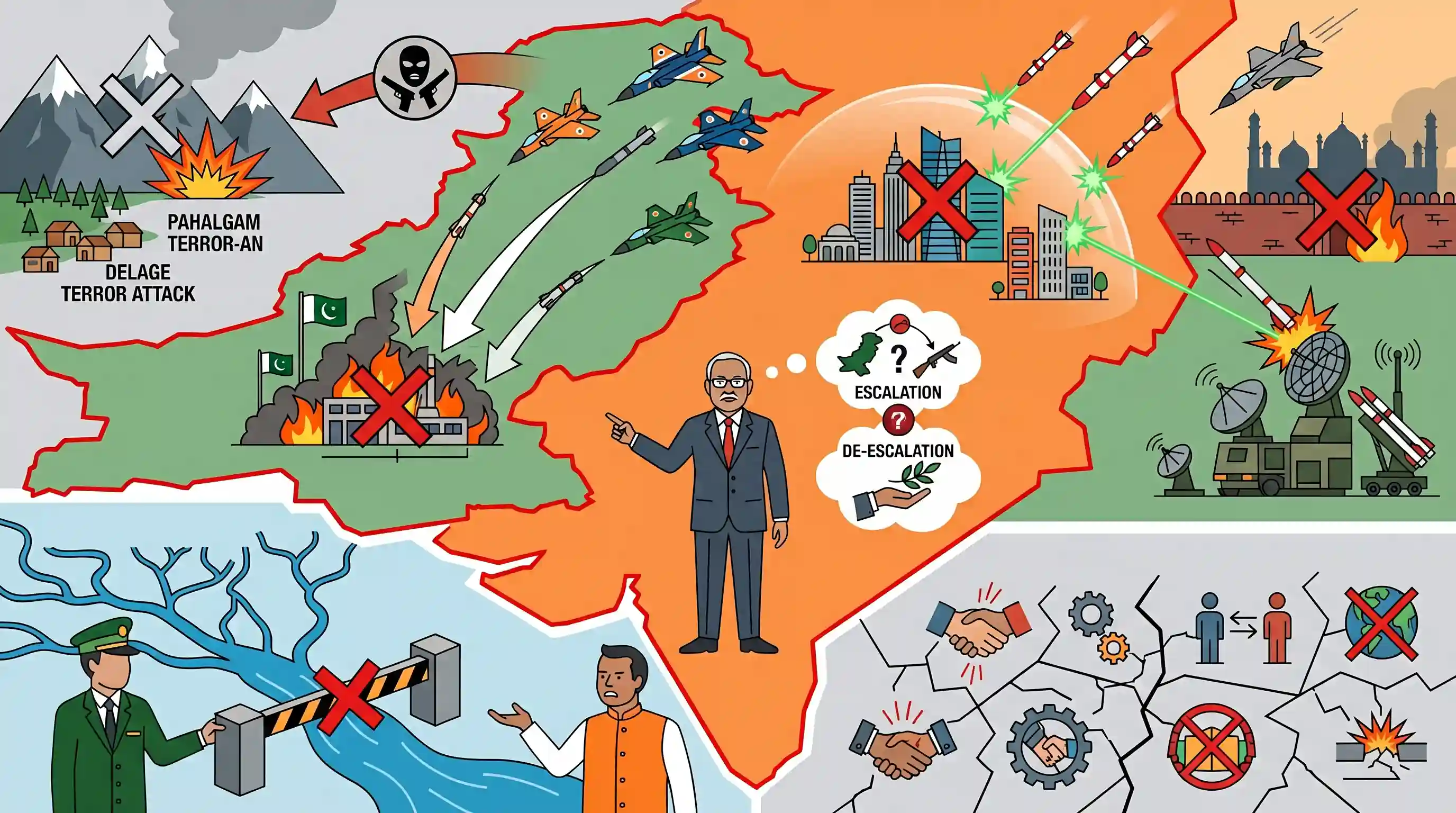
Following the deadly Pahalgam terror attack claimed by The Resistance Force, India launched Operation Sindoor to strike Jaish-e-Mohammad infrastructure in Pakistan. Foreign Secretary Vikram Misri asserted that Pakistan initiated the escalation and must choose whether to de-escalate. Amid heightened tensions, Indian forces neutralized retaliatory Pakistani strikes on multiple Indian cities and destroyed an air defence system in Lahore. Misri also criticized Pakistan for intentionally obstructing the Indus Waters Treaty, reflecting broader, multidimensional strains in India-Pakistan relations.
Key Points
- Foreign Secretary Vikram Misri stated that Pakistan escalated tensions with the April 22 Pahalgam terror attack, and the onus of de-escalation lies with them.
- India retaliated to the Pahalgam attack with Operation Sindoor, conducting precise strikes on terrorist infrastructure, including Jaish-e-Mohammad (JeM) strongholds in Bahawalpur.
- The Resistance Force (TRF) claimed responsibility for the Pahalgam attack, though Pakistan opposed mentioning TRF's role at the UNSC.
- Indian armed forces successfully thwarted Pakistani retaliatory military attempts aimed at multiple Indian cities and destroyed a Pakistani air defence system in Lahore.
- Misri highlighted Pakistan\'s ongoing obstructionism regarding the Indus Waters Treaty as another significant bilateral issue.
Important Terms
Operation Sindoor

A 2025/26 Indian retaliatory military operation involving precision missile strikes against terrorist infrastructure in Pakistan. It was launched following the Pahalgam terror attack to enforce a zero-tolerance policy against cross-border terrorism.
UPSC context
GS Paper III: Internal Security; tests India's evolving military doctrine of proactive deterrence and retaliatory precision strikes against state-sponsored terror.
Indus Waters Treaty
A 1960 World Bank-brokered water-sharing pact between India and Pakistan. In 2025, India held the treaty 'in abeyance' (suspended procedural cooperation), citing Pakistan's continued support for cross-border terrorism.
UPSC context
GS Paper II: International Relations; tests knowledge of bilateral water diplomacy, resource management, and the use of treaties as diplomatic leverage.
The Resistance Force (TRF)
A militant outfit active in Jammu & Kashmir, widely identified as a front for the Lashkar-e-Taiba (LeT). It gained notoriety for the 2025 Pahalgam attack targeting civilians to disrupt regional peace.
UPSC context
GS Paper III: Internal Security; tests understanding of proxy groups, "hybrid" militancy, and the shifting tactics of terror organisations in J&K.
Jaish-e-Mohammad (JeM)
A Pakistan-based, UN-proscribed terrorist organisation responsible for several major attacks in India. Its infrastructure was a primary target during Operation Sindoor as part of India's counter-terror campaign.
UPSC context
GS Paper III: Internal Security; focuses on global terror networks, cross-border security challenges, and the role of international sanctions (1267 Committee).
UNSC (1267 Sanctions Committee)
The UN body responsible for global peace. India frequently provides it with evidence of proxy terror groups like TRF to ensure they are recognized under the 1267 Sanctions Committee.
UPSC context
GS Paper II: International Institutions; tests understanding of global governance mechanisms and India’s efforts to internationalize the issue of cross-border terrorism.
Prelims Trap
India is completely prohibited from constructing any hydroelectric projects on the Western Rivers under the Indus Waters Treaty.
India is permitted to build 'run-of-the-river' (RoR) hydroelectric projects on the Western rivers (Indus, Jhelum, Chenab), provided they strictly adhere to specific design and storage criteria.
Static Concepts Connected
What is the 3-step dispute resolution mechanism under the Indus Waters Treaty?
- Questions (Step 1): Initial queries are handled by the Permanent Indus Commission, comprising commissioners from both India and Pakistan.
- Differences (Step 2): If unresolved, technical disagreements are referred to a 'Neutral Expert' appointed by the World Bank.
- Disputes (Step 3): Major legal or treaty interpretation failures escalate to a 7-member formal Court of Arbitration for binding settlement.
What characterizes a 'Run-of-the-River' (RoR) hydroelectric project?
- Minimal Storage: They rely on the natural downstream flow of a river for power generation, utilizing minimal to zero water storage (pondage).
- IWT Compliance: They are permitted on the IWT's Western rivers because they do not permanently divert, consume, or significantly delay water flow to Pakistan.
- Seasonal Dependence: Power generation is highly vulnerable to seasonal fluctuations in the river's natural water discharge.
Cross-Topic Patterns
FATF evasion via proxy terror fronts
TRF acts as a proxy for LeT to project indigenous resistance, aiming to shield the host state from FATF scrutiny and international terror-financing sanctions.
Asymmetric tech in border management
Using suicide drones to neutralize conventional air defence systems links the Internal Security syllabus directly with emerging asymmetric warfare and modern Integrated Air Defence Systems (IADS).

Expect a 2026 Mains question evaluating India's doctrinal shift from strategic restraint to offensive defense against proxy terror.
Linked PYQs · 3
Linked PYQs · 3
- 2015MainsGS2
Terrorist activities and mutual distrust have clouded India-Pakistan relations. To what extent the use of soft power like sports and cultural exchanges could help generate goodwill between the two countries? Discuss with suitable examples.
- 2016MainsGS2
Increasing cross-border terrorist attacks in India and growing interference in the internal affairs of several member-states by Pakistan are not conducive for the future of SAARC (South Asian Association for Regional Cooperation)." Explain with suitable examples.
- 2012MainsGS2
The situation today is far different to that prevalent fifty years back when the Indus Water Treaty was signed." Highlight the complexity of the current challenges on both sides of the border in this regard. Do you think that a review of the Treaty is in India's best interests?
