SCO Summit in Astana and India China Diplomatic Engagement
Source:The Hindu ↗
Why It Matters
The SCO is a major Eurasian geopolitical grouping where India balances its interests alongside strategic rivals like China and Pakistan. The summit highlights the intersection of multilateral diplomacy and unresolved bilateral border disputes (LAC standoff), which is a recurring theme in UPSC GS2 (International Relations) and GS3 (Security).
Summary
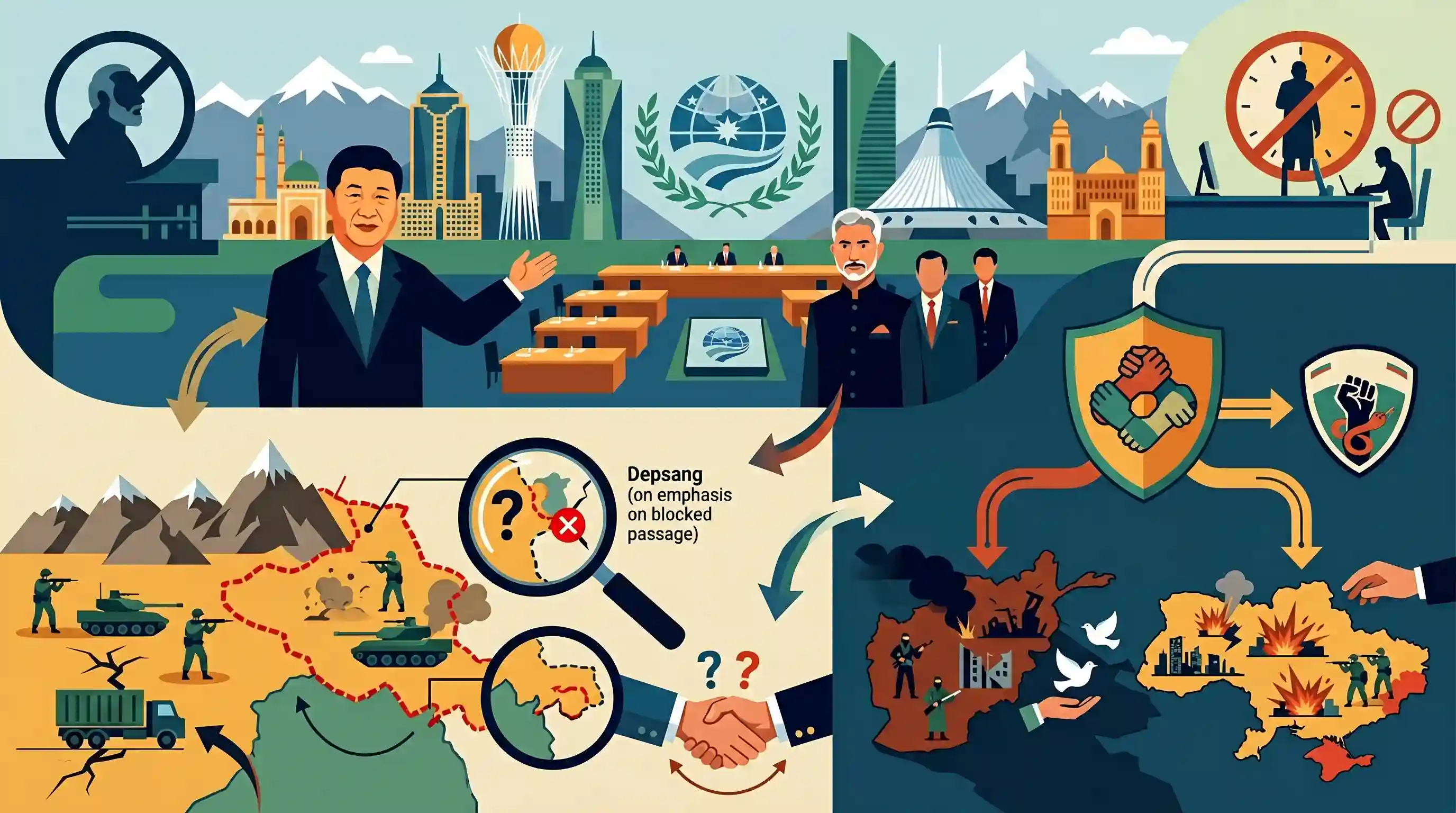
Chinese President Xi Jinping is scheduled to attend the 24th Shanghai Cooperation Organisation (SCO) summit in Astana, Kazakhstan. India's delegation will be led by External Affairs Minister S. Jaishankar, as Prime Minister Narendra Modi skips the event. The multilateral forum presents a critical opportunity for sideline diplomatic engagement between India and China amid strained bilateral relations since the May 2020 military standoff at the Line of Actual Control (LAC). While partial disengagement has occurred, India continues to demand resolution at Depsang and Demchok. The summit's broader agenda includes regional security, coordination via the Regional Anti-Terrorism Structure (RATS), and pressing global conflicts in Afghanistan and Ukraine.
Key Points
- Chinese President Xi Jinping will participate in the 24th SCO summit in Astana, Kazakhstan.
- India will be represented by External Affairs Minister S. Jaishankar, as Prime Minister Narendra Modi is skipping the event.
- The summit provides a potential platform for a sideline bilateral meeting between S. Jaishankar and Chinese Foreign Minister Wang Yi.
- India-China relations remain frosty due to the ongoing standoff at the Line of Actual Control (LAC) since May 2020.
- Despite 21 rounds of military talks and disengagement at several friction points, India continues to press for disengagement in Depsang and Demchok.
- The SCO agenda covers regional security, anti-terrorism (RATS), and geopolitical issues like the situations in Afghanistan and Ukraine.
Important Terms
Shanghai Cooperation Organisation (SCO)

A 10-member Eurasian alliance founded in 2001 for security and economic cooperation. Members include China, Russia, India, Pakistan, Iran, and Belarus (admitted in 2024).
UPSC context
GS Paper II: Important International Institutions; reflects India's Eurasian strategy and regional security interests.
Regional Anti-Terrorism Structure (RATS)
A permanent SCO organ based in Tashkent that facilitates intelligence sharing and coordinates member states' collective fight against terrorism, separatism, and extremism.
UPSC context
GS Paper II/III: Regional security and counter-terrorism; tests understanding of institutionalized intelligence cooperation.
Line of Actual Control (LAC)
The 3,488 km de facto border between India and China, lacking formal demarcation and divided into Western (Ladakh), Middle, and Eastern (Arunachal Pradesh) sectors.
UPSC context
GS Paper II/III: Neighborhood Relations/Security; essential for analyzing border management and bilateral diplomatic stalemates.
Depsang Plains
A strategic high-altitude plateau in Northern Ladakh where Chinese troops have blocked Indian patrols at "Y-junction" bottlenecks, threatening access to the Daulat Beg Oldie airfield.
UPSC context
GS Paper III: Border Security; a primary "legacy" friction point in India-China disengagement talks.
Demchok
A strategic sector in Southern Ladakh where India and China face ongoing disputes over grazing rights and tents pitched in the Charding Nala area near the LAC.
UPSC context
GS Paper III: Security; one of the two major unresolved friction points after the 2020 standoff.
Three Evils
The core security challenges defined by the SCO that its members pledge to combat: terrorism, separatism, and religious extremism.
UPSC context
GS Paper II: International Relations; defines the primary security mandate and ideological framework of the SCO.
Prelims Trap
"The Regional Anti-Terrorist Structure (RATS) is headquartered alongside the SCO Secretariat in Beijing."
RATS is indeed a permanent organ of the SCO, but its headquarters is located in Tashkent, Uzbekistan, whereas the SCO Secretariat is in Beijing.
Static Concepts Connected
What are the core permanent bodies of the SCO?
- SCO Secretariat: The SCO Secretariat is the primary executive body, headquartered in Beijing, China.
- RATS: Headquartered in Tashkent, Uzbekistan, it coordinates member state efforts against the "three evils": terrorism, separatism, and extremism.
Why are Depsang and Demchok critical friction points along the LAC?
- Depsang Plains: Located in Sub-Sector North (SSN), it provides critical access to the Daulat Beg Oldie (DBO) airstrip and Karakoram Pass, defending the route to Siachen.
- Demchok Sector: Situated in southeastern Ladakh near the Indus River, it remains a contested area with overlapping territorial claims that hinder full military disengagement.
Cross-Topic Patterns
Balancing the SCO and Quad
India's participation in the SCO while simultaneously deepening Quad ties exemplifies its strategic autonomy, balancing Eurasian continental realities with Indo-Pacific maritime security.
Bilateral disputes in multilateral forums
The inclusion of India and Pakistan has introduced bilateral frictions into the SCO, frequently stalling consensus-building and complicating counter-terror coordination under RATS.

Expect a 2026 Prelims map question pairing Eastern Ladakh friction points (Depsang, Demchok, Gogra) with adjacent rivers or passes.
Linked PYQs · 4
Linked PYQs · 4
- 2022PrelimsGS1
Consider the following: 1. Asian Infrastructure Investment Bank 2. Missile Technology Control Regime 3. Shanghai Cooperation Organisation India is a member of which of the above?
- 2021MainsGS2
Critically examine the aims and objectives of SCO. What importance does it hold for India?
- 2023MainsGS2
‘Virus of Conflict is affecting the functioning of the SCO’ In the light of the above statement point out the role of India in mitigating the problems.
- 2024MainsGS3
India has a long and troubled border with China and Pakistan fraught with contentious issues. Examine the conflicting issues and security challenges along the border. Also give out the development being undertaken in these areas under the Border Area Development Programme (BADP) and Border Infrastructure and Management (BIM) Scheme.
