Wang Yi India Visit Restarts Special Representatives Boundary Talks
Source:The Hindu ↗
Why It Matters
This visit marks a crucial step in normalizing India-China relations post the LAC standoff, highlighting the importance of the Special Representatives mechanism and high-level dialogue in resolving border disputes and enhancing bilateral cooperation within frameworks like the SCO.
Summary
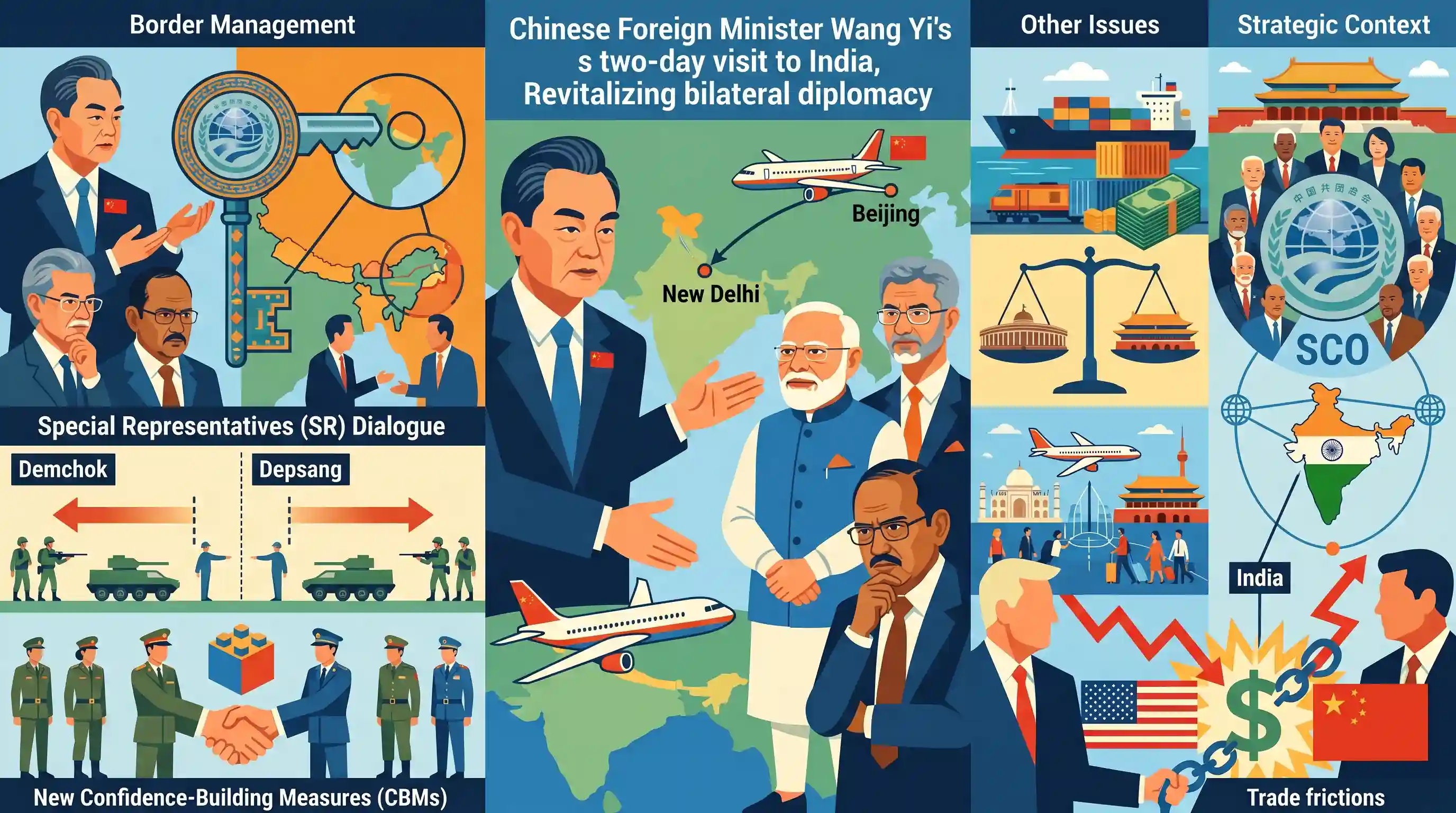
Chinese Foreign Minister Wang Yi's two-day visit to India is set to revitalize bilateral diplomacy with key meetings scheduled with PM Narendra Modi, External Affairs Minister S. Jaishankar, and National Security Adviser Ajit Doval. A significant aspect of the visit is the resumption of the Special Representatives (SR) dialogue on the boundary question. Discussions will focus on border stability following disengagement at Demchok and Depsang, new confidence-building measures (CBMs), and other issues like trade and direct flights. The visit is strategically timed ahead of the upcoming Shanghai Cooperation Organisation (SCO) summit in China and against the backdrop of recent trade frictions with the US.
Key Points
- Chinese Foreign Minister Wang Yi is visiting India to hold talks with top leaders, including PM Modi, EAM S. Jaishankar, and NSA Ajit Doval.
- The visit will feature a new edition of the Special Representatives (SR) dialogue on the boundary question between Wang Yi and NSA Ajit Doval.
- Key agenda items include new Confidence-Building Measures (CBMs), border stability post-disengagement at Demchok and Depsang, trade imbalances, resumption of direct flights, and the Kailash Mansarovar Yatra.
- The diplomatic engagement precedes PM Modi's expected visit to China for the annual SCO summit.
- The bilateral talks take place amid recent strain in India-US relations due to tariffs and disputes over Russian crude imports.
Important Terms
Special Representatives (SR) Dialogue

A high-level diplomatic mechanism established in 2003 between India and China to find a political solution to the boundary dispute, involving India’s NSA and China’s Foreign Minister.
UPSC context
GS Paper II: International Relations. Crucial for understanding border diplomacy and conflict resolution mechanisms in bilateral ties.
Confidence-Building Measures (CBMs)
Diplomatic and military protocols (e.g., hotlines, patrol notifications) designed to reduce mistrust, prevent accidental escalation, and maintain peace along the disputed border.
UPSC context
GS Paper III: Security; GS II: IR. Tests knowledge of border management and institutional stability frameworks.
Shanghai Cooperation Organisation (SCO)
A Eurasian political, economic, and security grouping founded in 2001. India became a full member in 2017, using it for regional stability and Central Asian engagement.
UPSC context
GS Paper II: Regional and Global Groupings. Tests India’s role in multilateralism and regional security (RATS).
Demchok and Depsang
Strategic friction points in Eastern Ladakh along the LAC where disengagement processes are critical for de-escalating the 2020 border standoff and restoring patrolling rights.
UPSC context
GS Paper III: Internal Security/Border Areas. Important for mapping exercises and security challenges in Western Sector.
Line of Actual Control (LAC)
The 3,488 km-long de facto border separating Indian-controlled territory from Chinese-controlled territory, divided into Western, Middle, and Eastern sectors.
UPSC context
GS Paper III: Security. Fundamental for questions on territorial integrity and Himalayan border disputes.
Prelims Trap
The Special Representatives (SR) dialogue is a military-level mechanism to physically delineate the LAC.
The SR mechanism, established in 2003, is a political and strategic dialogue led by the NSA. It seeks a political boundary settlement, unlike military commander talks.
Static Concepts Connected
What are the foundational India-China border agreements?
- 1993 Agreement: Formally recognized the Line of Actual Control (LAC) and committed both sides to maintain peace.
- 1996 CBMs: Instituted strict military caps, such as barring combat aircraft from flying within 10 km of the LAC.
- 2003 SR Mechanism: Appointed Special Representatives to explore a framework for boundary settlement from a political perspective.
What is the geographical significance of Depsang and Demchok?
- Depsang Plains: Located in Sub-Sector North (Ladakh), offering critical access to the strategic Daulat Beg Oldie (DBO) airstrip and the Karakoram Pass.
- Demchok: Situated in southeastern Ladakh near the Indus River and Charding Nullah, historically serving as a key trading route into Tibet.
Cross-Topic Patterns
US tariffs & Asian pragmatism
Escalating US trade friction and potential tariff wars under a new US administration are catalyzing tactical stabilization between Asian giants ahead of the SCO summit.
Border CBMs & Economic De-risking
While border disengagement progresses at Demchok, India's structural trade deficit exceeding $100B annually—driven by vital API and electronics imports—keeps absolute economic decoupling unviable.

Expect a chronological multi-statement question on India-China border mechanisms, tracing the evolution from 1993 CBMs to the SR dialogue.
Linked PYQs · 3
Linked PYQs · 3
- 2023MainsGS2
‘Virus of Conflict is affecting the functioning of the SCO’ In the light of the above statement point out the role of India in mitigating the problems.
- 2014MainsGS2
With respect to the South China sea, maritime territorial disputes and rising tension affirm the need for safeguarding maritime security to ensure freedom of navigation and over flight throughout the region. In this context, discuss the bilateral issues between India and China.
- 2021MainsGS2
Critically examine the aims and objectives of SCO. What importance does it hold for India?
