India China Bilateral Talks Focus on Border De-escalation
Source:The Hindu ↗
Why It Matters
The diplomatic exchanges highlight India's foundational foreign policy doctrine regarding China: peace on the border is an absolute prerequisite for normal bilateral relations. For UPSC aspirants, it is a prime case study of managing a complex adversarial relationship through parallel tracks of military de-escalation, Special Representative dialogue, and multilateral engagement (such as the SCO).
Summary
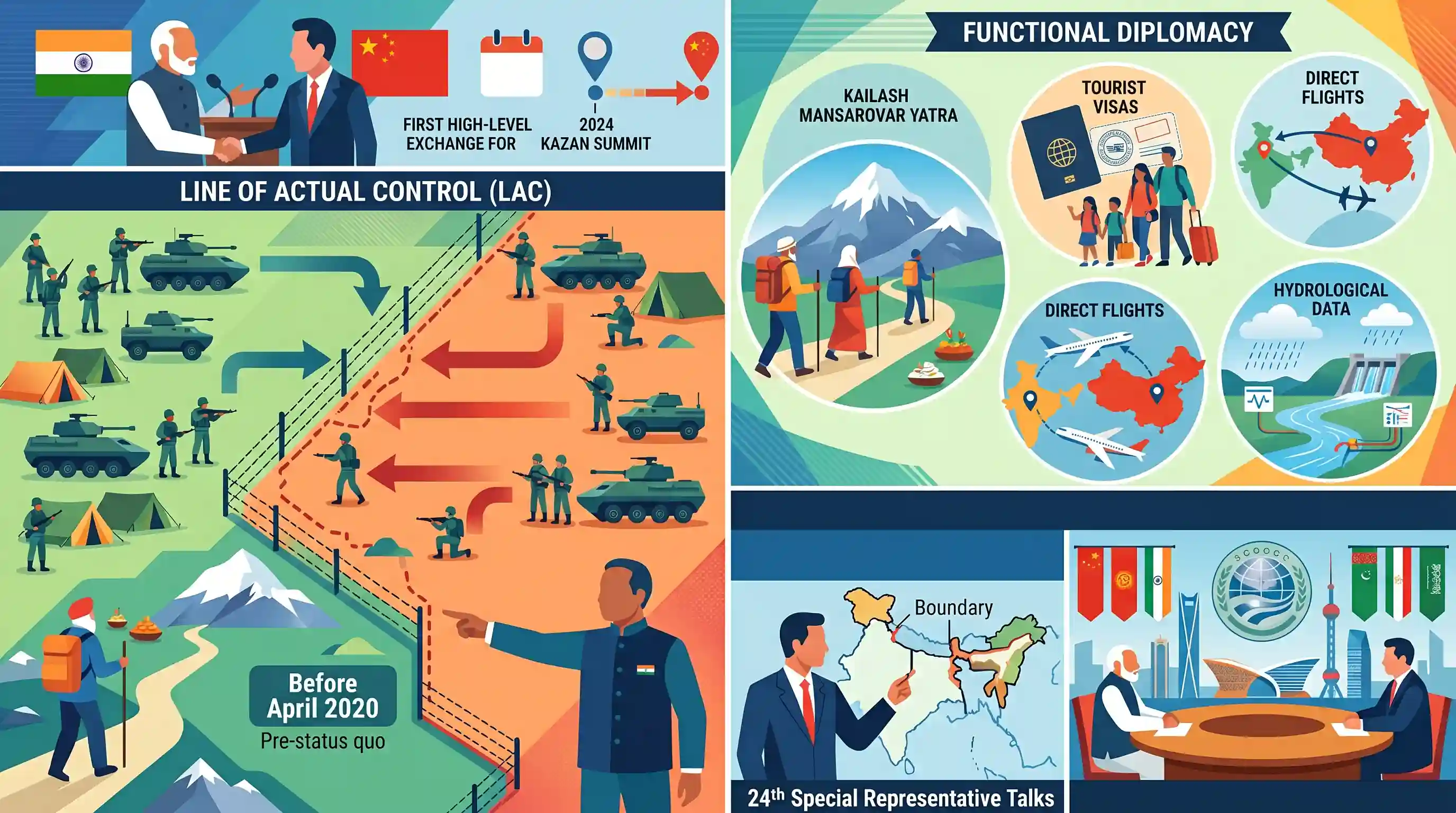
Chinese Foreign Minister Wang Yi's two-day visit to India marks the first high-level ministerial exchange since the 2024 Kazan summit, aimed at continuing the normalization of India-China relations. During the talks, External Affairs Minister S. Jaishankar firmly underscored that progress requires completing the troop de-escalation and demobilization process at the Line of Actual Control (LAC) to restore the pre-April 2020 status quo. The visit sets the stage for the 24th round of Special Representative talks on the boundary dispute led by NSA Ajit Doval, and lays the groundwork for a potential meeting between PM Modi and President Xi Jinping at the upcoming SCO summit in Tianjin. Alongside border security negotiations, the two nations are progressing on functional diplomacy, including restarting the Kailash Mansarovar Yatra, issuing tourist visas, and discussing the resumption of direct flights and hydrological data sharing.
Key Points
- EAM S. Jaishankar met Chinese FM Wang Yi, emphasizing that positive momentum in bilateral ties strictly depends on maintaining peace and tranquillity at the border and advancing the de-escalation process at the LAC.
- The high-level talks aim to prepare the groundwork for a prospective meeting between PM Modi and President Xi Jinping at the upcoming Shanghai Cooperation Organisation (SCO) summit in Tianjin.
- NSA Ajit Doval and Wang Yi are scheduled to hold the 24th round of Special Representative talks, focusing on boundary dispute resolution, delimitation negotiations, and border management.
- Signs of normalizing ties include the resumption of the Kailash Mansarovar Yatra, the issuance of tourist visas, and ongoing discussions to restart direct flights and sharing of transboundary river water data.
Important Terms
Line of Actual Control (LAC)

The un-demarcated, roughly 3,488 km effective border separating Indian-controlled territory from Chinese-controlled territory, which has been the site of significant military standoffs since April 2020.
UPSC context
GS-III Internal Security; vital for understanding border management, territorial sovereignty, and the geopolitical dynamics of the Himalayan region.
Special Representative (SR) talks
A high-level bilateral mechanism established in 2003, co-chaired by India's National Security Adviser and China’s Foreign Minister, to find a political solution to the boundary dispute.
UPSC context
GS-II International Relations; tests knowledge of bilateral diplomatic instruments and the phased approach to resolving long-standing territorial conflicts.
Shanghai Cooperation Organisation (SCO)
A Eurasian political, economic, and security organization comprising ten member states, including India and China, focused on regional stability and combating terrorism, separatism, and extremism.
UPSC context
GS-II International Relations; significant for regional groupings, India’s Central Asia outreach, and balancing multilateral interests.
Kailash Mansarovar Yatra
A sacred annual pilgrimage to Tibet’s Mount Kailash and Lake Mansarovar, managed by India’s MEA via the Lipulekh and Nathu La passes, recently resumed as a normalization gesture.
UPSC context
GS-I Culture and GS-II International Relations; reflects the role of cultural diplomacy and 'soft power' in neighborly ties.
De-escalation
The military process of withdrawing troops from forward-deployed 'face-off' positions to peacetime locations and dismantling temporary infrastructure to reduce border tensions.
UPSC context
GS-III Internal Security; relates to military protocols, border security management, and the restoration of the status quo ante.
Ministry of External Affairs (MEA)
The government department responsible for India's foreign policy, representation in international organizations like the UN, and the management of all bilateral and multilateral diplomatic relations.
UPSC context
GS-II Governance/International Relations; the primary agency for foreign policy formulation and implementation.
Prelims Trap
"India and China share Brahmaputra waters under a formal bilateral water treaty."
India has no formal water-sharing treaty with China. They only operate under Memorandums of Understanding (MoUs) for sharing hydrological data during flood seasons.
Static Concepts Connected
What is the Special Representative (SR) mechanism between India and China?
- Origin: Established in 2003 during PM Vajpayee's visit to explore a framework for boundary settlement from a political perspective.
- Leadership: Currently led by India's National Security Advisor (NSA) and China's Foreign Minister (Wang Yi).
- Three-stage process: 1) Guiding principles, 2) Framework for settlement, 3) Delineating the boundary on maps and ground.
How do India and China manage transboundary rivers?
- No Formal Treaty: Unlike the Indus Water Treaty (Pakistan) or Ganges Treaty (Bangladesh), India has no binding water-sharing treaty with China.
- MoU Mechanism: China provides hydrological data for the Brahmaputra (Yarlung Tsangpo) and Sutlej rivers to India during the monsoon season (May-October) under MoUs.
- Strategic Concern: China's upstream dam construction raises downstream ecological and water security concerns for India, making data-sharing a critical confidence-building measure.
Cross-Topic Patterns
Border negotiations + Plurilateral summits
Major India-China bilateral breakthroughs often occur on the sidelines of plurilateral summits (BRICS Kazan, SCO Tianjin), demonstrating the utility of these platforms for de-escalating bilateral friction.
Hydro-diplomacy + Disaster Management
The sharing of transboundary hydrological data by upper-riparian China directly dictates flood warning capabilities and disaster management readiness in India's Northeast (Assam, Arunachal Pradesh).

UPSC 2026 may frame a multi-statement question contrasting India's formal water treaties (IWT, Ganges) with non-treaty MoUs (China).
Linked PYQs · 3
Linked PYQs · 3
- 2024MainsGS3
India has a long and troubled border with China and Pakistan fraught with contentious issues. Examine the conflicting issues and security challenges along the border. Also give out the development being undertaken in these areas under the Border Area Development Programme (BADP) and Border Infrastructure and Management (BIM) Scheme.
- 2014MainsGS2
With respect to the South China sea, maritime territorial disputes and rising tension affirm the need for safeguarding maritime security to ensure freedom of navigation and over flight throughout the region. In this context, discuss the bilateral issues between India and China.
- 2021MainsGS2
Critically examine the aims and objectives of SCO. What importance does it hold for India?
