South Korea and China Diplomatic Rapprochement Amid Regional Tensions
Source:The Hindu ↗
Why It Matters
The evolving relationship between South Korea, China, Japan, and the US shapes the geopolitical stability of the Indo-Pacific. For UPSC aspirants, this highlights the intricate balance states must maintain between economic dependencies (like critical minerals for semiconductors) and security alliances, offering key insights into global supply chain vulnerabilities and regional security architectures.
Summary
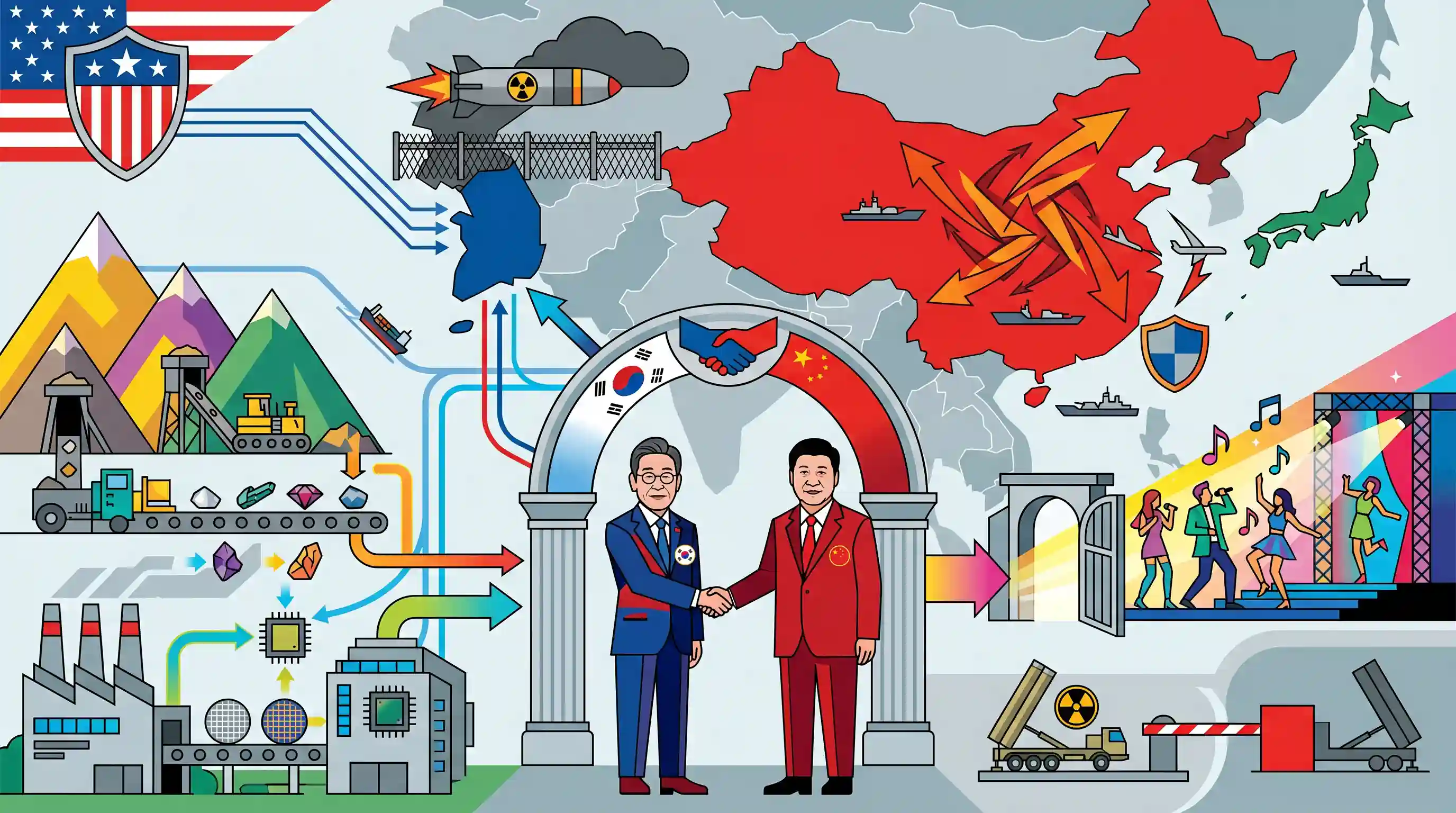
South Korean President Lee Jae Myung is making a state visit to China to meet President Xi Jinping, signaling a foreign policy shift aimed at restoring ties with South Korea's largest trading partner. The visit takes place against a backdrop of escalating tensions between China and Japan over Taiwan. Key agenda items include securing supply chains for critical minerals essential to semiconductor manufacturing, navigating the dynamics of the South Korea-US security alliance, addressing North Korea's nuclear threats, and potentially resolving China's ban on K-pop that was instituted following the 2017 deployment of the US THAAD missile defense system in South Korea.
Key Points
- South Korean President Lee Jae Myung is set to visit China to meet President Xi Jinping on January 4, 2026, seeking to restore bilateral ties.
- The diplomatic overture represents a pivot from the previous South Korean administration's strict alignment with the US and Japan.
- South Korea aims to secure its supply chains, particularly relying on China for critical minerals and rare earth elements necessary for its semiconductor industry.
- The meeting occurs amid escalated China-Japan tensions following Japanese PM Sanae Takaichi's remarks on potential military intervention over Taiwan.
- Discussions will touch upon the broader strategic landscape, including North Korea's nuclear program, the role of US forces in South Korea, and resolving China's 2017 ban on K-pop linked to the THAAD missile defense deployment.
Important Terms
THAAD (Terminal High Altitude Area Defense)

A U.S. anti-ballistic missile system designed to intercept short and medium-range missiles in their final flight phase using hit-to-kill technology.
UPSC context
GS Paper 2: International Relations. Relevant for understanding East Asian security dynamics and U.S.-China-South Korea relations.
U.S. Forces Korea (USFK)
The permanent military presence of the United States on the Korean Peninsula, mandated by the 1953 ROK-U.S. Mutual Defense Treaty.
UPSC context
GS Paper 2: International Relations. Key to understanding Indo-Pacific security architecture and U.S. strategic posture.
Critical Minerals
Non-fuel minerals like lithium and rare earths essential for high-tech industries, characterized by supply chain vulnerabilities and high economic importance.
UPSC context
GS Paper 3: Economy/Science & Tech. Critical for India's semiconductor mission and green energy transition.
Hallyu Ban
Unofficial restrictions imposed by China on South Korean cultural exports, including K-pop and films, as economic retaliation for security decisions.
UPSC context
GS Paper 2: International Relations. Illustrates the use of economic coercion and soft power in bilateral disputes.
Semiconductor Supply Chain
The globalized production network for microchips, involving mineral extraction, design, and fabrication, often subject to geopolitical tensions.
UPSC context
GS Paper 3: Science & Tech. Essential for understanding technological sovereignty and India's electronics manufacturing goals.
Prelims Trap
"Rare Earth Elements are extremely scarce in the Earth's crust."
REEs are actually relatively abundant in the Earth's crust. They are called 'rare' because they are seldom found in concentrated, economically viable ores.
Static Concepts Connected
What are Rare Earth Elements (REEs) and why are they critical?
- Composition: A group of 17 chemically similar elements comprising 15 lanthanides plus scandium and yttrium.
- Geological occurrence: They are technically abundant in the Earth's crust but rarely occur in economically viable concentrations, making extraction complex.
- Strategic applications: Indispensable for semiconductor manufacturing, clean energy technologies (EVs, wind turbines), and advanced defense systems.
How does the THAAD missile defense system operate?
- Origin: An American anti-ballistic missile defense system deployed in allied nations to counter regional threats.
- Mechanism: Utilizes 'hit-to-kill' kinetic energy technology rather than explosive warheads to destroy incoming missiles.
- Target Phase: Designed to intercept short- and medium-range ballistic missiles specifically during their terminal (descent) phase.
Cross-Topic Patterns
Middle Power Strategic Autonomy
South Korea balancing US security ties with Chinese economic dependence mirrors India's own 'multi-alignment' strategy, often requiring a tightrope walk between strategic partners and economic realities.
Semiconductors and Critical Minerals
South Korea's vulnerability to China's near-monopoly on processing REEs underscores the urgency behind India's Critical Minerals Mission and Quad supply-chain resilience initiatives.

Expect a 2026 Prelims question testing the 'hit-to-kill' mechanism of THAAD alongside a geography statement on the abundance of Rare Earth Elements.
Linked PYQs · 3
Linked PYQs · 3
- 2025MainsGS3
India aims to become a semiconductor manufacturing hub. What are the challenges faced by the semiconductor industry in India? Mention the salient features of the India Semiconductor Mission.
- 2021MainsGS2
The newly tri-nation partnership AUKUS is aimed at countering China's ambitions in the Indo-Pacific region. Is it going to supersede the existing partnerships in the region? Discuss the strength and impact of AUKUS in the present scenario.
- 2018PrelimsGS1
What is "Terminal High Altitude Area Defense (THAAD)", sometimes seen in the news?
