Xi Jinping Visits Kazakhstan to Strengthen Bilateral Ties
Source:The Hindu ↗
Why It Matters
Central Asia is a region of paramount strategic interest to India for energy security, regional connectivity (e.g., INSTC, Chabahar Port), and stability in Afghanistan. China's declaration of 'eternal' partnerships and its expanding economic dominance through the BRI in the Central Asian Republics pose geopolitical challenges to India's own outreach and connectivity ambitions in its extended neighborhood.
Summary
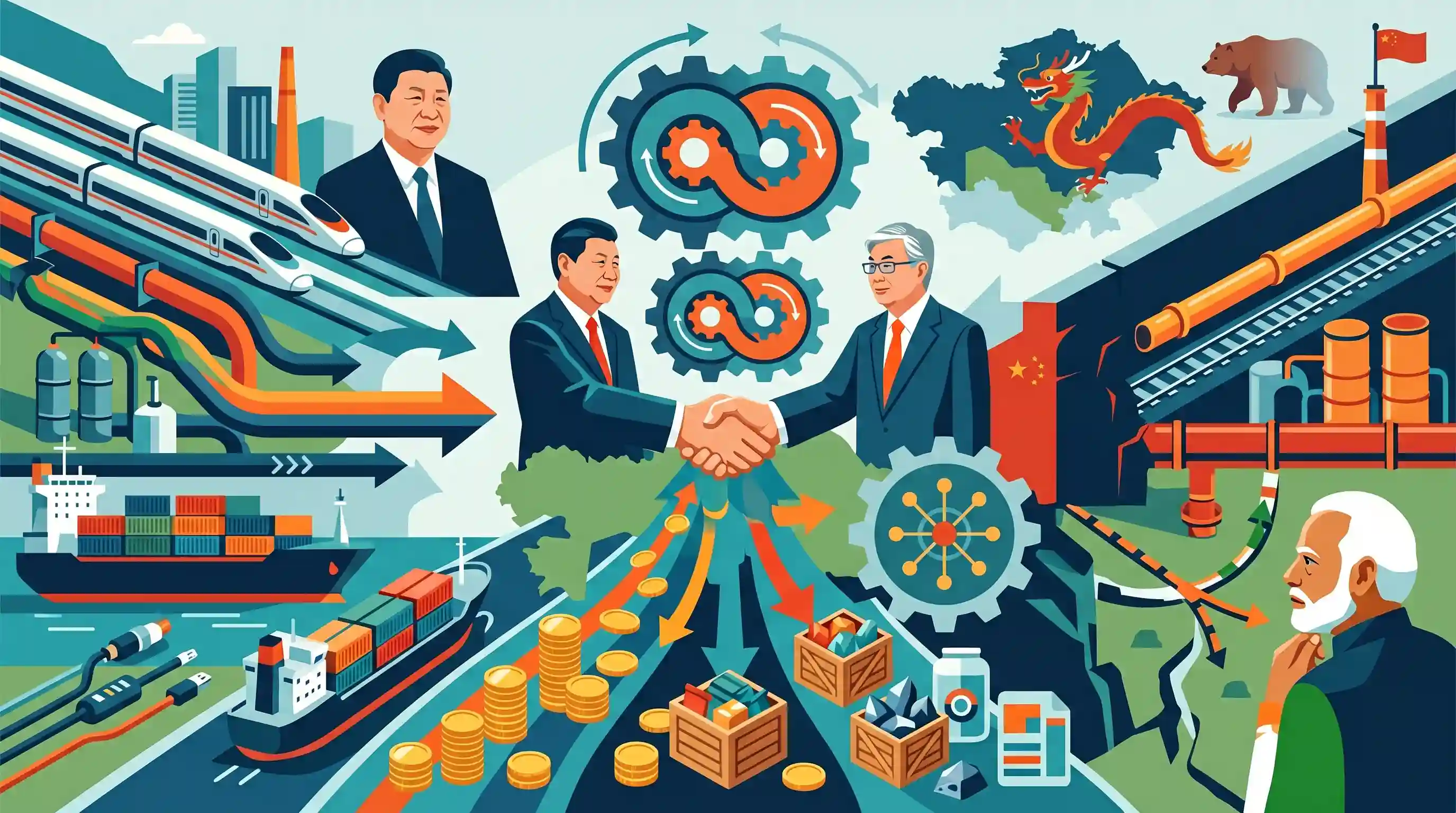
Chinese President Xi Jinping’s state visit to Kazakhstan underlines China’s deepening strategic penetration into Central Asia. Meeting with Kazakh President Kassym-Jomart Tokayev ahead of the Shanghai Cooperation Organisation (SCO) summit in Astana, the two leaders proclaimed an “eternal comprehensive strategic partnership.” This relationship is anchored by booming economic ties; bilateral trade surged 32% in 2023 to nearly $40 billion, establishing China as Kazakhstan's leading trade partner. The diplomatic maneuvering highlights Kazakhstan's critical role as a linchpin in the Belt and Road Initiative (BRI), offering Beijing secure overland trade corridors to Europe. Xi’s expanding influence in Central Asia, a region historically dominated by Russia, signifies China's growing geopolitical weight and its intent to secure resource and supply-chain stability.
Key Points
- Chinese President Xi Jinping visited Astana, Kazakhstan, to participate in the SCO summit and solidify bilateral relations with President Kassym-Jomart Tokayev.
- China and Kazakhstan declared an 'eternal comprehensive strategic partnership', highlighting Beijing's long-term strategic investments in Central Asia.
- Bilateral trade grew 32% in 2023 to nearly $40 billion, cementing China as Kazakhstan's largest trading partner.
- Central Asia serves as a crucial transit hub for China's Belt and Road Initiative (BRI), providing alternative land routes to Europe amidst geopolitical tensions.
- The visit reflects China's expanding footprint in a region traditionally viewed as Russia's strategic backyard, although both powers currently align against Western influence.
Important Terms
Belt and Road Initiative (BRI)

A global infrastructure strategy launched by China in 2013 to connect Asia, Europe, and Africa via land-based (Belt) and maritime (Road) networks.
UPSC context
GS-II: Regional groupings and agreements affecting India’s interests; specifically regarding sovereignty concerns (CPEC) and Chinese geopolitical expansion.
Shanghai Cooperation Organisation (SCO)
A Eurasian political, economic, and security alliance established in 2001. Members include India, Pakistan, China, Russia, and Central Asian states, focusing on regional stability.
UPSC context
GS-II: Important international institutions; tests India’s strategic balancing between Western-led forums and Eurasian groupings.
Central Asia
A landlocked geostrategic region comprising Kazakhstan, Kyrgyzstan, Tajikistan, Turkmenistan, and Uzbekistan, considered part of India’s 'extended neighborhood' and a vital energy hub.
UPSC context
GS-II: Bilateral and regional relations; central to India’s energy security (uranium) and the 'Connect Central Asia Policy.'
Comprehensive Strategic Partnership
A high-level diplomatic framework signifying a deep, multifaceted, and long-term commitment across diverse sectors like defense, trade, and technology, reflecting high mutual trust.
UPSC context
GS-II: Diplomatic terminology; relevant for analyzing the maturity and depth of bilateral relationships in international affairs.
Connect Central Asia Policy
India’s 2012 foreign policy initiative aimed at strengthening political, security, economic, and cultural links with the five Central Asian republics to overcome geographical barriers.
UPSC context
GS-II: India and its neighborhood; tests knowledge of strategic outreach to landlocked regions and Eurasian integration.
Regional Anti-Terrorist Structure (RATS)
A permanent body of the SCO based in Tashkent, designed to coordinate member states’ efforts against the 'three evils' of terrorism, separatism, and extremism.
UPSC context
GS-II/III: International institutions and internal security; vital for India's intelligence-sharing and counter-terrorism cooperation in Eurasia.
Prelims Trap
"The Middle Corridor connects China to Europe by transiting primarily through Russian territory."
The Middle Corridor (Trans-Caspian Transport Route) specifically bypasses Russia, routing goods from China through Kazakhstan, the Caspian Sea, Azerbaijan, and Georgia to reach Europe.
Static Concepts Connected
What are the core pillars of India's Connect Central Asia Policy?
- Launch & Scope: Initiated in 2012 to build deeper political, economic, and security partnerships with the five Central Asian Republics.
- Energy Security: Securing uranium (especially from Kazakhstan) and hydrocarbons (Turkmenistan/Uzbekistan) to fuel India's growing economy.
- Connectivity Barrier: Overcoming the lack of direct land access (due to Pakistan) via the INSTC and Chabahar Port in Iran.
What is the Shanghai Cooperation Organisation (SCO) and its core mandate?
- Eurasian Alliance: Formed in 2001 by China, Russia, and Central Asian states. India and Pakistan became full members in 2017.
- Security Mandate (RATS): The Regional Anti-Terrorist Structure (RATS) operates out of Tashkent to combat the 'three evils': terrorism, separatism, and extremism.
- Geopolitical Role: Increasingly viewed as a non-Western geopolitical bloc driving Eurasian integration, though internal India-China-Pakistan frictions limit consensus.
Cross-Topic Patterns
Uranium supply + Clean Energy
Kazakhstan is the world's largest uranium producer. China's deepening economic grip threatens to crowd out India's civil-nuclear fuel sourcing, which is critical for India's net-zero clean energy transition.
Middle Corridor vs INSTC connectivity
China is building the East-West 'Middle Corridor' bypassing Russia, while India develops the North-South INSTC bypassing Pakistan. Central Asia forms the geographic focal point of this connectivity race.

Map-based Prelims question on the Middle Corridor's route (Kazakhstan, Caspian, Caucasus) or an SCO vs Connect Central Asia mains Q in 2026.
Linked PYQs · 3
Linked PYQs · 3
- 2024MainsGS2
Critically analyse India's evolving diplomatic, economic and strategic relations with the Central Asian Republics (CARs) highlighting their increasing significance in regional and global geopolitics.
- 2018MainsGS2
A number of outside powers have entrenched themselves in Central Asia, which is a zone of interest to India. Discuss the implications, in this context, of India's joining the Ashgabat Agreement, 2018.
- 2022PrelimsGS1
Consider the following countries: 1. Azerbaijan 2. Kyrgyzstan 3. Tajikistan 4. Turkmenistan 5. Uzbekistan Which of the above have borders with Afghanistan ?
