Chinese Trade Practices and Global Supply Chain Securitisation
Source:The Hindu ↗
Why It Matters
The article is highly relevant for understanding the evolving global trade dynamics, specifically the 'Trade War' narrative, WTO reforms, and the growing intersection between economic policy and national security. It highlights India's stance on protectionism, supply chain resilience, and the strategic screening of FDI, which are crucial themes in both IR (GS2) and Economy/Security (GS3).
Summary
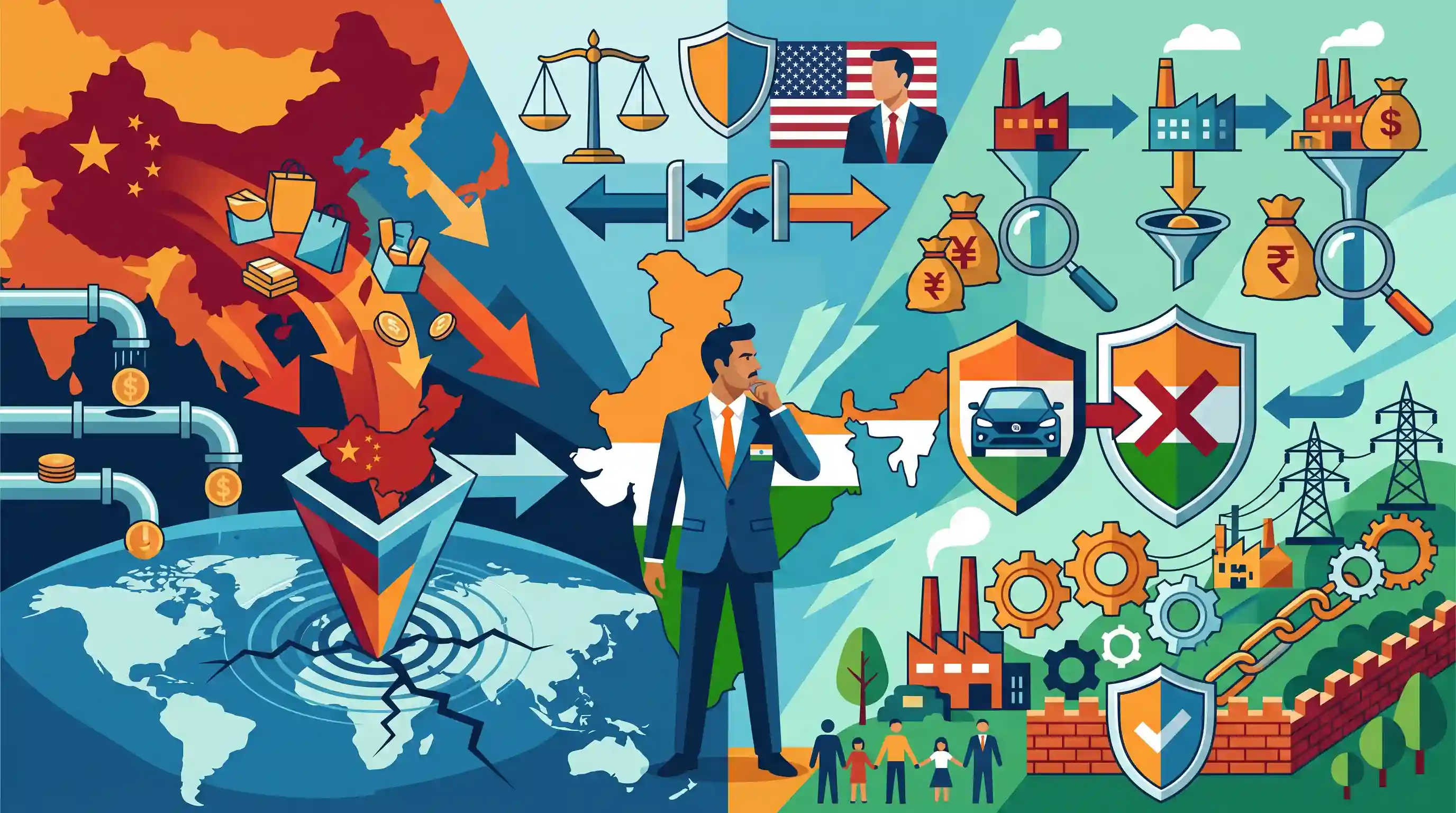
Commerce and Industry Minister Piyush Goyal criticized China's trade policies, specifically its non-transparent subsidies, dumping, and predatory pricing, arguing that its entry into the World Trade Organization (WTO) has led to significant global economic disruption. Goyal defended the idea of reciprocal tariffs, such as those proposed by US President-elect Donald Trump, as a legitimate mechanism to counter unfair global trade practices. Furthermore, Goyal highlighted India's strategic caution regarding Chinese investments, citing the rejection of an EV manufacturing proposal by BYD, emphasizing that Foreign Direct Investment (FDI) must not compromise national security or domestic supply chain resilience.
Key Points
- Union Minister Piyush Goyal attributed ongoing global economic turmoil to China's unfair trade practices, including non-transparent subsidies, dumping, and predatory pricing since its WTO entry.
- India expressed understanding toward the US's proposed 'reciprocal tariffs', validating protectionist measures as a response to imbalanced and unfair global trade practices.
- The rejection of a proposed electric vehicle plant by Chinese firm BYD highlights India's policy of securitising Foreign Direct Investment (FDI) to protect strategic interests and supply chains.
- The developments reflect a broader global shift away from unfettered globalization toward prioritizing supply chain resilience and protecting domestic manufacturing capacities.
Important Terms
World Trade Organization (WTO)

An international body (est. 1995) that regulates global trade rules, facilitates negotiations, and resolves disputes among its 166 members to ensure free and fair commerce.
UPSC context
GS Paper 2/3: Important International Institutions and global trade dynamics; critical for understanding India’s stance on subsidies.
Free Trade Agreements (FTAs)
Treaties between two or more countries to reduce or eliminate trade barriers like tariffs and quotas, aimed at increasing bilateral trade and economic integration.
UPSC context
GS Paper 3: Indian Economy and trade policy; tests knowledge of recent pacts (UAE, UK, EFTA) and export strategy.
Build Your Dreams (BYD)
A Chinese electric vehicle (EV) giant whose $1 billion manufacturing proposal was rejected by India, highlighting the intersection of foreign investment and national security concerns.
UPSC context
GS Paper 2/3: FDI policy and security challenges; specifically relevant to India-China relations and domestic manufacturing.
Predatory Pricing
An anti-competitive practice where a dominant firm sells products at very low prices (often below cost) to eliminate competitors and create a monopoly.
UPSC context
GS Paper 3: Competition law and fair trade; tests understanding of market distortions and regulatory responses.
Supply Chain Resilience Initiative (SCRI)
A trilateral framework between India, Japan, and Australia to diversify supply chains and reduce over-dependence on China in the Indo-Pacific region.
UPSC context
GS Paper 2: International Relations and Indo-Pacific geopolitics; tests knowledge of strategic economic groupings.
Press Note 3 (2020)
A 2020 Indian government regulation requiring prior approval for FDI from countries sharing a land border with India to prevent opportunistic takeovers.
UPSC context
GS Paper 3: FDI policy and National Security; crucial for explaining the legal basis of blocking Chinese investments.
Prelims Trap
FDI from countries sharing a land border with India is strictly prohibited under current policy.
Press Note 3 (2020) does not ban FDI from land-bordering nations; it mandates prior government approval, shifting it away from the automatic route to prevent opportunistic takeovers.
Static Concepts Connected
What are the primary trade defense instruments permitted under the WTO?
- Anti-dumping Duty (ADD): Imposed on imports priced below their normal domestic value to protect local manufacturing.
- Countervailing Duty (CVD): Levied on imports to neutralize the negative impact of non-transparent foreign government subsidies.
- Safeguard Measures: Temporary restrictions applied when a sudden surge in imports threatens serious injury to domestic producers.
How does India regulate FDI from land-bordering countries for national security?
- Press Note 3 (2020): Amended the FDI policy to require mandatory government approval for investments from any country sharing a land border with India.
- Beneficial Ownership Clause: The restriction applies even if the investing entity is based elsewhere but the ultimate beneficial owner resides in a bordering country.
- Strategic Intent: The core intent is to prevent opportunistic takeovers and secure critical supply chains (like EVs and pharma) from adversarial control.
Cross-Topic Patterns
EVs, Critical Minerals, and Trade Security
Rejecting Chinese EV plants intersects with India's push for domestic critical mineral security, highlighting the dilemma of needing advanced clean-tech while avoiding strategic over-reliance on Beijing.
IPEF and Supply Chain Resilience
The shift from WTO-led globalization to secure trade networks mirrors India's active participation in the Indo-Pacific Economic Framework (IPEF), specifically its supply chain resilience pillar.

Expect a 2026 multi-statement Prelims question contrasting WTO trade remedies (ADD vs CVD) with FDI regulations under Press Note 3.
Linked PYQs · 4
Linked PYQs · 4
- 2018MainsGS2
What are the key areas of reform if the WTO has to survive in the present context of "Trade War', especially keeping in mind the interest of India?
- 2016MainsGS2
The broader aims and objectives of WTO are to manage and promote international trade in the era of globalization. But the Doha round of negotiations seem doomed due to differences between the developed and the developing countries." Discuss in the Indian perspective.
- 2012MainsGS2
Discuss the likely negative impact of the protectionist measures proposed by the US on India's software industry.
- 2013MainsGS3
Discuss the impact of FDI entry into Multi-trade retail sector on supply chain management in commodity trade pattern of the economy.
