China warns Philippines over maritime disputes in South China Sea
Source:The Hindu ↗
Why It Matters
The South China Sea dispute is a defining feature of modern Indo-Pacific geopolitics. For UPSC aspirants, it is critical to understand the intersection of maritime territorial claims, the application of UNCLOS (such as EEZ rights), and the strategic power play between China and US-led alliances. This directly relates to India\'s own interests in a rules-based international order, freedom of navigation, and its strategic engagements like the Quad.
Summary
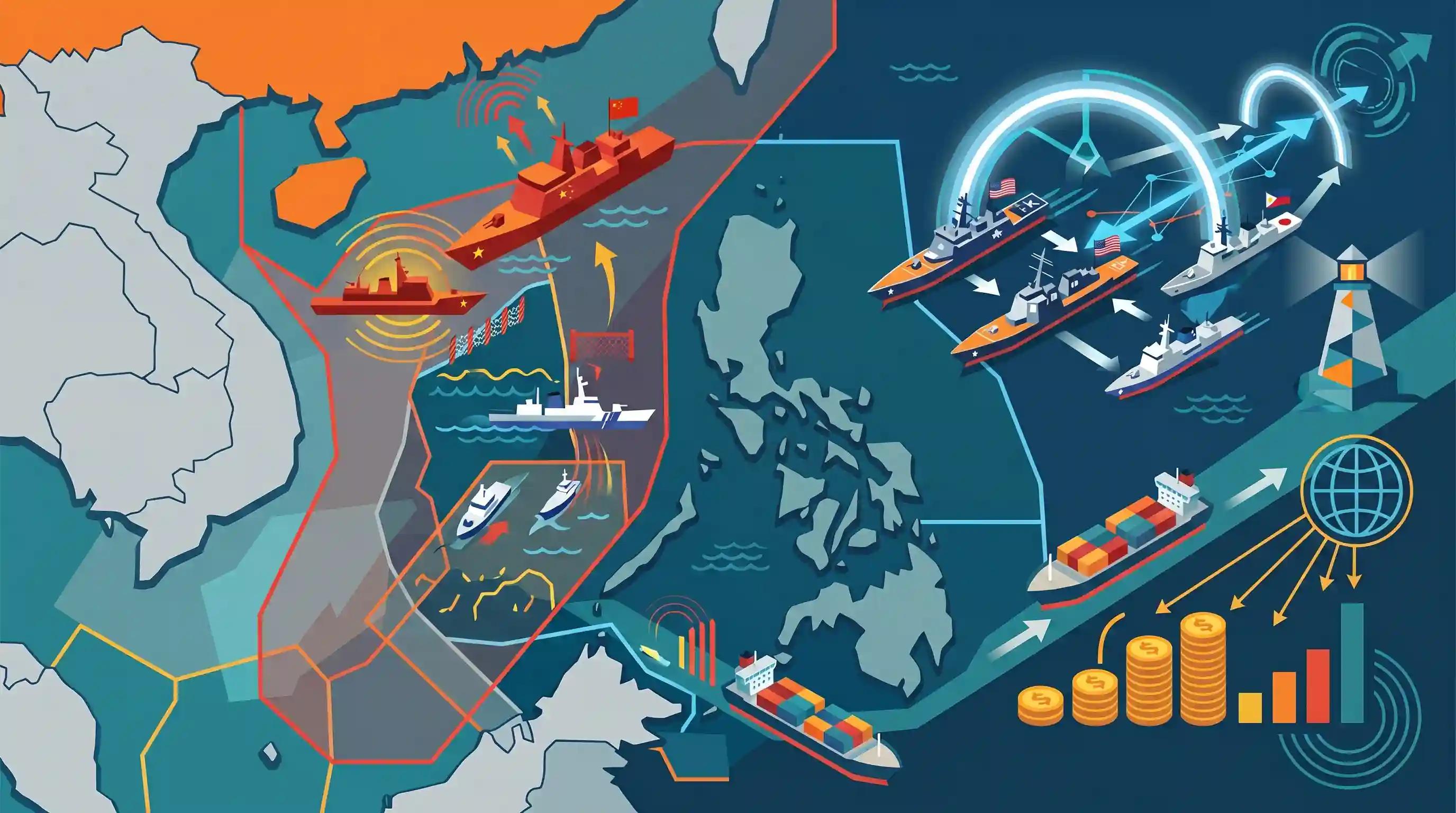
The Chinese military has issued a stern warning to the Philippines against what it terms "provocations" in the disputed South China Sea, following a series of maritime standoffs. This development coincides with joint maritime exercises conducted by the United States, Japan, and the Philippines within the Philippine Exclusive Economic Zone (EEZ) to promote a free and open Indo-Pacific. China claims almost the entirety of the resource-rich South China Sea, an assertion that overlaps with the maritime claims of the Philippines, Brunei, Malaysia, and Vietnam. The dispute underscores the broader geopolitical rivalry in the Indo-Pacific, with the US firmly affirming its support for Manila. Ensuring freedom of navigation in the South China Sea remains a critical global security concern, given that the waterway facilitates over $3 trillion in annual international commerce.
Key Points
- China\'s military warned the Philippines to halt "provocations" in the disputed South China Sea amid ongoing maritime standoffs.
- The US, Japan, and the Philippines conducted joint maritime exercises in the Philippine Exclusive Economic Zone (EEZ) to support a free and open Indo-Pacific.
- China claims almost the entire South China Sea, overlapping with the territorial claims of the Philippines, Brunei, Malaysia, and Vietnam.
- The South China Sea is a critical geopolitical waterway that carries over $3 trillion of annual global commerce, making freedom of navigation a major international priority.
- US Secretary of State Marco Rubio reaffirmed Washington\'s support for the Philippines, reflecting the broader strategic rivalry between the US and China in the Indo-Pacific region.
Important Terms
United Nations Convention on the Law of the Sea (UNCLOS)

A 1982 international treaty establishing a legal framework for all maritime activities, defining nations' rights and responsibilities regarding the world's oceans and resources.
UPSC context
GS-2 International Relations; tests knowledge of international law, maritime zones, and India’s support for a rules-based ocean order.
Exclusive Economic Zone (EEZ)
A sea zone extending up to 200 nautical miles from a coastal baseline where a state has exclusive rights for resource exploration and exploitation.
UPSC context
GS-1 Geography & GS-2 IR; relevant for maritime boundary disputes and resource management like India's Deep Ocean Mission.
Indo-Pacific
A strategic geopolitical space encompassing the Indian and Pacific Oceans, central to India’s ‘Act East’ policy and maritime security vision (SAGAR).
UPSC context
GS-2 Regional Groupings; core to discussions on QUAD, ASEAN centrality, and countering regional hegemony.
Nine-Dash Line
A U-shaped line used by China to claim historic sovereignty over nearly 90% of the South China Sea, declared legally baseless by a 2016 tribunal.
UPSC context
GS-2 India & Neighborhood; tests understanding of China's territorial assertiveness and its impact on regional security and trade.
Freedom of Navigation (FON)
An international law principle allowing ships of any state to transit international waters and EEZs without interference from other nations.
UPSC context
GS-2 Maritime Security; critical for global trade flows ($5T+ through SCS) and protecting India's energy interests.
Prelims Trap
Foreign military vessels require the coastal state's permission to navigate through its Exclusive Economic Zone (EEZ).
UNCLOS grants resource extraction rights in the EEZ, but surface waters retain freedom of navigation. Foreign military vessels do not need consent to transit.
Static Concepts Connected
What are the key maritime zones and their specific rights under UNCLOS?
- Territorial Sea: Extends 12 nautical miles from the baseline; the coastal state has absolute sovereignty, subject only to the right of 'innocent passage' for foreign ships.
- Contiguous Zone: Extends up to 24 nautical miles; the state can enforce customs, fiscal, immigration, and sanitary laws here.
- EEZ: Extends up to 200 nautical miles; the state holds sovereign rights over natural resources, but all other states enjoy freedom of navigation and overflight.
Who are the primary claimants in the South China Sea territorial dispute?
- Key Claimants: The overlapping claims involve China, Taiwan, the Philippines, Vietnam, Malaysia, and Brunei. (Indonesia has EEZ disputes but does not claim the disputed islands).
- Disputed Features: Major flashpoints include the Spratly Islands (claimed by multiple nations), the Paracel Islands (China, Vietnam, Taiwan), and the Scarborough Shoal (China, Philippines).
- PCA 2016 Ruling: A 2016 Permanent Court of Arbitration tribunal invalidated China's 'Nine-Dash Line' historical claims under UNCLOS, a ruling China wholly rejects.
Cross-Topic Patterns
BrahMos diplomacy + Act East Policy
India's supply of BrahMos missiles to the Philippines connects maritime disputes directly to India's Act East Policy, transitioning India from a normative power to a regional net security provider.
Rise of Indo-Pacific Minilaterals
Trilateral US-Japan-Philippines exercises mirror the broader shift toward issue-based minilateralism (like Quad and AUKUS) to enforce maritime order where UN institutions face enforcement deficits.

UNCLOS EEZ navigation rights and map-matching of South China Sea islands (Spratlys/Paracels) are prime targets for a 2026 prelims pair.
Linked PYQs · 4
Linked PYQs · 4
- 2014MainsGS2
With respect to the South China sea, maritime territorial disputes and rising tension affirm the need for safeguarding maritime security to ensure freedom of navigation and over flight throughout the region. In this context, discuss the bilateral issues between India and China.
- 2022PrelimsGS1
With reference to the United Nations Convention on the Law of Sea, consider the following statements : 1. A coastal state has the right to establish the breadth of its territorial sea up to a limit not exceeding 12 nautical miles, measured from baseline determined in accordance with the convention. 2. Ships of all states, whether coastal or land-locked, enjoy the right of innocent passage through the territorial sea. 3. The Exclusive Economic Zone shall not extend beyond 200 nautical miles from the baseline from which the breadth of the territorial sea is measured. Which of the statements given above are correct?
- 2020MainsGS2
What is the significance of Indo-US defence deals over Indo-Russian defence deals? Discuss with reference to stability in the Indo-Pacific region.
- 2021MainsGS2
The newly tri-nation partnership AUKUS is aimed at countering China's ambitions in the Indo-Pacific region. Is it going to supersede the existing partnerships in the region? Discuss the strength and impact of AUKUS in the present scenario.
