China Helium Export Ban Threatens Critical Technology Supply
Source:The Hindu ↗
Why It Matters
This article highlights a vital supply chain vulnerability in high-technology manufacturing. As India pushes to establish itself as a semiconductor fabrication hub under the India Semiconductor Mission (ISM), its 100% import dependency on helium—now subject to Chinese export curbs—poses a severe strategic bottleneck. It demonstrates how modern geopolitics has shifted from energy resources to critical materials and semiconductor supply chain dominance.
Summary
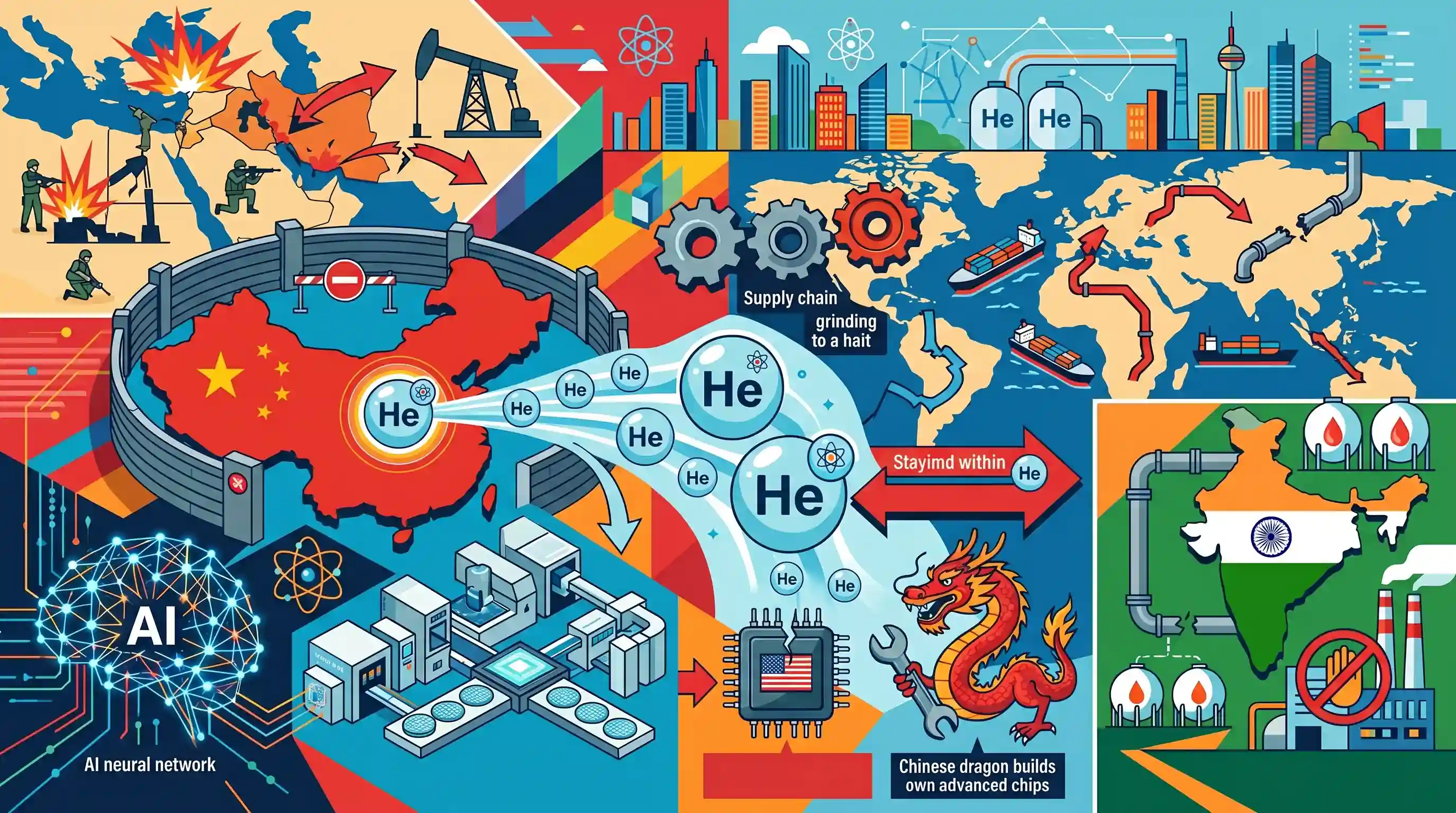
China has imposed a temporary export ban on helium, effective July 10, 2026, citing supply concerns driven by escalating military conflicts in West Asia (Israel-US strikes on Iran). Helium is indispensable for heat management in semiconductor fabrication and cryogenic technologies. China is securing its domestic supply to support its local AI and chip manufacturing industries, which are transitioning to self-reliance due to U.S. restrictions on high-end Nvidia chips. This development exposes severe global supply chain vulnerabilities, particularly for India, which relies 100% on imports for its helium needs, threatening its domestic semiconductor manufacturing ambitions.
Key Points
- China has announced an immediate and temporary export ban on helium (effective July 10, 2026) in response to escalating military conflicts in West Asia (Israel-US strikes on Iran), which threaten global supply chains.
- Helium is a critical raw material essential for thermal and heat management during semiconductor (chip) manufacturing, as well as for cryogenic applications such as China's EAST nuclear fusion reactor.
- The ban is a defensive measure by Beijing to secure domestic helium reserves for its fast-evolving artificial intelligence (AI) and chipmaking sectors, which are increasingly relying on domestic fabrication due to U.S. export controls on advanced Nvidia semiconductors.
- This move reflects a growing trend of 'resource nationalism' and supply preservation by China, which has previously restricted exports of other critical materials like fuel, fertilisers, and sulphuric acid.
- Crucially for India, the nation is 100% import-dependent for Helium, making its ambitious domestic semiconductor goals under the India Semiconductor Mission (ISM) and other high-tech sectors (such as healthcare MRI machines) highly vulnerable to such geopolitical shocks.
Important Terms
India Semiconductor Mission (ISM)

A Government of India initiative launched in 2021 with a ₹76,000 crore outlay to build a robust domestic semiconductor and display manufacturing ecosystem, covering design, fabrication, testing, and packaging.
UPSC context
GS Paper III (Science & Technology/Economy); tests knowledge of industrial policy, electronic manufacturing, and technology indigenisation.
National Critical Minerals Mission (NCMM)
A policy framework approved with a ₹16,300 crore outlay to secure India's supply of 30 critical minerals through domestic exploration, overseas acquisitions, recycling, and fast-tracked regulatory processes.
UPSC context
GS Paper III (Economy/Infrastructure); tests awareness of strategic resource security and the transition to clean energy technologies.
Helium
A lightweight, chemically inert noble gas that acts as an irreplaceable cooling agent in semiconductor manufacturing, MRI machines, and cryogenics due to its extremely low boiling point near absolute zero.
UPSC context
GS Paper III (Science & Technology/Resources); tests understanding of elemental properties, strategic applications, and import dependency.
Resource Nationalism
Geopolitical actions and state policies where countries prioritize domestic control, processing, and export restrictions of their natural resources (such as minerals) for national economic and strategic benefits.
UPSC context
GS Paper II (International Relations) & Paper III; tests analytical skills on trade geopolitics and global supply chains.
Nvidia
A leading global technology company specializing in graphics processing units (GPUs) and AI computing infrastructure, whose products are core to the global technology and semiconductor trade wars.
UPSC context
GS Paper III (Science & Technology/Economy); tests knowledge of AI hardware, semiconductor geopolitics, and global technological dominance.
Prelims Trap
Helium is a highly renewable resource on Earth, easily synthesized chemically or abundantly extracted as a primary component of Indian natural gas.
Helium is non-renewable on Earth (produced slowly via radioactive decay) and cannot be chemically synthesized. Furthermore, Indian natural gas fields are extremely lean in helium (<0.05%), making commercial extraction unviable.
Static Concepts Connected
What are the unique properties, origin, and commercial production methods of Helium?
- Commercial Extraction: Commercially extracted as a minor byproduct of Liquified Natural Gas (LNG) processing; it cannot be practically synthesized.
- Geological Origin: Formed over millions of years via the alpha decay (radioactive decay) of heavy elements like uranium and thorium.
- Key Properties: Possesses the lowest boiling point (-268.9°C), high thermal conductivity, and small atomic radius, making it irreplaceable for cryogenics.
Why does India face helium scarcity and where is it exploring alternative extraction?
- Lean Reserves: Indian natural gas fields contain extremely low concentrations (~0.05%), well below the 0.3% viable commercial extraction limit.
- Alternative Sources: Exploring geothermal hot springs in the Bakreswar-Tantloi region (West Bengal-Jharkhand), where helium concentrations reach an economically viable 1.2-2.7%.
- Strategic Vulnerability: India is 100% import-dependent, sourcing over half of its helium from Qatar, exposing high-tech sectors to West Asian geopolitical shocks.
Cross-Topic Patterns
Geothermal exploration meets critical mineral security
Linking geothermal energy exploration to critical gas harvesting, transforming thermal hot springs into strategic mineral reserves to power India's semiconductor and space missions.
Export bans: Metals to process gases
The expansion of resource nationalism from rare earth solids to critical process gases, redefining supply chain vulnerabilities under WTO trade rules.

Helium's physical properties, alpha decay origin, and India's Bakreswar geothermal prospects will likely form a GS Prelims question in 2026.
Linked PYQs · 3
Linked PYQs · 3
- 2026PrelimsGS1
Which of the following statements about Rare Earth Elements (REEs) and Critical Minerals is/are correct ? 1. Modern technological innovations including Artificial Intelligence, robotics and space exploration extensively utilise Rare Earth Elements (REEs). 2. China has the highest share in mining of REEs followed by India. 3. The Government of India launched the National Critical Mineral Mission (NCMM) in 2025 to establish a robust framework for self-reliance in the critical mineral sector. 4. Rare Earth Elements are a set of 13 metallic elements. Select the answer using the code given below :
- 2025MainsGS3
India aims to become a semiconductor manufacturing hub. What are the challenges faced by the semiconductor industry in India? Mention the salient features of the India Semiconductor Mission.
- 2021MainsGS2
“The USA is facing an existential threat in the form of a China, that is much more challenging than the erstwhile Soviet Union.” Explain.
