Internal Vulnerabilities and Structural Challenges of Chinese Economy
Source:Indian Express ↗
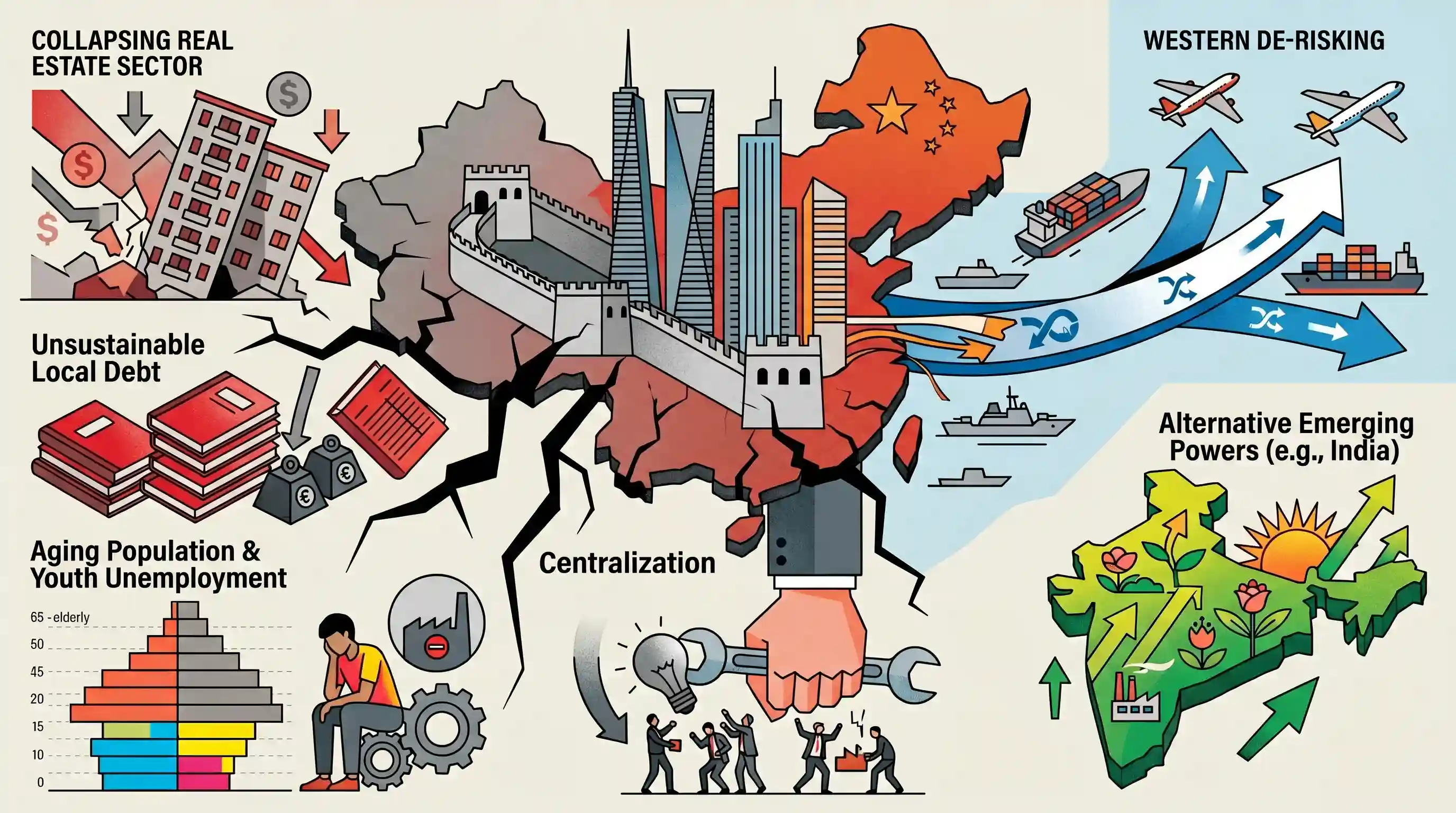
Why It Matters
Understanding China's internal vulnerabilities is crucial for UPSC aspirants, as it provides a nuanced perspective on the shifting global balance of power, the US-China rivalry, and the strategic rationale behind the West fostering India as a counterweight in global supply chains.
Summary
The article critically examines the narrative of China's inevitable global hegemony, arguing that its dominance is built on increasingly fragile foundations. While Beijing projects power on the world stage, it faces severe internal crises, including a collapsing real estate sector, unsustainable local debt, and a rapidly aging population alongside high youth unemployment. Furthermore, the centralization of political power has stifled private-sector innovation and economic dynamism. Externally, this vulnerability is exacerbated as Western nations and multinational corporations accelerate 'de-risking' efforts and adopt 'China Plus One' strategies to diversify supply chains, presenting significant geopolitical and economic opportunities for alternative emerging powers like India.
Key Points
- China's outward projection of global hegemony masks deep-seated structural and economic vulnerabilities.
- The Chinese economy is facing severe headwinds from a prolonged real estate crisis, mounting local government debt, and stagnating overall growth.
- Demographic decline, characterized by an aging population and high youth unemployment, threatens long-term productivity and domestic consumption.
- Authoritarian consolidation has increasingly stifled private enterprise and technological innovation, reducing economic dynamism.
- Global realignments, including Western 'de-risking' policies and the 'China Plus One' supply chain strategy, are compounding China's economic challenges and offering strategic opportunities for countries like India.
Important Terms
China Plus One Strategy

A global business strategy where companies diversify supply chains by expanding operations to alternative countries while maintaining a presence in China to mitigate risks of over-reliance and geopolitical disruption.
UPSC context
GS Paper 2 (IR) and GS Paper 3 (Economy); tests supply chain resilience and India’s manufacturing potential.
De-risking
A diplomatic and economic approach focused on reducing strategic dependencies and vulnerabilities (specifically on China) through trade safeguards and diversification, rather than seeking complete economic separation (decoupling).
UPSC context
GS Paper 2 (IR); relevant to G7 communiqués and India’s stance on global economic volatility.
Local Government Financing Vehicles (LGFVs)
State-owned investment platforms used by Chinese local governments to borrow off-budget for infrastructure projects, often creating "hidden debt" that poses systemic risks to China's internal economic stability.
UPSC context
GS Paper 3 (Economy) and GS Paper 2 (IR); highlights China’s internal vulnerabilities and global financial contagion risks.
Decoupling
The process of deliberately severing or significantly reducing deep-seated economic, trade, and technological interdependencies between two nations to eliminate perceived national security threats or strategic vulnerabilities.
UPSC context
GS Paper 2 (IR); critical for understanding US-China trade wars and the evolution of global trade blocs.
Demographic Dividend
The economic growth potential resulting from a shift in a population’s age structure, specifically when the share of the working-age population is larger than the dependent (young/old) population.
UPSC context
GS Paper 1 (Population Issues); tests comparative analysis of India’s youth surge versus China’s demographic decline.
Global Hegemony
The political, economic, or military predominance of one state over others in the international system, often involving the ability to set global norms and rules.
UPSC context
GS Paper 2 (IR); central to debates on the "unipolar" vs "multipolar" world order and China's rise.
Three Red Lines
A 2020 regulatory policy introduced by Beijing to deleverage the real estate sector by setting strict debt-to-asset limits for developers, which inadvertently triggered a major housing market collapse.
UPSC context
GS Paper 3 (Economy); illustrates the consequences of state-led market interventions on sectoral and national growth.
Prelims Trap
The 'de-risking' strategy by Western nations aims to achieve complete economic decoupling and zero trade reliance on China.
'De-risking' mitigates vulnerabilities in critical supply chains. 'Decoupling' implies severing all economic ties, which Western nations explicitly avoid due to deep economic integration.
Static Concepts Connected
What defines the 'Demographic Dividend' and when does a country lose it?
- Definition: The economic growth potential resulting from a shift in a population's age structure, where the working-age population is larger than the non-working-age share.
- Turning Point: The dividend reverses when the dependency ratio rises again due to an aging population, declining birth rates, and increased healthcare/pension burdens.
How do Global Value Chains (GVCs) differ from traditional international trade?
- Fragmentation: Instead of producing a whole good domestically, production processes are fragmented across different countries based on cost and resource advantages.
- FDI Linkage: GVCs are heavily driven by efficiency-seeking Foreign Direct Investment (FDI), aiming to optimize supply chain components rather than just accessing a foreign market.
Cross-Topic Patterns
China's internal debt vs. BRI
While China allegedly exports debt via the Belt and Road Initiative (BRI), its own local government financing vehicles (LGFVs) are facing a severe, unsustainable internal debt crisis.
China Plus One meets India's PLI
India's Production Linked Incentive (PLI) schemes strategically align with the 'China Plus One' window, attempting to attract diverted FDI by boosting domestic manufacturing in electronics and pharma.

Expect a 2026 Mains GS2/GS3 question connecting China's structural slowdown to Western 'de-risking' and India's PLI scheme efficacy.
Linked PYQs · 2
Linked PYQs · 2
- 2024MainsGS2
‘The West is fostering India as an alternative to reduce dependence on China's supply chain and as a strategic ally to counter China's political and economic dominance.’ Explain this statement with examples.
- 2021MainsGS2
“The USA is facing an existential threat in the form of a China, that is much more challenging than the erstwhile Soviet Union.” Explain.
