DeepSeek R1 Model Update and AI Geopolitics
Source:The Hindu ↗
Why It Matters
The article is crucial for understanding the intersection of emerging technologies (GS3) and international relations (GS2). It highlights how algorithmic innovations in AI can bypass geopolitical hardware constraints like export controls, fundamentally altering the U.S.-China tech rivalry and the global AI governance landscape.
Summary
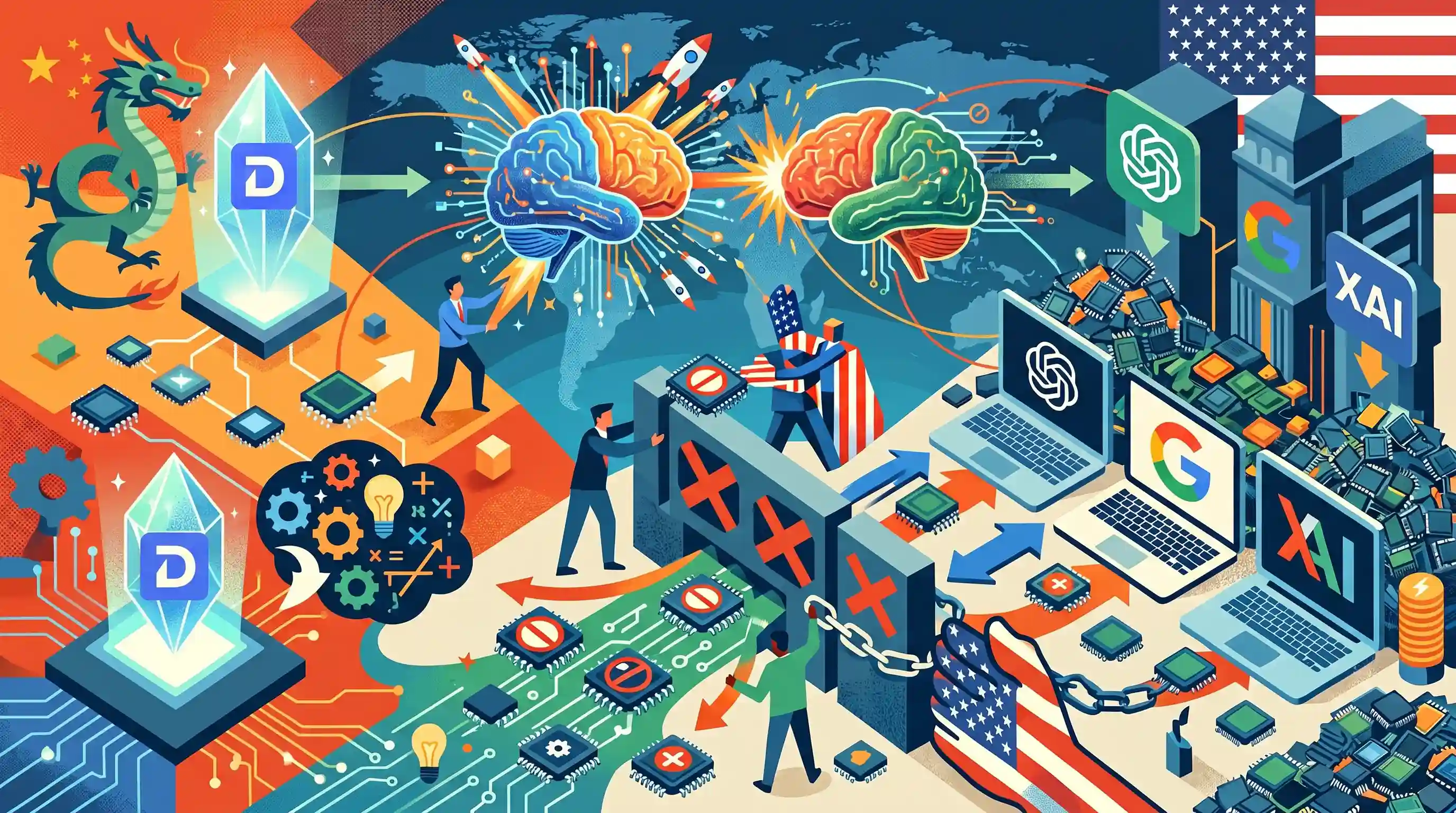
China's prominent AI startup DeepSeek has released an update to its highly successful R1 reasoning model, placing it in direct competition with U.S. giants like OpenAI, Google, and xAI. The original DeepSeek R1 model disrupted the AI industry by achieving state-of-the-art reasoning capabilities at a fraction of the computational and financial costs typically associated with frontier models. Crucially, the model's development demonstrated that algorithmic efficiency can overcome hardware limitations, significantly questioning the efficacy of U.S. export controls designed to restrict China's access to advanced semiconductors. This underscores the intensifying geopolitical technology war and the rapid, cost-effective evolution of global artificial intelligence.
Key Points
- Chinese AI startup DeepSeek released an updated version of its R1 reasoning model, named R1-0528, on the AI platform Hugging Face.
- The release comes amidst intense competition with major U.S. AI companies like OpenAI, Google, and xAI, who have also recently unveiled advanced reasoning models.
- DeepSeek R1 previously demonstrated that top-tier AI models can be developed efficiently at a fraction of the cost, challenging the belief that AI advancement strictly requires massive computing power and capital.
- The model's success undermined assumptions that U.S. export controls on advanced semiconductors (like Nvidia chips) were effectively stifling China's artificial intelligence capabilities.
Important Terms
U.S. semiconductor export controls

Trade restrictions by the US Department of Commerce designed to limit China's access to advanced artificial intelligence chips and semiconductor manufacturing equipment to maintain a technological lead.
UPSC context
Relevant for GS Paper II (International Relations) and GS Paper III (Science & Technology and Economy) regarding global trade wars and tech-geopolitics.
DeepSeek
A Chinese AI startup that gained global prominence for developing 'DeepSeek R1,' a reasoning model achieving state-of-the-art performance at significantly lower computational and financial costs.
UPSC context
Important for GS Paper III (Science & Technology) as a case study of algorithmic efficiency and the shifting global AI landscape.
OpenAI
A leading US-based AI research laboratory and company, creator of ChatGPT, whose frontier models serve as the global benchmark for large language model (LLM) capabilities and safety standards.
UPSC context
Relevant for GS Paper III (Science & Technology) regarding digital economy, AI applications, and ethical governance of emerging technologies.
Nvidia
The dominant American semiconductor company whose Graphics Processing Units (GPUs) are essential for training large-scale AI models; a central figure in the US-China technology rivalry.
UPSC context
Pertinent to GS Paper III (Infrastructure and Supply Chains) and GS Paper II (Bilateral Relations) concerning strategic mineral and chip dependencies.
Hugging Face
An open-source collaboration platform and community hub for machine learning models and datasets, often described as the 'GitHub of AI' for its role in democratizing technology access.
UPSC context
Useful for GS Paper III (Science & Technology) topics concerning open-source software, digital public goods, and the democratization of innovation.
Prelims Trap
Advanced AI models fundamentally require cutting-edge semiconductor hardware, making them entirely vulnerable to export controls.
DeepSeek's R1 explicitly proved that algorithmic efficiency and software innovations can bypass hardware limitations imposed by US export controls.
Static Concepts Connected
How do Reasoning AI models differ from traditional Large Language Models (LLMs)?
- Predictive vs Logical: LLMs predict the next likely word based on training data, while reasoning models use reinforcement learning to incrementally solve complex multi-step math and logic problems.
- Algorithmic Efficiency: Through innovative architectures (like Mixture-of-Experts), reasoning models can achieve state-of-the-art performance while requiring a fraction of the raw computational power and hardware.
Which multilateral export control regimes govern the transfer of dual-use technologies?
- Wassenaar Arrangement: Promotes transparency and greater responsibility in transfers of conventional arms and dual-use goods and technologies, preventing destabilizing accumulations.
- Dual-Use Applications: Items like advanced semiconductors, chipmaking equipment, and AI hardware are regulated as dual-use because they possess both commercial civilian and critical military applications.
Cross-Topic Patterns
Export controls & India's Semiconductor Mission
As US-China hardware decoupling shows limitations against software efficiency, India's strategy to balance indigenous semiconductor fabs (ISM) with software-led AI (IndiaAI Mission) becomes geostrategically vital.
Open-source AI & Digital Public Goods
DeepSeek hosting models on open platforms like Hugging Face mirrors India's advocacy for Digital Public Infrastructure (DPI) to democratize technology and counter Big Tech monopolies.

Expect a Prelims question differentiating LLMs from Reasoning AI, or a Mains question on the limits of tech-denial regimes in 2026.
Linked PYQs · 4
Linked PYQs · 4
- 2025PrelimsGS1
Consider the following statements: I. It is expected that Majorana 1 chip will enable quantum computing. II. Majorana 1 chip has been introduced by Amazon Web Services (AWS). III. Deep learning is a subset of machine learning. Which of the statements given above are correct?
- 2023MainsGS3
Introduce the concept of Artificial Intelligence (AI). How does Al help clinical diagnosis? Do you perceive any threat to privacy of the individual in the use of Al in healthcare?
- 2021MainsGS2
“The USA is facing an existential threat in the form of a China, that is much more challenging than the erstwhile Soviet Union.” Explain.
- 2024MainsGS2
‘The West is fostering India as an alternative to reduce dependence on China's supply chain and as a strategic ally to counter China's political and economic dominance.’ Explain this statement with examples.
