Geopolitical Narratives and Global South Strategy of China
Source:Indian Express ↗
Why It Matters
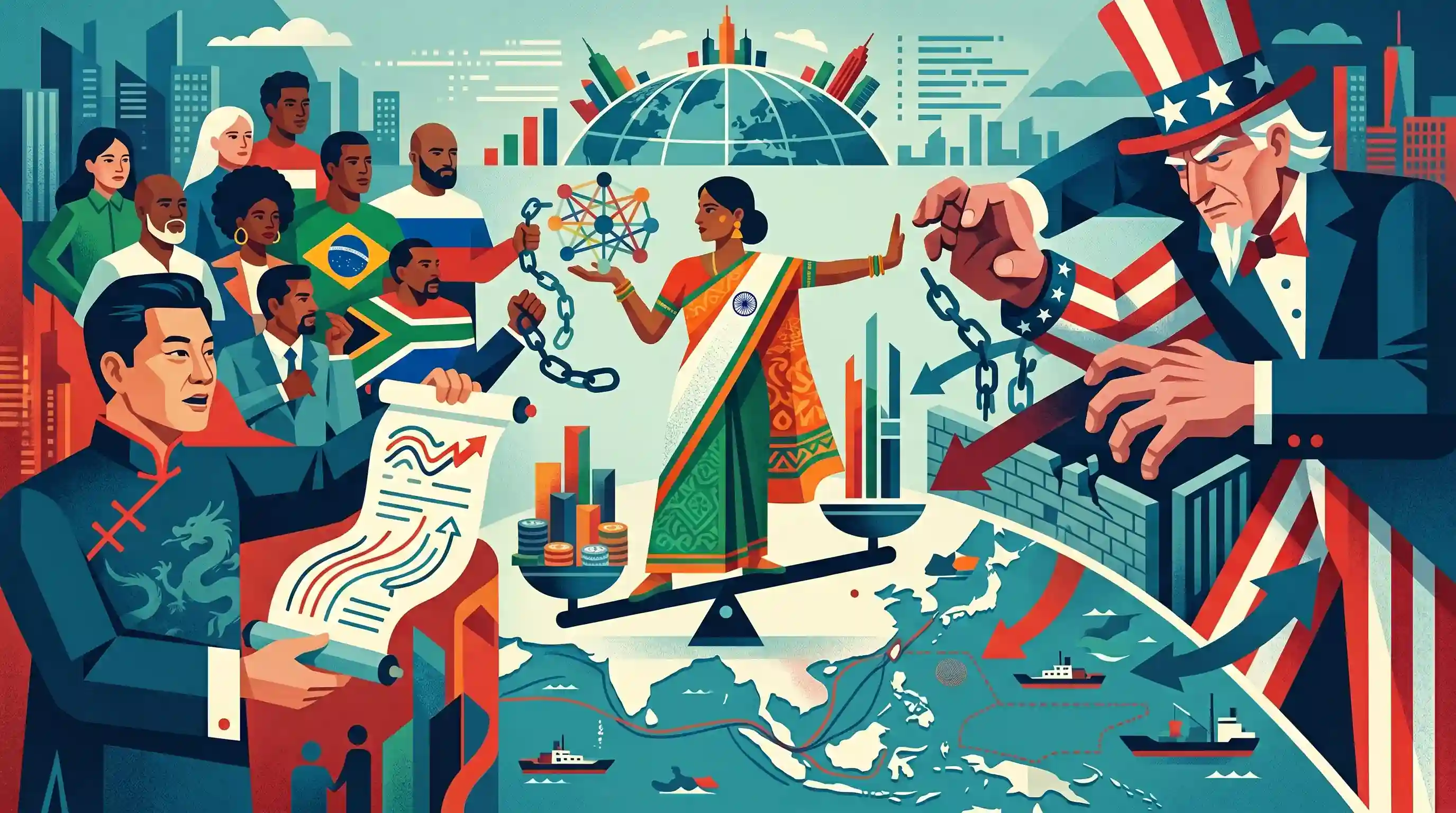
Understanding the geopolitical narratives propagated by China is crucial for analyzing the complex US-China-India strategic triangle. It provides insight into Beijing's diplomatic strategy to leverage the 'Global South' identity and India's tradition of strategic autonomy to counter US alliances (like the Quad) in the Indo-Pacific, directly impacting India's foreign policy calculus and strategic maneuvering.
Summary
The Chinese Ambassador to India has authored an opinion piece urging India and the broader Global South to resist perceived 'bullying' by the United States. The article highlights Beijing's narrative that Washington's unilateralism, protectionism, and hegemonic practices are detrimental to the interests of developing nations. By appealing to India's historical commitment to strategic autonomy and its prominent role in forums like BRICS and the SCO, China seeks to foster a unified stance among major developing economies against Western dominance, aiming to promote a multipolar world order and counter US influence in the Indo-Pacific region.
Key Points
- The Chinese Ambassador to India urges New Delhi and the broader Global South to unite against US 'hegemony' and unilateral policies.
- Beijing characterizes Washington's actions, such as trade protectionism, tech wars, and unilateral sanctions, as 'bullying' that undermines the interests of developing nations.
- The op-ed emphasizes the shared identity of China and India as large developing countries, key players in BRICS and the SCO, and leaders of the Global South.
- China subtly invokes India's tradition of strategic autonomy and non-alignment, aiming to discourage New Delhi from aligning too closely with US-led security architectures like the Quad.
- The overarching narrative advocates for a transition toward a multipolar world order and genuine multilateralism, challenging the existing US-dominated global system.
Important Terms
Strategic Autonomy

A state's capacity to pursue national interests and foreign policy independently, without being constrained by dependencies or dictated to by other sovereign powers or blocs.
UPSC context
GS Paper II (Foreign Policy). Tests India's ability to balance competing interests among major powers like the US, Russia, and China.
Global South
A term for diverse nations in Africa, Latin America, and developing Asia, typically sharing colonial histories and developmental challenges, often seeking to reform Western-centric global governance.
UPSC context
GS Paper II (International Relations). Essential for understanding India's leadership ambitions and the push for 'reformed multilateralism.'
BRICS
An intergovernmental grouping of major emerging economies—originally Brazil, Russia, India, China, and South Africa—focused on economic cooperation and providing a counterweight to Western-dominated institutions.
UPSC context
GS Paper II (Global Groupings). Crucial for analyzing India’s role in non-Western forums and its economic diplomacy.
Shanghai Cooperation Organisation (SCO)
A Eurasian political, economic, and security alliance led by China and Russia, primarily addressing regional security, counter-terrorism, and economic integration in Central Asia.
UPSC context
GS Paper II (Regional Groupings). Relevant for India's 'Connect Central Asia' policy and neighborhood security management.
Quad (Quadrilateral Security Dialogue)
An informal strategic forum featuring India, the US, Japan, and Australia, dedicated to maintaining a 'free and open Indo-Pacific' and countering regional assertiveness.
UPSC context
GS Paper II (Indo-Pacific). Central to India's maritime security and its strategic partnership with Western democratic powers.
Multilateralism
The practice of multiple countries coordinating policy through international institutions (like the UN or WTO) to address global issues based on a shared set of rules.
UPSC context
GS Paper II (Global Governance). Tests understanding of the rules-based international order and current challenges to the WTO-led trade system.
Prelims Trap
"India’s policy of 'Strategic Autonomy' mandates strict equidistance from the US and China."
Strategic autonomy today means 'issue-based alignment' (multi-alignment) to maximize national interests, not strict Cold-War style neutrality or geopolitical equidistance.
Static Concepts Connected
What differentiates the primary mandates of BRICS and the SCO?
- BRICS Focus: Focuses primarily on geoeconomics, reforming global financial architecture (e.g., NDB), and amplifying the voice of the Global South.
- SCO Focus: Focuses predominantly on Eurasian geopolitical and security cooperation, particularly counter-terrorism (via RATS) and border stability.
What are the pillars of contemporary 'Economic Statecraft'?
- Trade Protectionism: Using targeted tariffs and non-tariff barriers to shield domestic industries or economically punish geopolitical rivals.
- Tech Denial: Imposing export controls on critical technologies (e.g., advanced semiconductors) to stunt a rival's military or economic rise.
- Financial Sanctions: Leveraging dominance in global financial messaging systems (like SWIFT) to isolate and pressure adversary nations.
Cross-Topic Patterns
Minilateralism vs Multilateralism
China critiques US minilaterals (Quad, AUKUS) as containment tools, while using larger multilateral platforms (BRICS) to champion a multipolar order, contrasting issue-based coalitions with broad-based forums.
Weaponization of Supply Chains
The tech wars and trade sanctions mentioned by Beijing link IR directly to static economy topics like semiconductor PLIs, de-dollarization, and critical mineral dependencies.

A 2026 Mains Q will likely test how India balances 'Global South' solidarity in BRICS/SCO with US-aligned security interests in the Quad.
Linked PYQs · 3
Linked PYQs · 3
- 2025MainsGS2
"The reform process in the United Nations remains unresolved, because of the delicate imbalance of East and West and entanglement of the USA vs. Russo-Chinese alliance.” Examine and critically evaluate the East-West policy confrontations in this regard.
- 2021MainsGS2
The newly tri-nation partnership AUKUS is aimed at countering China's ambitions in the Indo-Pacific region. Is it going to supersede the existing partnerships in the region? Discuss the strength and impact of AUKUS in the present scenario.
- 2020MainsGS2
Quadrilateral Security Dialogue (Quad)' is transforming itself into a trade bloc from a military alliance, in present times - Discuss.
