China Announces New Emission Reduction Targets for 2035
Source:The Hindu ↗
Why It Matters
Understanding international climate commitments, specifically the Nationally Determined Contributions (NDCs) of major emitters like China, is central to tracking progress on the Paris Agreement. These developments are directly testable in GS3 Environment under global climate change mitigation efforts and international agreements.
Summary
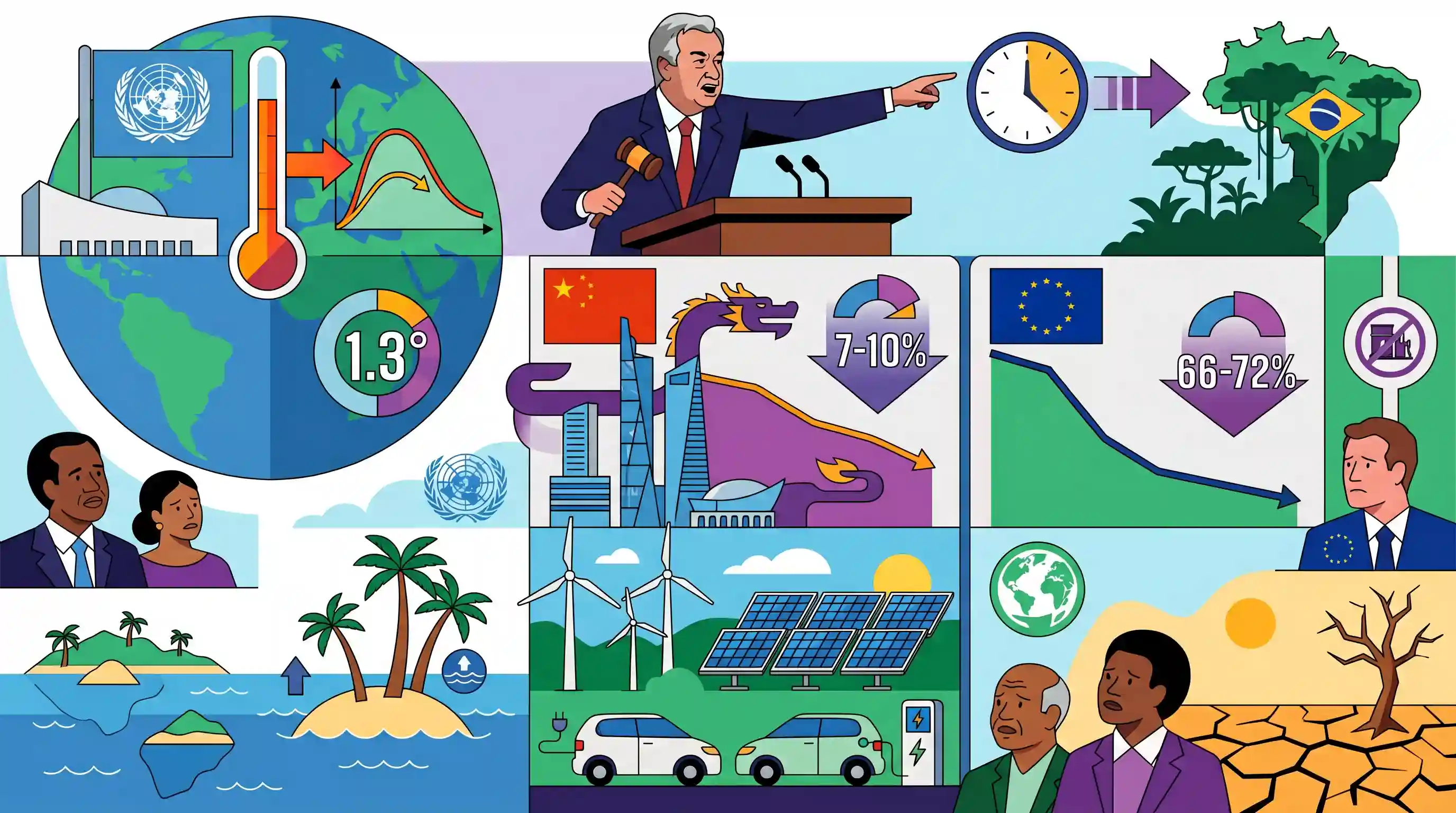
At a recent UN high-level climate summit, China—the world\'s largest carbon polluter—announced its first major emission cuts, aiming for a 7-10% reduction by 2035. President Xi Jinping also pledged to dramatically increase wind and solar power and expand the use of pollution-free vehicles. The European Union followed suit, indicating its updated Nationally Determined Contribution (NDC) would reflect a 66-72% emissions drop. The UN Secretary-General emphasized the urgency of curbing fossil fuel emissions ahead of the upcoming climate negotiations (COP) in Brazil, noting that while the Paris Agreement has reduced projected warming trajectories, the earth has already warmed by 1.3 degrees Celsius. Leaders from vulnerable nations underscored the catastrophic impacts of climate change they are already facing.
Key Points
- China, the world\'s largest carbon emitter (>31% of global emissions), announced at a UN climate summit a new goal to cut emissions by 7-10% by 2035.
- President Xi Jinping committed to a six-fold increase in wind and solar power from 2020 levels and to mainstream zero-pollution vehicles.
- The European Union updated its climate-fighting plan, stating its new Nationally Determined Contribution (NDC) would range between 66% to 72% reduction.
- The UN Secretary-General urged nations to submit updated five-year NDC plans as required by the 2015 Paris Agreement before the upcoming major COP climate negotiations in Brazil.
- Global warming has currently reached about 1.3 degrees Celsius above pre-industrial levels, dangerously close to the 1.5-degree limit set by the Paris Agreement.
- Leaders of climate-vulnerable countries, including the Marshall Islands and Pakistan, emphasized the urgent need to address accelerating warming and devastating extreme weather events like floods and droughts.
Important Terms
Paris Agreement

A legally binding 2015 international treaty aiming to limit global warming to well below 2°C, preferably 1.5°C, above pre-industrial levels through collective action.
UPSC context
GS Paper III (Environment) and GS Paper II (International Relations). Tests knowledge of global governance and climate protocols.
Nationally Determined Contributions (NDCs)
Self-determined national climate action plans submitted every five years under the Paris Agreement, detailing specific targets for emission reductions and climate adaptation.
UPSC context
GS Paper III. Essential for questions on climate mitigation strategies and India's own "Panchamrit" targets.
Conference of the Parties (COP)
The supreme decision-making body of the UNFCCC that meets annually to review progress and negotiate new global climate commitments.
UPSC context
GS Paper II & III. Focuses on outcomes of summits like COP30 (Brazil) and major global declarations.
UNFCCC
The 1992 foundational treaty aimed at stabilizing greenhouse gas concentrations; it serves as the parent framework for the Kyoto Protocol and Paris Agreement.
UPSC context
GS Paper III. Core framework for environmental conventions and international climate law.
European Commission
The executive arm of the European Union responsible for drafting legislation and representing the bloc in international climate negotiations.
UPSC context
GS Paper II (International Relations). Relevant for studying regional blocs and their impact on global environmental standards.
Carbon Neutrality (Net Zero)
A state where human-induced greenhouse gas emissions are balanced by their removal from the atmosphere, effectively resulting in zero net increase.
UPSC context
GS Paper III. Key to understanding long-term decarbonization goals of major economies like India and China.
Prelims Trap
"Nationally Determined Contributions (NDCs) are legally binding emission reduction targets under the Paris Agreement."
While updating and submitting NDCs every 5 years is a legally binding procedural requirement under the Paris Agreement, achieving the specific emission targets within them is strictly non-binding.
Static Concepts Connected
What are the core mechanisms of NDCs under the Paris Agreement?
- Ratchet Mechanism: A mandatory system where countries must update and submit their NDCs every five years with progressively stricter targets.
- Global Stocktake: A process to assess the world's collective progress toward achieving the Paris Agreement’s goals, informing the next round of NDCs.
- Bottom-up Approach: Unlike the Kyoto Protocol, the Paris Agreement uses a 'bottom-up' approach where nations determine their own feasible targets.
Who are the top greenhouse gas emitters globally?
- Current Emitters: China is currently the world's largest absolute emitter (>31%), followed by the US and India.
- Historical Emitters: The United States remains the largest historical contributor to cumulative global greenhouse gas emissions since the industrial revolution.
- Per Capita vs Aggregate: India's per capita emissions remain significantly below the global average, despite being the third-largest aggregate emitter.
Cross-Topic Patterns
Decarbonization vs. Trade Protectionism
China's pledge to mainstream zero-pollution vehicles coincides with Western tariffs on Chinese EVs and solar panels, showing the tension between global climate targets and domestic trade protectionism.
Vulnerability & Loss and Damage
Appeals from nations like Pakistan and the Marshall Islands directly link lagging major-emitter NDCs to the urgency of operationalizing the Loss and Damage Fund negotiated at recent COPs.

A 2026 multi-statement question will likely pair the 'ratchet mechanism' of Paris NDCs with current top emitter rankings (China, US, India).
Linked PYQs · 5
Linked PYQs · 5
- 2025MainsGS3
Write a review on India's climate commitments under the Paris Agreement (2015) and mention how these have been further strengthened in COP26 (2021). In this direction, how has the first Nationally Determined Contribution intended by India been updated in 2022?
- 2022MainsGS3
Discuss global warming and mention its effects on the global climate. Explain the control measures to bring down the level of greenhouse gases which cause global warming, in the light of the Kyoto Protocol, 1997.
- 2025PrelimsGS1
Consider the following statements : Statement I: Article 6 of the Paris Agreement on climate change is frequently discussed in global discussions on sustainable development and climate change. Statement II: Article 6 of the Paris Agreement on climate change sets out the principles of carbon markets. Statement III : Article 6 of the Paris Agreement on climate change intends to promote inter-country non-market strategies to reach their climate targets. Which one of the following is correct in respect of the above statements?
- 2021PrelimsGS1
The 'Common Carbon Metric', supported by UNEP, has been developed for
- 2022PrelimsGS1
"Climate Action Tracker" which monitors the emission reduction pledges of different countries is a :
