Prime Minister Modi Visit to China for SCO Summit
Source:The Hindu ↗
Why It Matters
Provides critical context on how India balances its complex bilateral border friction with China while engaging in multilateral regional forums like the SCO. Essential for GS2 answers on Sino-Indian diplomacy, border disengagement processes, and India's strategic role in Eurasian geopolitics.
Summary
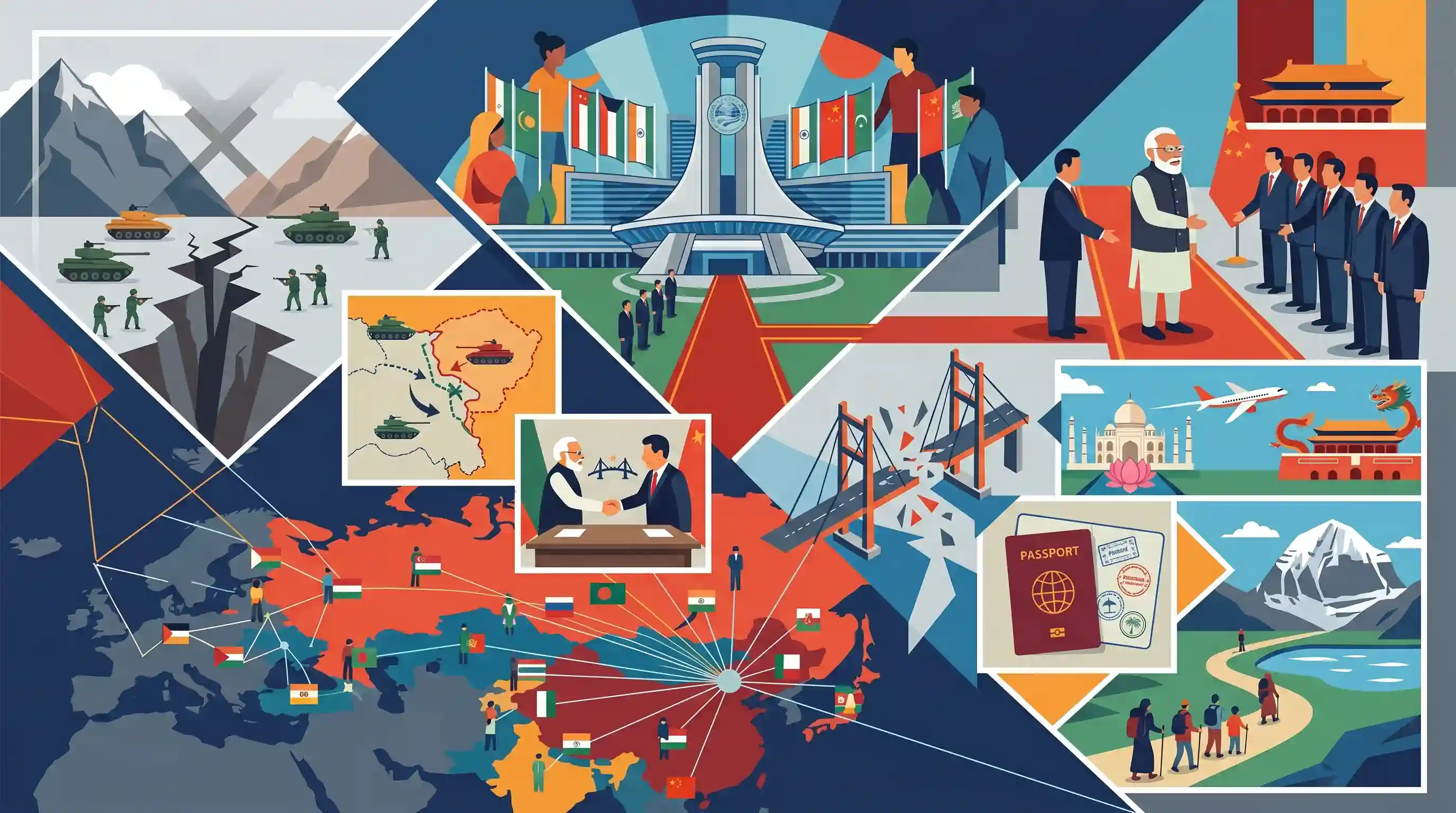
China has formally welcomed Prime Minister Narendra Modi's anticipated visit to Tianjin for the upcoming Shanghai Cooperation Organisation (SCO) Summit in August 2025. This prospective visit, his first to China in over seven years, highlights a gradual normalization of bilateral ties which were severely strained by the May 2020 military standoff along the Line of Actual Control (LAC) in eastern Ladakh. A turning point was reached with the finalization of a military disengagement agreement at Demchok and Depsang in October 2024, followed by a sideline meeting between PM Modi and President Xi Jinping in Kazan. Since then, high-level diplomatic and security exchanges have resumed, alongside active discussions on restoring confidence-building measures such as direct flights, tourist visas, and the Kailash Mansarovar Yatra. The SCO Tianjin Summit itself will be the organization's largest gathering to date, underscoring its growing geopolitical footprint in Eurasia.
Key Points
- PM Narendra Modi is expected to attend the SCO Summit in Tianjin in August 2025, marking his first visit to China since the 2018 SCO summit.
- The Tianjin Summit is set to be the largest in the SCO's history, expecting leaders from over 20 countries and 10 international organisations.
- The visit indicates a continued thaw in India-China ties, recovering from the May 2020 military standoff in eastern Ladakh following the October 2024 disengagement at Demchok and Depsang.
- Confidence-building measures are underway, with discussions on resuming the Kailash Mansarovar Yatra, establishing direct flight services, and restarting tourist visas for Chinese nationals.
Important Terms
Shanghai Cooperation Organisation (SCO)

A Eurasian political, economic, and security alliance of ten nations, including India, China, and Russia. It focuses on regional stability, counter-terrorism, and trade cooperation.
UPSC context
GS Paper II: International Relations and global groupings. Important for understanding India's strategic balancing between Eastern and Western blocs.
Line of Actual Control (LAC)
A de facto 3,488-km boundary line separating Indian-controlled territory from Chinese-controlled territory. It is not an officially demarcated international border, leading to differing perceptions and frequent standoffs.
UPSC context
GS Paper II & III: India-China relations and border management/security. Vital for issues concerning territorial integrity and national security.
Military Disengagement
The process of withdrawing military forces from a face-off or friction point to reduce tensions. In eastern Ladakh, this involved removing temporary structures and pulling back troops.
UPSC context
GS Paper III: Security challenges and their management in border areas. Tests knowledge of de-escalation protocols and border stability.
Regional Anti-Terrorist Structure (RATS)
A permanent body of the SCO headquartered in Tashkent, Uzbekistan. It facilitates cooperation between member states to combat the "three evils": terrorism, separatism, and extremism.
UPSC context
GS Paper II: International institutions and their mandate. Focuses on regional security architecture and India's role in counter-terrorism.
Confidence-Building Measures (CBMs)
Diplomatic or military actions taken to reduce suspicion and prevent accidental conflict. Examples include hotline establishment, border personnel meetings, or resuming direct flights and visas.
UPSC context
GS Paper II: Bilateral relations. Crucial for understanding the incremental steps required to normalize strained diplomatic ties.
Status Quo Ante
A Latin term meaning "the state of affairs that existed before." In border disputes, it refers to returning to the positions and patrolling protocols held prior to a conflict.
UPSC context
GS Paper II: International Relations/Dispute resolution. Used to describe the goal of border negotiations and restoration of peace.
Prelims Trap
Demchok and Depsang are both located in the northernmost sector of Ladakh near the Karakoram Pass.
While Depsang is in the north near Daulat Beg Oldie, Demchok is in southern eastern Ladakh near the Indus River. UPSC often swaps these locations.
Static Concepts Connected
What are the key geographic locations of LAC friction points in Ladakh?
- Depsang Plains: Located in northern Ladakh, providing crucial access to the strategic Daulat Beg Oldie (DBO) airstrip and the Karakoram Pass.
- Demchok: Situated in southern eastern Ladakh, located near the confluence of the Charding Nullah and the Indus River.
- Pangong Tso: An endorheic lake where the LAC passes through mountainous spurs known as 'Fingers', site of the initial 2020 clashes.
How has the Shanghai Cooperation Organisation (SCO) expanded its membership recently?
- Founding Members: Formed in 2001 by China, Russia, Kazakhstan, Kyrgyzstan, Tajikistan, and Uzbekistan (the 'Shanghai Five' plus Uzbekistan).
- India and Pakistan: Both nations were officially admitted as full members in 2017 at the Astana summit.
- Latest Additions: Iran (2023) and Belarus (2024) were recently admitted as full members, expanding the grouping to 10 states.
Cross-Topic Patterns
SCO and BRICS as bilateral icebreakers
Multilateral forums like the SCO and BRICS (e.g., Kazan 2024) provide neutral sidelines for Indian and Chinese leadership to de-escalate bilateral border crises without formal state visits.
Pilgrimage routes traversing contested borders
Resuming the Kailash Mansarovar Yatra highlights the intersection of cultural diplomacy and hard geography, relying on strategic border passes like Lipulekh (Uttarakhand) and Nathu La (Sikkim).

Map-based questions pairing LAC disengagement sites (Demchok, Depsang) with their corresponding rivers or passes are highly likely in 2026.
Linked PYQs · 4
Linked PYQs · 4
- 2023MainsGS2
‘Virus of Conflict is affecting the functioning of the SCO’ In the light of the above statement point out the role of India in mitigating the problems.
- 2022PrelimsGS1
Consider the following: 1. Asian Infrastructure Investment Bank 2. Missile Technology Control Regime 3. Shanghai Cooperation Organisation India is a member of which of the above?
- 2014MainsGS2
With respect to the South China sea, maritime territorial disputes and rising tension affirm the need for safeguarding maritime security to ensure freedom of navigation and over flight throughout the region. In this context, discuss the bilateral issues between India and China.
- 2007PrelimsGS1
Consider the following statements: 1. China has the observer’s status at the South Asian Association for Regional Cooperation. 2. India has the observer’s status at the Shanghai Cooperation Organisation. Which of the statements given above is/are correct?
