China Warns US over Taiwan Interference and Regional Tensions
Source:The Hindu ↗
Why It Matters
The Taiwan issue is a major global flashpoint. A U.S.-China confrontation over Taiwan or growing tensions with Japan would severely disrupt the security architecture of the Indo-Pacific and global supply chains, requiring India to navigate complex diplomatic and strategic challenges.
Summary
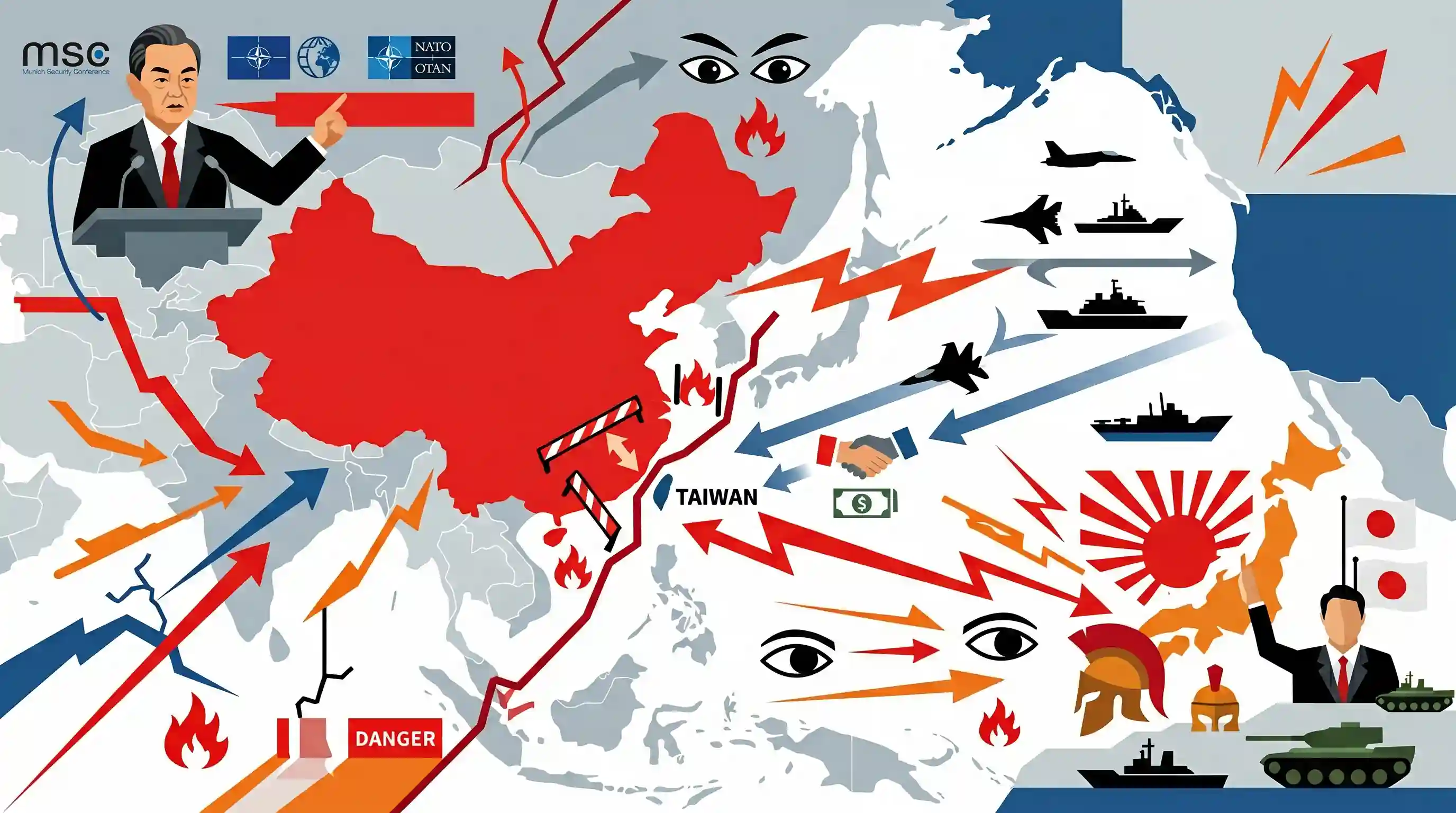
At the Munich Security Conference, Chinese Foreign Minister Wang Yi issued a strong warning to the United States against interfering in Taiwan, stating that any attempts to split China by using Taiwan cross Beijing's "red line" and risk a direct confrontation. Wang also addressed regional tensions with Japan, cautioning against the revival of militarism under Prime Minister Sanae Takaichi's right-wing government. The remarks highlight escalating frictions in the Indo-Pacific region as China fiercely opposes the U.S.'s role as Taiwan's primary arms supplier and political backer.
Key Points
- Chinese Foreign Minister Wang Yi warned the U.S. against plotting to divide China through Taiwan, stating such actions cross Beijing's red line and could lead to confrontation.
- Speaking at the Munich Security Conference, Wang Yi called for the U.S. to adopt a positive and pragmatic approach towards China.
- The U.S. remains Taiwan's most crucial backer and largest arms supplier, adding to tensions as Beijing claims self-ruled Taiwan as its territory.
- Wang Yi also warned Japan against right-wing forces attempting to revive militarism under Prime Minister Sanae Takaichi, threatening self-destruction if Japan goes down that path.
Important Terms
Munich Security Conference

An annual international forum held in Germany since 1963, serving as the world's leading 'marketplace of ideas' for debating global security policy and diplomatic initiatives.
UPSC context
GS Paper 2 (International Relations); significant for understanding global security architecture and multilateral diplomacy forums.
One China Principle
Beijing's core diplomatic stance asserting that there is only one China, Taiwan is an inalienable part of it, and the PRC is the sole legitimate government.
UPSC context
GS Paper 2; critical for analyzing India-China and US-China relations and the territorial sovereignty of Taiwan.
One China Policy
A diplomatic framework (used by the US and others) that acknowledges China's claim over Taiwan without formally recognizing it, allowing for unofficial relations with Taipei.
UPSC context
GS Paper 2; tests the distinction between 'acknowledgment' and 'recognition' in international diplomacy and strategic ambiguity.
Taiwan Relations Act
A 1979 US law mandating the provision of defensive arms to Taiwan and maintaining unofficial relations after the US shifted diplomatic recognition to Beijing.
UPSC context
GS Paper 2; essential for understanding the legal basis of US involvement in the Taiwan Strait and regional security.
Strategic Ambiguity
The long-standing US policy of being intentionally unclear about whether it would intervene militarily if China attacked Taiwan, intended to deter both sides from changing the status quo.
UPSC context
GS Paper 2; a key concept in deterrence theory and Indo-Pacific security dynamics.
Indo-Pacific
A geopolitical construct integrating the Indian and Pacific Oceans into a single strategic space, emphasizing a 'free and open' maritime order.
UPSC context
GS Paper 2; central to India's foreign policy (SAGAR, Act East) and major power rivalries in the 21st century.
Sanae Takaichi
The first female Prime Minister of Japan (in 2026 context), known for her right-wing, hawkish stance and advocacy for constitutional revision and re-militarization.
UPSC context
GS Paper 2; relevant for studying Japan's evolving defense posture and its impact on East Asian regional stability.
Prelims Trap
"India officially and explicitly reiterates the 'One China Policy' in all recent bilateral agreements."
India stopped explicitly mentioning the 'One China' policy in joint statements with Beijing in 2010, adopting a nuanced approach while maintaining unofficial ties.
Static Concepts Connected
What is Article 9 of the Japanese Constitution and its recent evolution?
- Renunciation of war: A post-WWII constitutional clause that officially outlaws war as a sovereign right to settle international disputes.
- Armed forces prohibition: It forbids the maintenance of military forces with war potential, limiting Japan to the strictly defensive Japan Self-Defense Forces (JSDF).
- Collective self-defense: Due to regional threats from China and North Korea, Japan recently reinterpreted the clause to allow collective self-defense and increased military spending.
How does the "One China Policy" differ from the "One China Principle"?
- The Principle (PRC): Beijing's absolute stance asserting that Taiwan is an inalienable part of China and the PRC is the sole legitimate government.
- The Policy (US): The US diplomatic stance that acknowledges Beijing's claim but stops short of conceding sovereignty, allowing unofficial but robust ties with Taiwan.
- Strategic ambiguity: Under this framework, the US deliberately leaves it unclear whether or how it would militarily intervene to defend Taiwan if attacked.
Cross-Topic Patterns
Taiwan + Global Chip Supply Chain
Taiwan dominates advanced semiconductor manufacturing. A US-China conflict over the island directly threatens global electronics supply chains, directly impacting India's domestic tech ecosystem and semiconductor mission.
Indo-Pacific Maritime Chokepoints
Tensions over Taiwan and the Senkaku islands overlap with freedom of navigation concerns, frequently linking GS-2 geopolitical maneuvers with GS-1 map-based questions on the East China Sea.

Expect a Prelims question mapping East Asian disputed islands (Senkaku) or testing India's nuanced 'One China' diplomatic stance in 2026.
Linked PYQs · 3
Linked PYQs · 3
- 2020MainsGS2
What is the significance of Indo-US defence deals over Indo-Russian defence deals? Discuss with reference to stability in the Indo-Pacific region.
- 2021MainsGS2
The newly tri-nation partnership AUKUS is aimed at countering China's ambitions in the Indo-Pacific region. Is it going to supersede the existing partnerships in the region? Discuss the strength and impact of AUKUS in the present scenario.
- 2019MainsGS2
‘The time has come for India and Japan to build a strong contemporary relationship, one involving global and strategic partnership that will have a great significance for Asia and the world as a whole.’ Comment.
